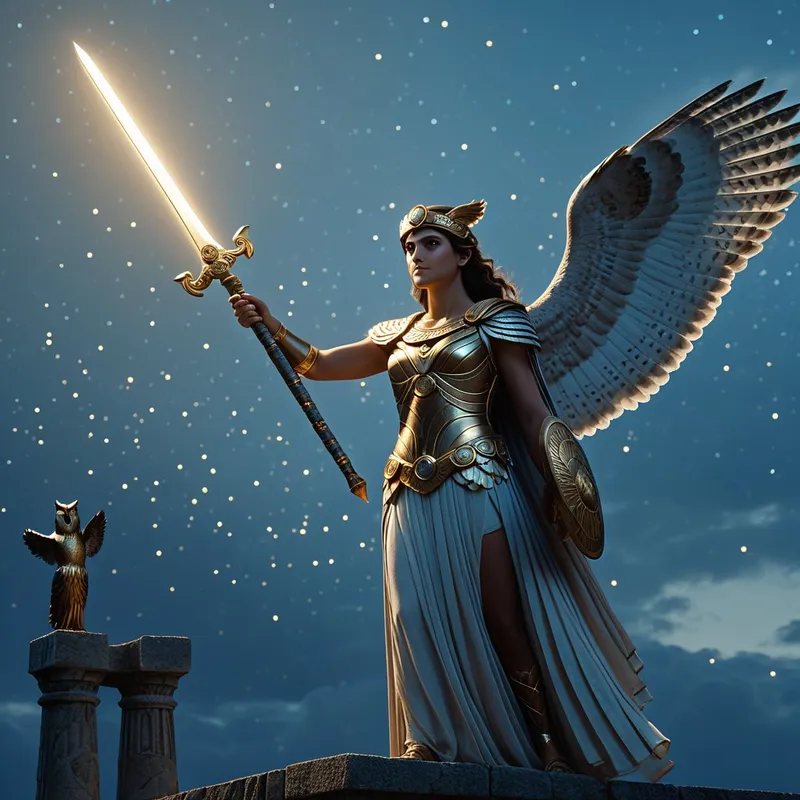
Athena's Sword Myth Meaning & Symbolism
The myth of the goddess Athena's sword, a divine weapon born of intellect and justice, representing the sharp clarity that separates chaos from order.
The Tale of Athena's Sword
Listen, and I will tell you of a birth that shook the heavens, not of blood and water, but of thunder and thought.
In the time before time was measured, the great sky-father Zeus was plagued. A prophecy, whispered by the ancient Gaia herself, coiled in his mind like a serpent: his first wife, the titaness Metis, would bear children of such power that they would one day overthrow him, just as he had overthrown his own father. Fear, a cold and unfamiliar guest, took root in the heart of the Thunderer. He remembered the cunning of Metis, who had helped him trick his father Cronus. What child of such a mind could not be a threat?
So, with a deceit born of terror, Zeus spoke sweet words to Metis and, when she was close, opened his mouth and swallowed her whole. He believed he had contained the threat, imprisoning wisdom itself within the fortress of his own divine flesh. For a time, there was silence within him.
But wisdom cannot be digested. It gestates.
The pain began as a dull ache within the god-king’s skull, a pressure behind his eyes that grew with each passing season. It became a pounding, a splitting agony that roared like a tempest trapped in a cave. No ambrosia could soothe it; no nectar could dull the fire. The lord of the bright sky clutched his head and bellowed in torment, his cries echoing across the Olympus. The other gods looked on in fear and confusion. What ailment could cripple the mightiest of them?
The divine smith Hephaestus, seeing his father’s suffering, approached. Understanding dawned in his soot-streaked face. The solution was not healing, but release. Taking up his mightiest axe, a tool that had shaped the foundations of the world, Hephaestus stood before the kneeling Zeus. With a prayer and a heave born of pity and precision, he brought the axe down upon the god’s brow.
There was no gush of ichor, no spilling of divine blood. Instead, from the cleft in Zeus’s forehead, there erupted a flash of blinding light and a deafening shout of war that was also a cry of perfect clarity. From the wound sprang a figure in full armor, a helmet upon her head, a spear in one hand, and in the other, a sword of such brilliant, cold silver it seemed forged from moonlight and resolve.
She was Athena, and her first act was not of violence, but of proclamation. She shook her spear, and the very ether rang with her voice: “I am born of the mind of my father!” The sword in her hand did not drip with the blood of birth; it gleamed with the sharp, clean light of intellect emerged. The pain in Zeus’s head vanished, replaced by awe. The prophecy was fulfilled, yet not as fear had foretold. This was no usurper, but the embodiment of his own sovereign reason, his strategic might, given independent form. The sword was not a weapon of rebellion, but the instrument of an order more profound than brute force.

Cultural Origins & Context
This myth, known as the birth of Athena, is central to the Greek pantheon and was a cornerstone of Athenian civic identity. The primary literary sources are the Theogony of Hesiod and various Homeric Hymns. It was not merely a story of divine genealogy but a foundational narrative performed and celebrated, most spectacularly during the Panathenaia.
The myth served a crucial societal function. For the city-state of Athens, which claimed Athena as its patron and namesake, the story legitimized a unique cultural ideal. It elevated wisdom (metis), strategic warfare, and civilized arts over raw, chaotic power. Athena’s birth from Zeus’s head—not from the maternal womb—symbolized the Athenian pride in intellect, law, and male-dominated civic life, while still honoring the cunning of Metis as its source. The sword, therefore, was not just a weapon of war but a symbol of judicial authority and the sharp discernment required to rule a just polis. It was the blade that separates barbarism from civilization, impulse from strategy, chaos from cosmos.
Symbolic Architecture
The sword of Athena is an archetypal symbol of discrimination in its highest sense. It represents the luminous, penetrating power of consciousness to cut through confusion, ambiguity, and the murky depths of the unconscious.
The sword is the weapon that does not destroy the unknown, but defines it, carving the known world from the formless mass of potential.
Metis, swallowed and hidden, symbolizes the deep, intuitive, and potentially overwhelming wisdom of the unconscious. Zeus’s headache is the psychic tension of unintegrated knowledge, a creative pressure that becomes pathological when repressed. Hephaestus’s axe is the catalyzing intervention—often a crisis, a wound, or a necessary act of violence—that forces a new structure into being. Athena’s emergence, fully armed, signifies the miraculous birth of a new psychic faculty: the conscious ego’s capacity for strategic thought, ethical judgment, and creative intelligence, born directly from the union of sovereign authority (Zeus) and deep wisdom (Metis).
The sword is thus twofold. It is defensive, a aegis of discernment protecting the nascent self from being overwhelmed by unconscious contents. It is also active, a tool for making decisive cuts—choosing one path over another, severing unhealthy ties, or enacting the clear, sometimes severe, judgments of conscience.

The Dreamer's Resonance
When the motif of Athena’s Sword appears in modern dreams, it seldom manifests as a literal weapon. More often, it is felt as a quality: a sudden, piercing insight that “cuts through the noise”; a decision made with cool, detached clarity after a period of mental anguish; or the discovery of an inner resource of strategic intelligence in a complex life situation.
The somatic experience preceding such a dream is often Zeus’s headache: a state of obsessive rumination, mental gridlock, or the feeling of being “pregnant” with an idea or solution that cannot find its way out. The dreamer may feel pressurized, stuck, and in psychological pain. The emergence of the sword-symbol—perhaps as a beam of light, a sharp geometric shape, or an actual blade of exceptional craftsmanship—marks the resolution. It signals the psyche’s alchemical process of distilling a chaotic, internal conflict into a usable, conscious principle. The dream is an announcement: a new capacity for clear-sighted judgment has been forged in the fires of your own mental struggle.

Alchemical Translation
The myth models the individuation process of conceptio et partus mentalis—conception and birth in the mind. For the modern individual, Zeus represents the ruling conscious attitude, which often attempts to control or swallow the transformative, feminine wisdom of the deep Self (Metis). This leads not to security, but to the torment of neurosis, the “splitting headache” of a life out of alignment with its own inner truth.
The alchemical vessel is the skull. The prima materia is the swallowed wisdom. The fire is the pain of contradiction. The product is the philosopher’s sword.
Hephaestus’s axe blow is the necessary crisis—the therapy session, the life failure, the devastating insight—that cracks open the hardened shell of the old attitude. This is not a gentle process; it is a solve, a dissolution. From this rupture, the latent Self is born not as a helpless infant, but as a fully-formed, armored aspect of the personality: the inner Athena. Her sword is the newly-won ability to discriminate between the ego’s wants and the Self’s needs, between shadow projections and reality, between compulsive reaction and chosen response.
To integrate this myth is to stop fearing the wisdom you have swallowed. It is to allow the pressure of un-lived life to build until, with the help of a catalyzing force (the Hephaestian craft of introspection or life itself), you can give birth to your own strategic intelligence. You forge your sword. You become capable of cutting your own path with clarity, protecting your inner sanctum with wisdom, and administering a justice within your own soul that is neither cruel nor lenient, but impeccably precise. The sword of Athena, once a symbol on Olympus, becomes the living edge of your own conscious existence.
Associated Symbols
Explore related symbols from the CaleaDream lexicon: