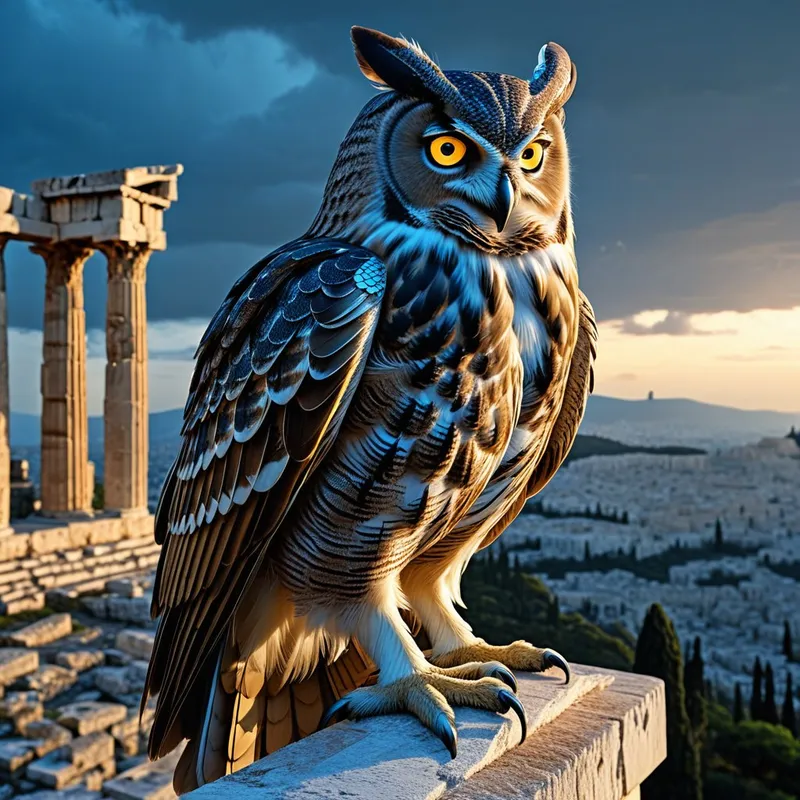
Athena's Owl - Greek goddess o Myth Meaning & Symbolism
The owl, companion to the goddess of wisdom, sees through the darkness of ignorance, representing strategic clarity born of divine intellect and inner knowing.
The Tale of Athena's Owl
Before the world knew its own name, when the air was thick with the scent of olive groves and the dust of unborn cities, there was a silence. It was not an empty silence, but a listening one, a vast, dark intelligence waiting in the hollow of a sacred oak. From this listening, Athena was born, springing fully formed from the mind of Zeus, her battle cry a clarion call that split the primordial quiet.
She was a paradox clad in gleaming aegis: a warrior who wove peace, a strategist who cherished the arts. Her city, Athens, rose under her grey-eyed gaze, a testament to ordered thought. Yet, for all her brilliance, a shadow remained—the shadow of the unseen, the unspoken truth that lurks beyond the campfire's light. Her divine sight pierced the veils of mortal deception, but she sought a companion whose vision was born of a different darkness.
She went to the deep woods, not to the sun-dappled glades, but to the heart of the old growth where the sun forgot to shine. There, in the perpetual twilight, she found the owl. It did not startle. It simply turned its great, round head, and in its eyes, Athena did not see a reflection of herself, but of the world stripped bare. Here was a creature that did not fear the night but mastered it, whose silent wings made no apology for their passage, whose gaze could pinpoint a field mouse's heartbeat in total blackness.
No words were exchanged, for none were needed. The owl, understanding a patron of profound order, left its branch and alighted upon the goddess’s shoulder. Its talons, gentle yet unyielding, rested against the cool metal of her armor. In that moment, the marriage was sealed: the blazing, strategic intellect of the goddess and the patient, penetrative sight of the creature of gloom. From then, whether presiding over the Areopagus or surveying the intricate loom, the owl was her constant shadow. It witnessed the birth of laws from chaos, saw strategies unfold like tragic plays before they reached their final act. It was the silent witness to wisdom being born, not in the shout, but in the watchful pause between heartbeats.

Cultural Origins & Context
The myth of Athena’s owl is woven into the very fabric of polis life. It is not a singular, authored tale but a pervasive symbolic truth that emerged from the cultural psyche of ancient Greece, particularly Athens. The owl (Glaux) was not merely a pet; it was a theophany—a visible manifestation of the goddess’s presence and favor.
This symbol functioned on multiple societal levels. On coinage, the Athenian owl guaranteed value and authenticity, linking economic trust to divine wisdom. In the civic sphere, the owl represented the ideal of the enlightened citizen: watchful, discerning, and capable of navigating the complex shadows of democracy and debate. It was a reminder that true governance required the ability to see what others wished to hide. The myth was passed down not just by poets like Homer or Hesiod, but through daily ritual, art on pottery, and the very architecture of the Parthenon. It served as a cultural compass, orienting a society toward the values of measured judgment, strategic foresight, and the intellectual clarity that must prevail over brute force.
Symbolic Architecture
The owl of Athena is an emblem of metis—a specifically Greek concept meaning cunning intelligence, practical skill, and strategic wisdom. It symbolizes the faculty that discerns patterns in chaos and finds the hidden path.
The owl does not create the light, but it sees by a light invisible to the day-bound eye. It is the psyche’s capacity to navigate by the stars of the unconscious.
Psychologically, the owl represents the illuminated intellect, but an intellect tempered by intuition. It is the “third eye” function that synthesizes data and instinct. The owl’s habitat—the borderland between day (consciousness) and night (the unconscious)—is crucial. It signifies wisdom that is not afraid to engage with the shadow, with ambiguity, and with the unknown. Its silent flight speaks to the power of observation without immediate intervention, of gathering intelligence before acting. The fixed, unblinking gaze symbolizes focused attention that pierces through illusion, hypocrisy, and superficiality to the structural truth beneath.

The Dreamer's Resonance
When the owl of Athena visits a modern dream, it often heralds a psychic shift from confusion to clarity. The dreamer may be in a period of intellectual fog, ethical dilemma, or strategic impasse. The owl’s appearance is somatic—one might feel a chilling clarity, a sudden stillness in the dream-body, a focusing of attention.
This dream image suggests the unconscious is activating the inner “sage” or strategist. The process is one of illumination, not comfort. The owl might be seen perched high in a dream library, watching the dreamer struggle with a puzzle, or its eyes might glow from a dark corner of a familiar room, indicating a truth being overlooked. It calls for a withdrawal from reactive thinking and an entry into a state of deep, almost detached observation. The psychological work is to stop seeking answers in the noise and to learn to see in the dark—to trust the insights that come not from frantic searching, but from patient, penetrating watchfulness.

Alchemical Translation
The myth models the alchemical process of sublimation—the transmutation of base, instinctual energy (the predatory nature of the owl) into a higher, spiritual faculty (divine wisdom). For the modern individual striving toward individuation, Athena’s owl represents the integration of the shadow with the conscious mind.
The journey begins in the “deep woods” of one’s own unconscious complexity and fear. The owl is a native of this terrain. To integrate it is not to become nocturnal, but to acquire its vision. The alchemical work involves forging a relationship with one’s own innate, often overlooked, perceptive capacities. It is the cultivation of strategic silence, the ability to hold multiple conflicting truths without premature judgment.
The triumph is not in winning the argument, but in seeing the architecture of the argument itself. The owl’s perch on Athena’s shoulder signifies the conscious ego granting sovereignty to this deeper seeing.
The ultimate transmutation is the birth of a new governing principle within the psyche. One moves from being a victim of circumstance (lost in the dark) to a strategist of one’s own life (seeing in the dark). The intellect, once perhaps used for defense or aggression, becomes a tool of profound navigation. The individual learns to “strike” not with blind force, but with the precise, timely application of insight—the owl’s silent dive made manifest in a life of conscious, considered action. Wisdom becomes not just knowledge possessed, but a mode of perception embodied.
Associated Symbols
Explore related symbols from the CaleaDream lexicon: