Athena's Owl Myth Meaning & Symbolism
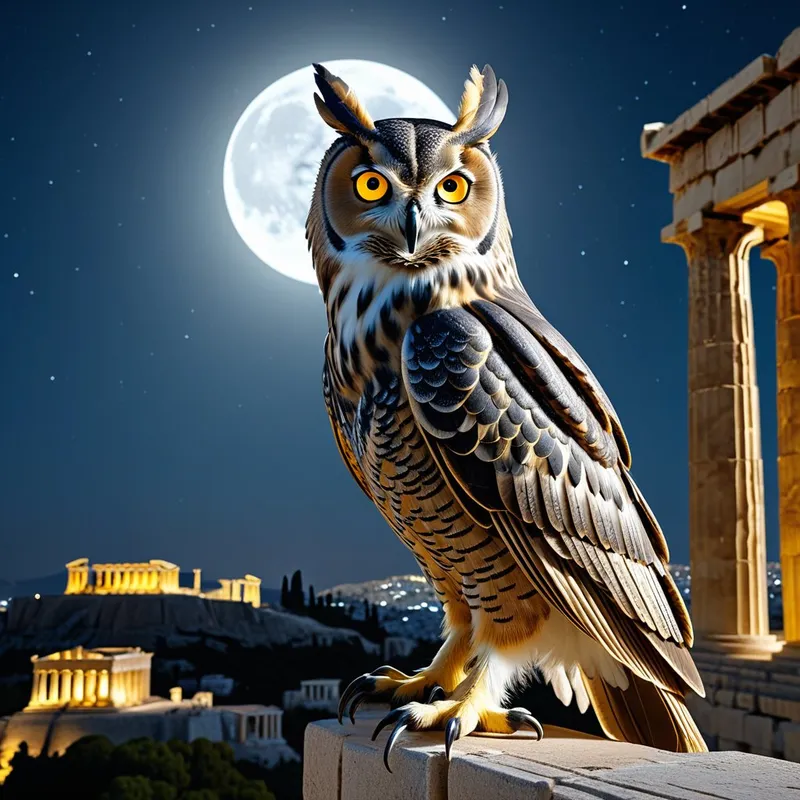
The sacred owl, companion to the goddess Athena, embodies the piercing wisdom that sees through darkness, born from the mind of the divine.
The Tale of Athena's Owl
Listen, and let the mist of time part. Before the first marble of the Parthenon was cut, before the name of Athens was whispered, there was only the great, silent mind of Zeus. And within that mind, a pain blossomed—a splitting, thunderous ache. The Titan Metis, the first wife of Zeus, was with child. A prophecy had been spoken: this child would surpass its father in wisdom and power. Fear, cold and sharp, pierced the heart of the king of gods.
He could not let this be. With a cunning born of desperation, he coaxed Metis, she who was the very essence of wise counsel, into transforming herself into a fly. And when she did, buzzing lightly in the palm of his hand, Zeus swallowed her whole. He consumed wisdom itself, thinking to contain the threat.
But one cannot contain a goddess. The seed of Metis grew not in a womb, but in the sacred chamber of the divine skull. For seasons uncounted, the pain within Zeus’s head grew, a pounding, forging pressure. It was not a sickness, but a gestation. The divine smith, Hephaestus, was summoned. With a double-edged axe that flashed like lightning, he struck the forehead of the groaning Zeus.
From the cleft, not blood, but a radiant light erupted. And with a cry that was neither infant nor warrior, but the clear tone of a thought made manifest, she emerged. Athena sprang forth, fully armed, her spear tip gleaming, her shield bright. Her eyes held the grey of a storm-cleared sky and the deep knowing of the earth. She was wisdom born of crisis, strategy born of the mind, order born of chaos.
In her first moments, as the gods stood in awe, a shadow passed over the sun. It was silent, a breath of the twilight. From the high crags of Mount Olympus, a creature descended—a great owl, its feathers the color of tarnished silver and aged parchment. It did not land at her feet, but upon the rim of her shield, turning its head in a slow, complete circle. Its eyes were vast pools of amber, seeing not just what was before it, but what lay behind and within. It saw the darkness in the corners, the hidden motives, the truths obscured by shadow. Athena met its gaze, and a silent pact was forged. This was no mere bird, but the living embodiment of the sight she possessed—the ability to see in the dark, to perceive the hidden pattern. It became her sacred companion, Glaux, the unblinking witness, the familiar of her profound mind.

Cultural Origins & Context
The bond between Athena and her owl is not a singular story from one text, but a tapestry woven from cult practice, art, and the collective identity of a people. It emerges from the deep soil of Mycenaean culture, where bird goddesses were venerated, and finds its full flowering in the classical Athenian city-state. Here, Athena was not just a goddess; she was the patron and protector, the divine embodiment of the city's highest ideals: reasoned intelligence, strategic justice, and civilized craft over brute force.
The owl was her constant attribute on countless amphorae, statues, and coins, most famously on the Athenian tetradrachm. This "owl coin" was the standard currency of the Aegean, making the symbol synonymous with Athenian wealth, influence, and the enlightened trade it wished to represent. The myth was passed down not by a single bard, but by the state itself—in temple friezes, in the rituals of the Parthenon, and in the everyday handling of money. Its societal function was multifaceted: it was a divine seal of approval on Athenian hegemony, a reminder that true power is guided by insight, and a popular symbol that connected the lofty ideals of the goddess to the daily life of the citizen. To be an Athenian was, in a sense, to live under the gaze of the owl.
Symbolic Architecture
The owl of Athena is a symbol of immense density, a psychic compound of profound meanings. Primarily, it represents noos—the active, penetrating intellect that discerns the true nature of things, as distinct from mere knowledge (logos). It is the light of the mind that operates in the realm of shadows.
The owl does not create the light, but sees by it. It is the faculty that turns illumination into insight.
Its nocturnal nature is crucial. Wisdom is not the brilliance of the noonday sun, which reveals all and blinds to nuance. It is the vision that functions in the crepuscular—the twilight zones of ambiguity, in the dark woods of confusion, crisis, and the unknown. The owl symbolizes the ability to navigate the inner and outer shadows, to see the hidden patterns, the unspoken motives, the consequences coiled within actions. It is the ally in our personal darkness.
Furthermore, its silent flight speaks to the quality of this wisdom. It is not loud or boastful; it is observant, patient, and strikes with precise understanding. The owl is also a creature of the borderlands between earth and sky, mirroring Athena's own nature as a bridge between the celestial strategy of Zeus and the grounded, practical arts of human civilization. It represents a wisdom that is both transcendent and imminently applicable.
The Dreamer's Resonance
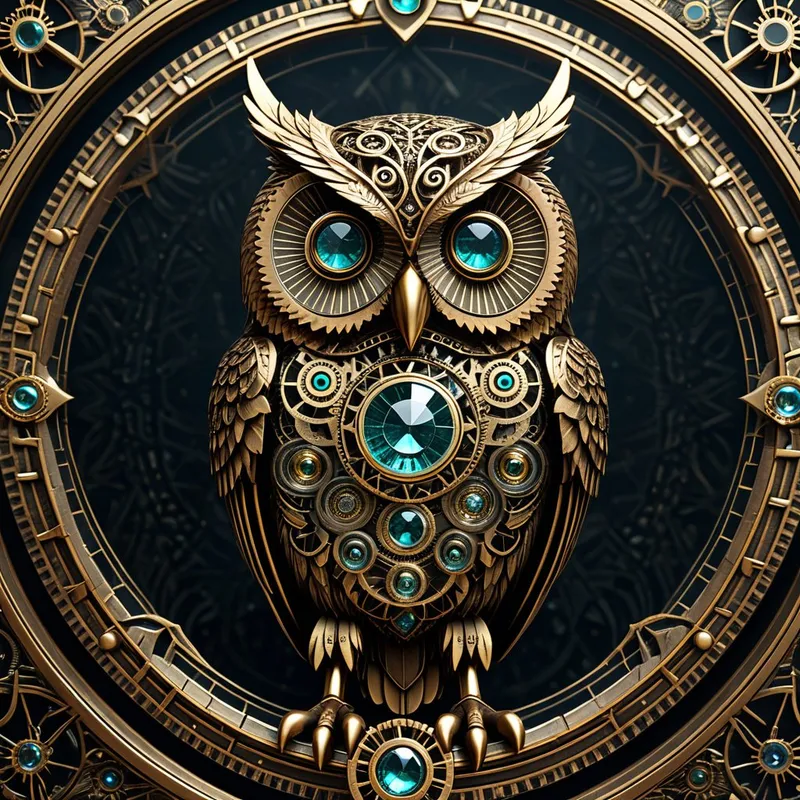
When the owl of Athena visits the modern dreamer, it signals an activation of the inner sage. It appears not in times of clear daylight certainty, but during periods of confusion, ethical dilemma, or when one feels "in the dark" about a life direction or a relationship. Its arrival in a dream is often somatic: one might feel a chill, a profound stillness, or a piercing focus that cuts through the dream's chaos.
Psychologically, this dream image marks a process of discernment. The unconscious is presenting a figure of deep seeing to compensate for the dreamer's conscious-state blindness. Perhaps the dreamer is ignoring a painful truth, is lost in emotional turmoil, or is facing a complex problem where the solution is not obvious. The owl’s gaze is an invitation—and sometimes a demand—to look deeper. To turn the head a full 360 degrees, to survey the entire psychic landscape without flinching. It may feel unsettling, as true insight often requires confronting what we have chosen to keep in shadow. The dream owl is the psychopomp of insight, guiding the soul through its own obscured passages.

Alchemical Translation
In the alchemical vessel of the psyche, the myth of Athena's Owl models the stage of illumination—not as a gentle dawning, but as a sudden, often painful, cracking open. The process begins with the "headache of Zeus": a state of psychic pressure, where old ways of thinking (the dominant, ruling consciousness) are strained to breaking point by an emerging, more complex understanding (the child of Metis). This is the suffering that precedes insight, the frustration that comes before a breakthrough.
The blow from Hephaestus' axe is the catalytic crisis—the shocking event, the piercing thought, the therapeutic interpretation, the moment of surrender that splits the hard shell of the ego. From this rupture, the latent wisdom (Athena) is born, fully formed. It is not slowly learned; it is recognized as having always been there, contained within the structure of the mind itself.
The owl is the permanent companion to this born wisdom. It signifies that the achievement is not a one-time event, but the acquisition of a new faculty: the enduring capacity for shadow-sight.
For the modern individual striving toward individuation, the myth teaches that true wisdom (the sage archetype) is not merely accumulated knowledge. It is a dynamic, born of integrating the repressed "counsel" (Metis) we have swallowed—our own deeper, perhaps feared, intelligence. The owl then becomes the symbol of the ongoing work: to continually use this hard-won sight to navigate life's inevitable darknesses with clarity and poise, to become the sovereign of one's own inner city-state. The goal is not to live in perpetual light, but to become a creature who can see, with unblinking eyes, in the dark.
Associated Symbols
Explore related symbols from the CaleaDream lexicon: