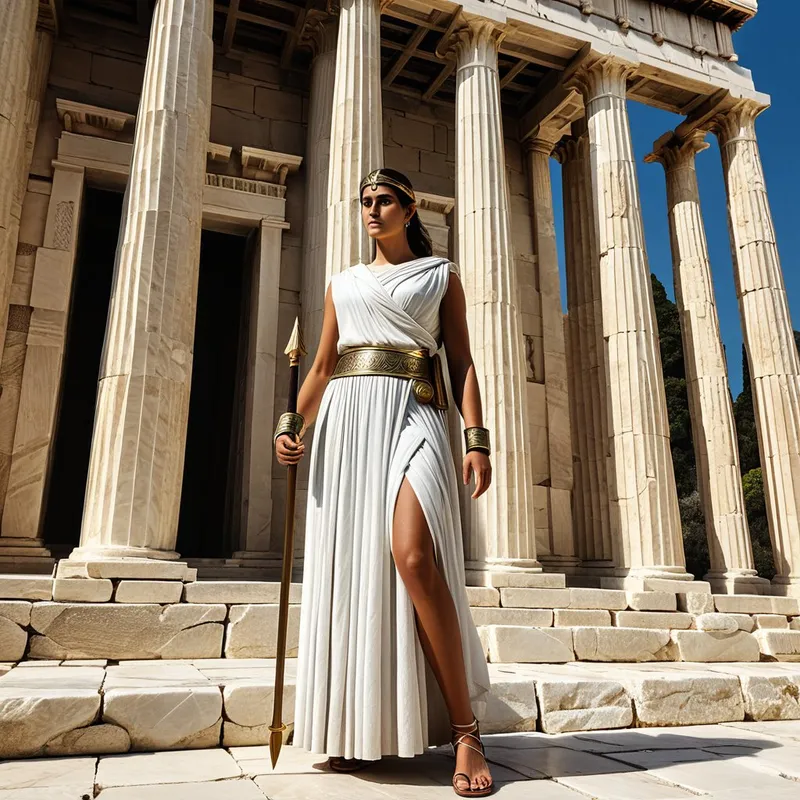
Athena's Library Myth Meaning & Symbolism
A myth of the goddess Athena's hidden repository of cosmic knowledge, guarded by her own shadow, accessible only through a profound inner reconciliation.
The Tale of Athena's Library
Hear now, a tale not sung in the great halls, nor carved upon the temple’s frieze. It is a whisper among the olive trees, a secret passed from philosopher to initiate when the moon is high and the world sleeps. It speaks of a library that was, and is, and ever shall be, hidden in the heart of the rock upon which Athena placed her sacred claim.
Before the Parthenon cast its first shadow, before the first stone of the city was laid, the goddess walked the wild hill. With a touch, she stilled the quarreling winds; with a gaze, she measured the arc of the stars. And she saw that while men would build cities of stone, their greatest poverty would be a city of the mind without memory, without light. So, from the essence of her own divine intellect—born not of womb but of the thunderous brow of Zeus—she fashioned a repository.
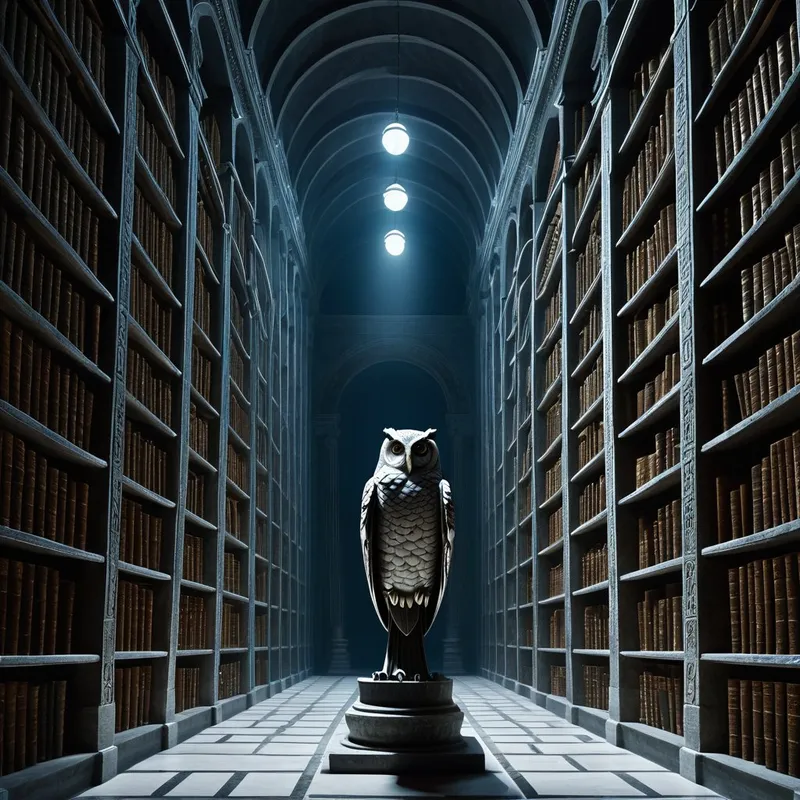
She called it the Mnemosynon, the Place of Remembrance. Its walls were not built but thought, emerging from the bedrock as veins of silver-veined marble and polished obsidian. Its shelves stretched into twilight, holding not scrolls of papyrus, but vessels of crystal and amber. Within them flickered the unspoken laws of geometry, the strategies of just rule, the patterns of the loom, the true names of stars, and the histories of things yet to pass. At its center burned a silent flame, the Logos Lamp, whose light was pure understanding.
Yet for all its splendor, the library stood empty of visitors. The heroes sought glory, the kings sought power, the people sought harvest. The door, seamless and immense, offered no handle, no keyhole. Many a proud thinker, hearing the rumor, would ascend the hill, recite their accomplishments, and demand entry. The marble remained mute, the door immovable.
For Athena, in her flawless wisdom, knew a terrible truth: raw knowledge, untouched by the soul, is a weapon. It is pride. It is coldness. It is the very shadow cast by brilliant light. And so, she appointed a guardian. Not a monster, not a riddle, but a manifestation born of her own divine nature: her Shadow. This was Sophrosyne’s Echo, a figure of equal majesty and profound silence, clad not in gleaming armor but in shades of twilight and dust. It was all the wisdom Athena had ever set aside—the unspoken doubt, the cost of pure strategy, the lonely weight of foresight.
The guardian’s decree was simple, and absolute: “None may enter who seeks to take. Only one who comes to meet.”
Generations passed. The library became a legend, then a metaphor, then a forgotten dream. Until a young woman, a weaver of intricate tales rather than tapestries, climbed the hill not for conquest, but in despair. Her city was troubled by faction and falsehood. She had studied all known philosophies and found them wanting. She came not to the door, but slumped beside it, her forehead against the cool stone, and spoke not to the gods, but to the silence within herself. She confessed her confusion, her fear that for all her learning, she understood nothing.
As her tears touched the marble, the shadow of the guardian fell upon her. It did not speak. It simply extended a hand, not in threat, but in mirroring. In its palm rested a single, perfect feather from Athena’s owl. The woman, with a heart stripped of pretense, did not reach for it. She looked into the featureless face of the shadow and saw her own reflection—her ambition, her isolation, her intellectual pride. She bowed her head, not in submission, but in recognition. “I see you,” she whispered.
At that moment of acknowledgment, the seamless door dissolved into a mist of swirling starlight. The guardian stepped aside, its form softening, and for the first time, the silent flame of the Logos Lamp warmed rather than illuminated. The weaver entered not as a conqueror, but as a guest. She did not read the crystal vessels; their light flowed into her, and she understood that true wisdom is not possessed, but integrated. When she emerged at dawn, she carried no scroll, no secret formula. She carried a reconciled mind. And it is said the pattern of wise governance she later wove into the life of her city was inspired not by a stolen secret, but by a wholeness finally earned.
Cultural Origins & Context
The myth of Athena’s Library exists in the liminal space between official state cult and esoteric mystery tradition. You will not find it in Homer or Hesiod. Its carriers were likely the philosophers, the itinerant teachers, and the initiates of private cults dedicated to Sophia (Wisdom) and Mnemosyne. It functioned as a pedagogical allegory within the philosophical schools of Athens, particularly those influenced by Heraclitus and later, the Platonic tradition.
Its societal function was multifaceted. For the polis, it reinforced the ideal that Athena’s gift to Athens was not merely military victory (as with the contest with Poseidon), but a deeper, more demanding gift: the capacity for enlightened self-governance, which must be earned through inner work. For the individual, especially the intellectual or seeker, it served as a crucial corrective to the hubris of the "unexamined life." It warned that the pursuit of knowledge (episteme) without self-knowledge (gnothi seauton) leads only to a sealed door. The myth was a narrative embodiment of the Delphic maxims, teaching that the path to wisdom is one of humility, integration, and encounter with the denied parts of the self.
Symbolic Architecture
The Library is the temenos, the sacred precinct, of the mind. It represents the totality of cosmic order, law, and potential understanding—the objective psyche, or what Carl Jung might call the archetypal realm of the Senex. It is not personal memory, but the collective memory of the species, the patterns of reality itself.
The guardian is not an obstacle to wisdom, but its final and most essential gate. It is the knowledge that knowing costs the knower.
Athena’s Shadow, the guardian, is the myth’s masterstroke. It symbolizes the inevitable daimon of the intellect: emotional detachment, the loneliness of perspective, the arrogance of certainty, the repressed cost of always being "right." In a culture that venerated Athena’s rationality, this myth daringly acknowledges that her brilliance casts a long, cold shadow. The hero’s journey here is inverted; it is not a slaying, but a facing. The victory is not over the shadow, but with it.
The owl’s feather is the symbol of gnosis—direct, intuitive knowing. It is offered, not seized. The dissolution of the door signifies the transcendence of the ego’s rigid boundaries. When the seeker acknowledges the shadow, the dichotomy between "self" and "wisdom" collapses; the seeker realizes they are already within the library of the Self.

The Dreamer's Resonance
When this myth stirs in the modern unconscious, it often manifests as dreams of vast, labyrinthine archives, locked rooms, or forgotten books. The dreamer may be searching frantically for a specific text but cannot read the titles, or they may find the book only to have the words dissolve. These are somatic signals of intellectual or spiritual hunger coupled with frustration—a sense that the knowledge needed is just out of reach.
Psychologically, this dream pattern indicates a critical juncture in the process of individuation. The dream ego is identified with the proud seekers of the myth, relying on conscious effort and acquisition. The locked door reflects a life approach that has hit its limit. The anxiety in the dream is the friction of the psyche urging a paradigm shift: from taking to receiving, from analyzing to understanding. The appearance of a silent, watchful figure (often shadowy or featureless) in the dream is the guardian making itself known. The healing begins not when the dreamer fights this figure, but when they, like the weaver, turn toward it with curiosity and acknowledgment.

Alchemical Translation
The alchemical process mirrored here is not the vulgar search for gold, but the opus contra naturam—the work against one’s own ingrained nature. The seeker’s initial state is nigredo, the blackening: the despair and confusion before the sealed door, the realization that one’s learned intellect is insufficient.
The transmutation occurs in the solutio—not a dissolving into chaos, but the dissolving of the barrier between the seeker and the sought, through the solvent of humble self-encounter.
The confrontation with the shadow is the albedo, the whitening. It is the revelation that the "guardian" of one’s deepest potential is one’s own disowned self. The act of saying "I see you" is the sacred coniunctio oppositorum, the marriage of the conscious, striving mind (the weaver) with the unconscious, silent wisdom-keeper (the shadow). This union produces the lapis philosophorum, the philosopher’s stone—which in this myth is not an object, but a state of being: the integrated personality.
The weaver who emerges does not possess new facts; she possesses a new faculty. She has internalized the library. Her subsequent actions in the world are no longer applications of external knowledge, but spontaneous expressions of an aligned Self. For the modern individual, the myth maps the journey from being a consumer of information to becoming a vessel of wisdom. It teaches that our greatest resource—the library of the collective unconscious and our unique place within it—is unlocked not by credentials, but by the courage to meet, and integrate, the wise shadow we have spent a lifetime guarding against.
Associated Symbols
Explore related symbols from the CaleaDream lexicon: