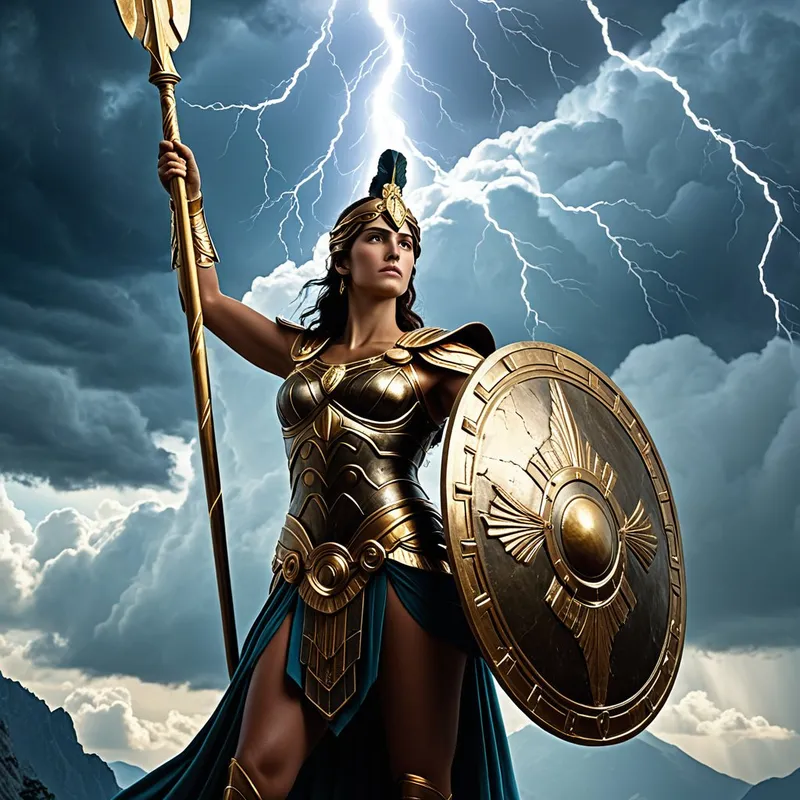
Athena springing fully formed Myth Meaning & Symbolism
The goddess of wisdom and strategy, born not from a womb but from the split skull of her father, Zeus, fully armored and ready for war.
The Tale of Athena springing fully formed
Let the thunder be your drum. Let the ache in the divine bone be your guide. Listen.
In the high halls of Olympus, a silence had fallen, thick and troubling as the clouds that cloak the mountain’s peak. The king of gods, Zeus, sat upon his throne of power, but his face was not that of a ruler. It was a mask of torment. A pain had taken root within him, not in his heart, but in the very fortress of his being—his head. It was a pounding, splitting agony, as if the sky itself were trying to birth a new constellation from the marrow of his skull. He had swallowed the Titaness Metis, fearing the prophecy that her child would surpass him. Now, her wisdom and her unborn child stirred within, a storm of potential he could not contain.
The other gods gathered, their eternal merriment stilled. The laughter of Aphrodite was a memory. The feasts of Dionysus were forgotten. The only sound was the low, guttural groan of the All-Father, his hands pressed to his temples, his eyes seeing not the splendors of heaven but an internal, cracking pressure. This was no ordinary divine malady. This was a genesis trapped in a prison of fear.
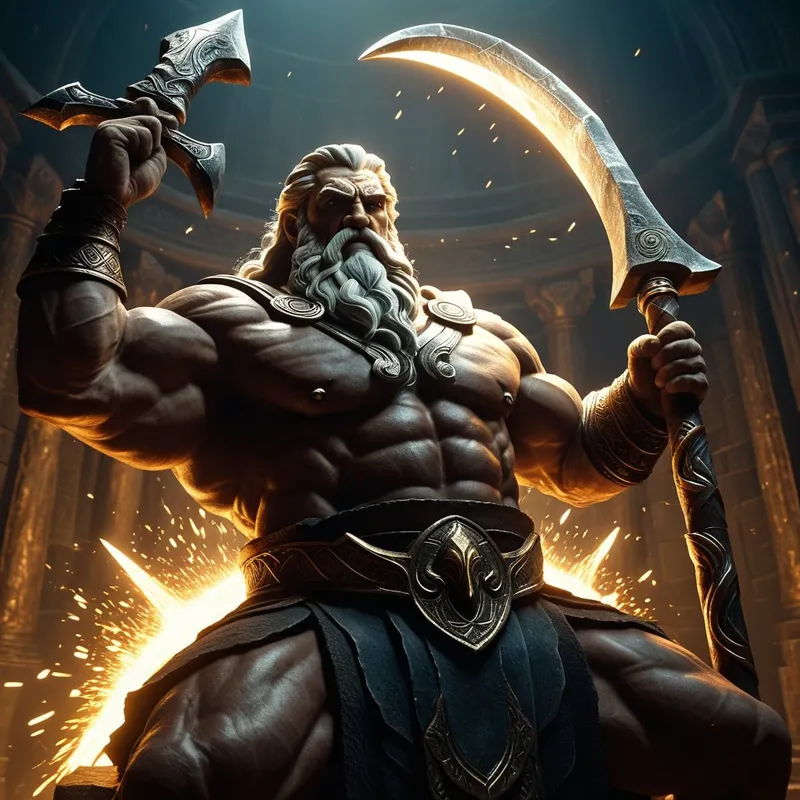
Desperation forced a decision. The god of the forge, Hephaestus, was summoned. His limping gait echoed in the silent hall. In his soot-streaked hands, he did not carry a jewel or a toy, but a tool of profound violence: a great double-headed axe, its edge honed on the whetstone of necessity. The command was given, terrible and clear. The solution to creation was to be an act of destruction.
Hephaestus raised the axe high. The gathered deities held their breath. There was no ceremony, only the stark physics of release. With a strike that carried the weight of inevitability, he brought the blade down upon the crown of Zeus’s head.
The sound was not of splitting bone, but of a universe cracking open. From the cleft, not blood, but a radiance erupted—a light of pure, unadulterated intellect. And from that radiance, with a warrior’s cry that shook the foundations of Okeanos, she emerged.
She was not a babe. She was complete. Athena sprang forth, fully formed and clad in gleaming, resplendent armor. A helmet of polished bronze crowned her head. A goatskin shield, the Aegis, was upon her arm. A sharp-tipped spear was in her grasp. Her grey eyes, the color of a storm-cleared sky, swept the assembly with a gaze that was both fierce and profoundly calm. She had bypassed childhood, bypassed helplessness. She was wisdom incarnate, born from crisis, strategy forged in the crucible of a god’s splitting skull. The pain of Zeus ceased, replaced by awe. The first act of the newborn goddess was not a cry for milk, but a triumphant shout that echoed through the cosmos, announcing the arrival of a new kind of power.
Cultural Origins & Context
This myth is central to the Greek cosmological narrative, primarily recorded in Hesiod’s Theogony and referenced in later hymns and plays. It functioned as a foundational charter myth for Athens, the city that claimed Athena as its patron and namesake. The story was not merely an etiological tale for her unusual birth but a profound theological statement passed down by poets and priests. It served to establish Athena’s unique authority: her wisdom was not derivative but primary, sourced directly from the sovereign power of Zeus himself. She was the embodiment of metis (cunning intelligence) legitimized and weaponized by bie (raw force). In a patriarchal pantheon, her birth from the male head, not the female womb, positioned her as an intellect devoid of “weaker” feminine traits, aligning her perfectly with the idealized civic virtues of the polis—reason, justice, and disciplined warfare over brute passion.
Symbolic Architecture
The myth is a masterclass in the symbolism of psychic emergence. The head of Zeus represents the totality of conscious authority and power—the ruling principle of the psyche. The unbearable headache signifies the unsustainable pressure of an unconscious content (the swallowed Metis and her potential child) demanding recognition. This is not a gentle nudge from the unconscious; it is a crisis that threatens to dismantle the ego’s very structure.
The most profound wisdom is not learned; it is born from the necessary shattering of a previous certainty.
The axe of Hephaestus symbolizes the catalyzing, often violent, intervention required for transformation. Hephaestus, the lame craftsman, represents the creative force that works through limitation and applied effort. The blow is not murder; it is a surgical strike of liberation. Athena’s emergence, fully armed, signifies that what is born from such a rupture is not a vulnerable, nascent idea but a complete, functional, and potent new complex. She is logos (reasoned word) and techne (craft) combined, a form of consciousness that is both contemplative and capable of action in the world. She is the sudden, brilliant solution that arrives only after all conventional thinking has failed and the mind has been forced open.

The Dreamer’s Resonance
When this mythic pattern stirs in the modern dreamer, it manifests as dreams of immense pressure in the head, of skulls cracking or opening, or of giving birth to fully-formed objects or beings from the forehead. One might dream of a sudden, explosive insight solving a long-intractable problem, or of finding a powerful tool or weapon in a moment of extreme duress. Somatically, this can correlate with actual tension headaches or migraines that precede or accompany periods of intense cognitive restructuring.
Psychologically, the dreamer is in the climax of an incubation period. An idea, a perspective, or a necessary life-strategy has been gestating in the unconscious, often fueled by a “swallowed” experience or insight (like Metis) that the conscious mind initially tried to suppress. The pressure builds until the psyche’s own “Hephaestus”—perhaps a dream image, a life crisis, or a therapeutic breakthrough—delivers the liberating blow. The dream signals that the struggle is not to prevent the rupture, but to prepare for the formidable and complete new faculty that will emerge from it.

Alchemical Translation
In the alchemy of individuation, the myth models the coniunctio or sacred marriage that occurs not between opposites, but within the structure of consciousness itself. The sovereign ego (Zeus) must first integrate the feminine principle of deep, cunning wisdom (Metis). But this integration is so profound it becomes a pregnancy—a state where the ego is no longer solely in charge but is a vessel for a greater process.
The subsequent crisis and splitting represent the nigredo, the blackening and dissolution of the old, rigid form of consciousness. It is a necessary despair, the “headache” of transformation.
The birth of the Self is always an act of strategic violence against the autocracy of the ego.
From this darkness comes the albedo, the whitening: the emergence of Athena in her shining armor. She represents the birth of the transcendent function. This is not a passive wisdom but an active, discerning intelligence capable of navigating the world. For the modern individual, the alchemical translation is the movement from being paralyzed by a complex or life problem (the splitting headache) to achieving a sudden, coherent, and empowered understanding. It is the moment when insight becomes instinct, when knowledge becomes capability. We do not slowly become wise; we are, at times, shattered into wisdom, and from the fragments arises a self more complete and armored for the battles of existence than the one that existed before the fracture.
Associated Symbols
Explore related symbols from the CaleaDream lexicon: