Ataraxia Myth Meaning & Symbolism
The myth of Ataraxia, the elusive goddess of serene tranquility, reveals the soul's arduous journey beyond passion and pain to find unshakable calm.
The Tale of Ataraxia
Hear now, you who are tossed upon the wine-dark sea of your own passions, of the one who dwells beyond the storm. In the days when gods walked with men, and men sought to touch the divine, there was a longing not for power, nor love, nor even wisdom as it is commonly known. It was a longing for the great quiet.
They called her Ataraxia. She was not found on Olympus, amidst the thunderous laughter and petty quarrels. Nor did she walk in the sun-drenched groves where Aphrodite held court. Her realm was the high, barren place, where the air grows thin and the noise of the world fades to a whisper. It was said her palace was carved from the very silence that hangs between stars.
Many sought her. The warrior, sickened by the metallic taste of fear and the adrenaline-shriek of battle, climbed the crags, only to find his own frantic heartbeat echoing in the emptiness. The lover, scorched by the fire of Eros and the ice of betrayal, called her name into the wind, but heard only the mournful echo of his own longing. They sought her as a prize, a final trophy to end their suffering, and thus they could never find her.
But one seeker, a philosopher with eyes worn deep from seeing, approached differently. He did not seek to conquer the mountain, but to be worn smooth by it. He sat at its base for a year, listening. He heard the chaos of the marketplace, the weeping from the houses, the distant clamor of the agora’s debates—all carried on the wind as a single, mournful drone. He did not flee it. He let it wash over him until he knew every note of its discord.
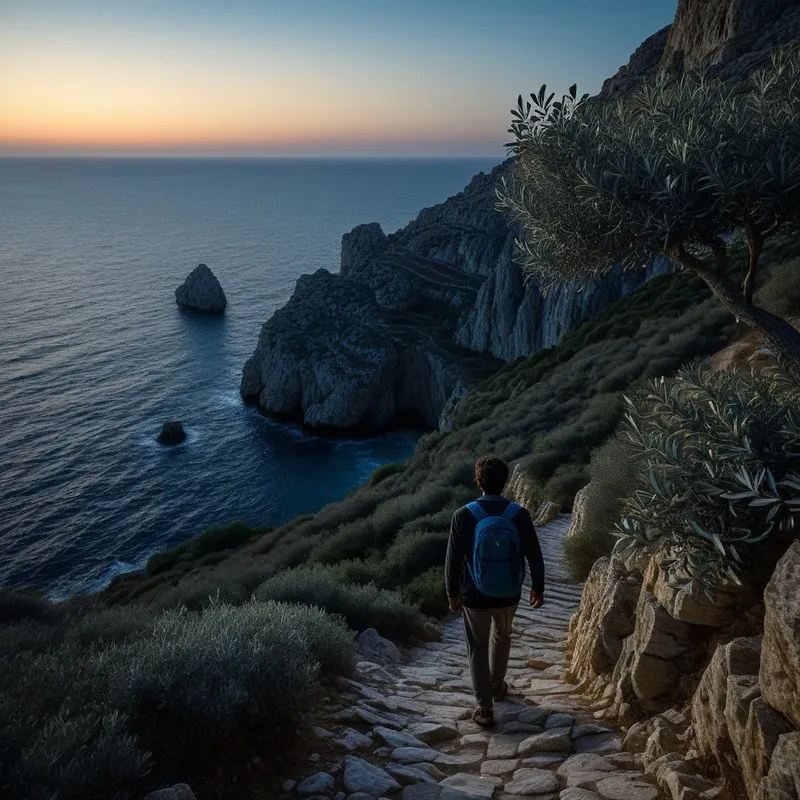
Then, he began to climb. Not with force, but with a weary, deliberate grace. When the storm winds of Boreas tried to fling him from the path, he did not fight. He became like the ancient, gnarled tree, bending so as not to break. When the phantom voices of past regrets—shaped by the Erinyes—screeched in his mind, he acknowledged them, named them, and let their cries pass through him like mist.
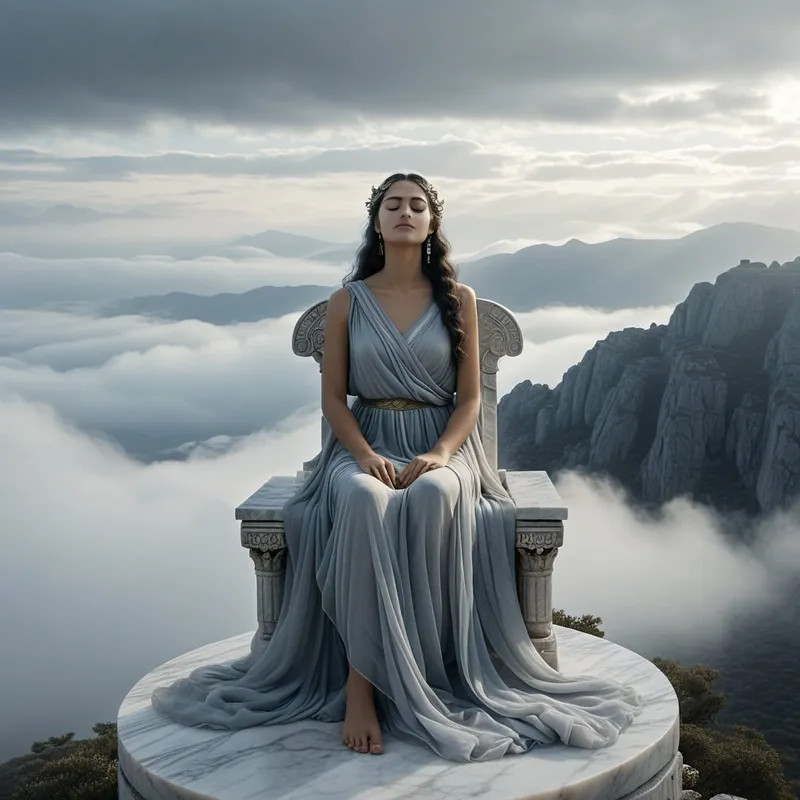
After a journey that stripped him of every assumption, every identity, he found not a palace, but a simple cave opening, veiled by a waterfall of pure, silent light. And there, seated on unadorned stone, was She. Ataraxia. She wore no crown. She held no sceptre. Her face was neither young nor old, beautiful nor plain. It was simply clear, like a deep pool undisturbed. She spoke no greeting, for in her presence, language was a crude tool. She merely looked at him, and in that look, he felt the final knot within him—the knot of wanting itself—come undone.
He did not stay. He descended, back into the world of sound and sorrow. But he carried the silence within him now, a still center around which the world’s tumult could whirl, yet never touch his core. He had not captured the goddess. He had, for a moment, remembered his own nature in her reflection.
Cultural Origins & Context
The figure of Ataraxia is less a character from epic poetry and more a philosophical concept personified. Her roots are deeply entwined with the Hellenistic schools of thought that arose after the conquests of Alexander, in an age of political uncertainty and cosmic anxiety. While not worshiped in grand temples with public sacrifices, she was the central ideal of philosophies like Epicureanism and, most prominently, Stoicism.
She was a "daimona"—a spirit or personified state of being. Her myth was not passed down by bards in feasting halls but by teachers in colonnaded walks like the Stoa Poikile. The story was a teaching tool, a narrative map for the soul's journey. Its societal function was profoundly therapeutic: in a world where fortune was fickle and the old civic gods seemed distant, Ataraxia offered an internal citadel. She represented the achievable goal of a life lived by reason and virtue, a state of soul where one could face loss, pain, and even death without being overthrown by passion (pathos).
Symbolic Architecture
Ataraxia is not the absence of feeling, but the transformation of one's relationship to feeling. She symbolizes the pinnacle of psychic integration, where the warring factions of the self—desires, fears, ambitions—are not slain, but witnessed from a place of profound inner unity.
Ataraxia is the calm eye of the hurricane of self. It is not the cessation of the storm, but the discovery of the immutable center around which it spins.
The mountain is the archetypal axis mundi, the path of ascent from the chaotic, plural world of appearances (doxa) to the singular, unified realm of essence. The cave of light subverts the usual Platonic symbolism; here, it is not a prison of shadows but a womb of clarity, suggesting that true illumination comes not from escaping the world, but from retreating into the deepest, most silent chamber of the self. The seeker’s ordeals—the winds, the phantom voices—are the externalized forms of internal attachments: our clinging to opinions, our identification with suffering, our addiction to drama.
Most crucially, Ataraxia herself is never possessed. She is encountered. This is the myth’s core psychological truth: tranquility is not a permanent state to be acquired and owned, but a mode of perception to be periodically remembered and inhabited. She represents the Self, in the Jungian sense—the total, integrated personality that is both the goal and the origin of the individuation process.

The Dreamer's Resonance
When this myth stirs in the modern unconscious, it often manifests in dreams of profound stillness amidst chaos. One may dream of being in the center of a raging city or a violent argument, yet experiencing it all through a thick pane of silent glass. Or one may dream of finding a secret, perfectly quiet room inside a familiar but noisy house.
These dreams signal a somatic and psychological process of detoxification. The psyche is attempting to metabolize and distance itself from overwhelming affects—chronic anxiety, obsessive rumination, or emotional reactivity. The dream-ego is practicing non-identification. It is not that the conflicts vanish; rather, the dreamer discovers they have a "location" that is not identical to the conflict. This is the nascent experience of the observing ego, the first tremor of Ataraxia. The body in such dreams often reports a sensation of deep, grounding calm upon waking, a somatic echo of the psychic shift.
Conversely, dreams of frantically seeking such a room but being perpetually blocked may indicate the dreamer’s ego is still seeking tranquility as an object to grasp, rather than as a space within to cultivate. The myth is presenting itself as a task yet to be properly understood.
Alchemical Translation
The alchemical process mirrored in the myth of Ataraxia is the coagulatio of spirit into a stable, unshakeable form—the creation of the Philosopher's Stone of the soul. It models the individuation journey not as a quest for more—more insight, more experience, more power—but as a radical subtraction.
The first stage, Nigredo, is the seeker sitting at the base of the mountain, immersed in the world’s noise. This is the necessary confrontation with the shadow and the chaotic prima materia of one’s own unfiltered experience. One must fully acknowledge the pain, the desire, the fear, without immediate spiritual bypass.
The climb is the Albedo, the whitening. Here, the passions and attachments (the colored elements) are subjected to the ascetic discipline of observation and reason. They are not repressed, but "bleached" of their compulsive, identifying power. The storm winds and phantom voices are these elements being purified, their emotional charge gradually distilled away.
The ultimate alchemy is not turning lead to gold, but turning reaction into reflection, and identification into witness.
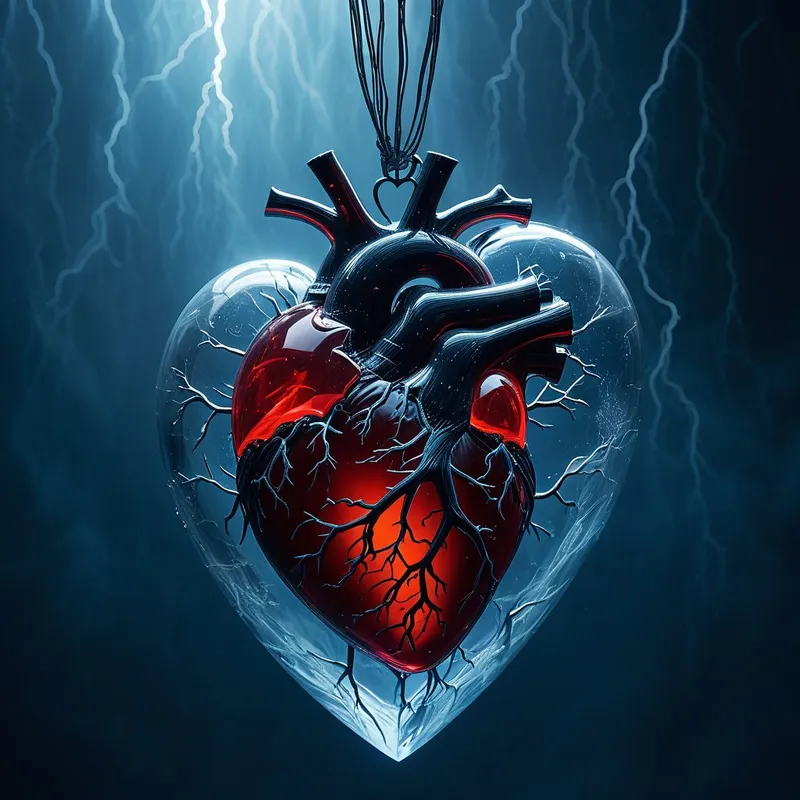
The encounter in the cave is the Rubedo, the reddening or culmination. It is often symbolized by the sacred marriage (coniunctio). Here, the seeker does not marry another, but marries the silent, receptive aspect of his own psyche (the Anima, in masculine psychology) to the active, seeking aspect. This union births the "filial stone," the integrated Self, represented by the serene presence of Ataraxia. The golden pulse within the symbolic sphere is this achieved, living center.
The return to the world is the final, often overlooked stage: the projection of the achieved stone back onto life. The tranquil center is not for hoarding in isolation. It is the foundation from which one can engage with the world with compassion, clarity, and true effectiveness, no longer driven by unconscious complexes but anchored in what the Stoics called hegemonikon—the ruling faculty of a serene mind. The myth thus completes the circle, teaching that the highest tranquility is not an escape from humanity, but the precondition for fully, peacefully, inhabiting it.
Associated Symbols
Explore related symbols from the CaleaDream lexicon: