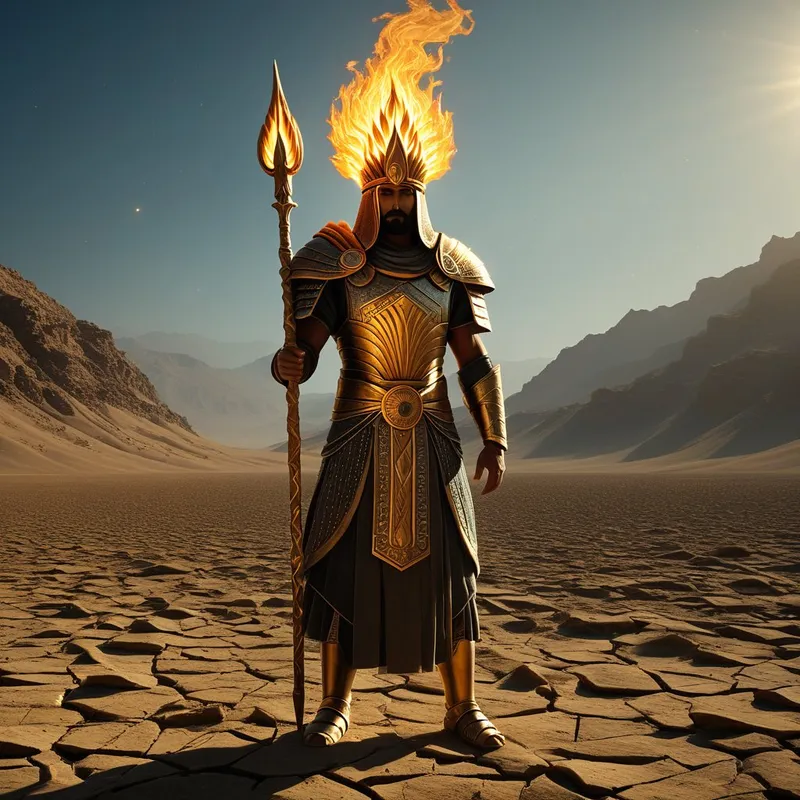
Atar Myth Meaning & Symbolism
The myth of Atar, the divine fire, battling the demon of drought to protect the cosmic order and the seed of life itself.
The Tale of Atar
Listen, and hear the tale of the First Light, the breath of the Wise Lord that became a warrior. In the beginning, when Ahura Mazda fashioned the world, he placed within its heart a sacred, living flame. This was not mere heat, but the very essence of truth, order, and luminous consciousness. He named it Atar, and gave it a solemn charge: “You are the protector. You are the witness. You are the unquenchable spark at the center of all things.”
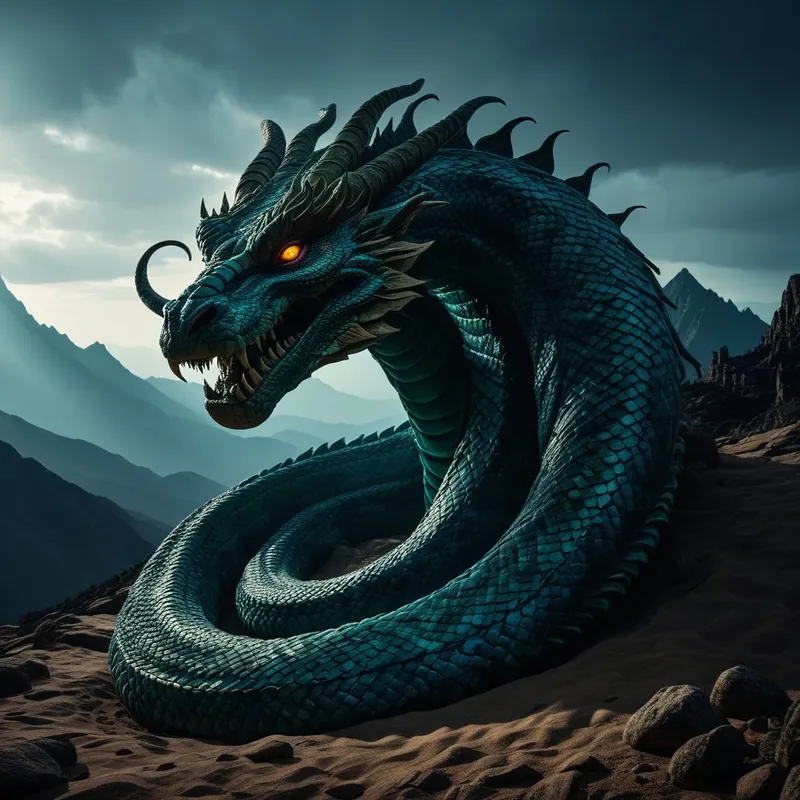
For ages, Atar blazed in the heart of creation, a golden pillar connecting the earthly realm to the celestial. Its light nurtured the first plants, warmed the first creatures, and illuminated the path of righteousness. But from the void of negation, Angra Mainyu gazed upon this light with hatred. To extinguish order, he must first snuff out its guardian. So, he summoned his most potent lieutenants of chaos: the demon of drought, Apaosha, a creature of parched scales and a breath that turned soil to dust, and the demon of death, Astovidatu, a shadow that smothered all vitality.
Their assault was a blight upon the world. Apaosha slithered across the land, drinking rivers from their beds and sucking moisture from the very air. Plants withered to ash. Animals fell, tongues swollen with thirst. The world became a cracked, gray wasteland, and the great pillar of Atar began to flicker, its fuel of life devoured by the encompassing dryness. Astovidatu’s chilling presence wrapped around the flame, seeking to drain its warmth into the eternal cold.
Atar’s light dimmed to a desperate, wavering glow. Yet, within its core, it guarded the ultimate treasure: the Chinvat, the seed of all plants, the promise of future life. To let this seed be captured or destroyed was to surrender creation itself. So, Atar gathered its remaining strength. It did not flee, but condensed its essence from a vast pillar into a fierce, concentrated point of white-hot fury—a warrior’s heart of fire.
The battle was not of clashing steel, but of fundamental essences. Apaosha exhaled his desiccating breath, a wind that could turn granite to sand. Atar met it with a roar of pure incandescence, a heat so intense it created its own atmosphere, boiling away the demon’s dryness. Astovidatu lunged with shadows that froze time itself. Atar blazed brighter, its light a sword of revelation that left no room for the void’s deception. The conflict shook the foundations of the mountains. For three days and nights, the light and the drought, the warmth and the death, struggled in a titanic stalemate.
Then, from the heavens, the divine rains came, sent by the Amesha Spentas. The waters, allies of Atar, fell upon the battlefield. Apaosha, the demon of drought, writhed and hissed as his power was undone by the very element he denied. Strengthened, Atar unleashed a final, triumphant surge. Its flame engulfed Apaosha, not to burn, but to purify—to transmute the concept of absolute lack back into potential. The demon was defeated, forced to retreat into the dark corners of the world. Astovidatu’s shadow dissolved before the restored, radiant pillar.
Atar stood, not diminished, but magnified. It had protected the seed. It had held the line. And in its victory, it was recognized not just as fire, but as the divine son of Ahura Mazda, the active, defending principle of cosmic order. From that day, every hearth fire, every temple flame, became a living fragment of that first, victorious warrior—a tiny, vigilant Atar guarding against the ever-present cold and dark.
Cultural Origins & Context
This myth is central to the Avesta, particularly in the Atash Nyayesh and within the greater cosmological narratives. For the ancient Iranians, fire was never merely a tool. It was a palpable divinity, the most immediate and awe-inspiring manifestation of the sacred in daily life. The myth of Atar’s battle was likely recited by priests (Mobeds) during rituals before the ever-burning temple fires, reinforcing the fire’s role as a active agent of cosmic defense, not a passive symbol.
Societally, this narrative functioned on multiple levels. It explained natural phenomena—drought was the literal presence of Apaosha, broken by rains aiding the righteous fire. It provided a model for the individual’s spiritual duty: to nurture their own inner fire (conscience, vitality, truth) against the internal demons of sloth, deceit, and spiritual death. On a communal level, it sanctified the hearth and the temple as fortresses of order (Asha) against chaos (Druj). The fire’s victory was a perpetual reminder that the preservation of life and culture required constant, vigilant effort.
Symbolic Architecture
At its core, the myth of Atar is a profound map of consciousness confronting entropy. Atar represents the individuated spark of awareness—the Self in its nascent, tasked state.
The first duty of consciousness is not to understand the world, but to defend the possibility of meaning within it.
Atar is that defending principle. The Chinvat seed it protects is the latent potential of the psyche—the unmanifested future, the unique destiny, the core of life that exists before form. Apaosha, the demon of drought, symbolizes the psychological forces that drain energy and meaning: apathy, depression, cynicism, and spiritual aridity. Astovidatu is the shadow of annihilation, the pull toward non-existence, nihilism, and the abandonment of one’s own vitality.
The battle’s setting—a world turning to dust—is the inner landscape when these demons gain power. Creativity dries up, relationships become barren, and the inner light flickers. The myth tells us this is not a personal failure, but the archetypal struggle of being. The intervention of the divine rains signifies that the isolated ego cannot win this fight alone; it requires grace, or connection to a transpersonal source (the Amesha Spentas, the larger psyche).
The Dreamer's Resonance
When this myth stirs in the modern unconscious, it often manifests in dreams of desperate safeguarding and encroaching desiccation. You may dream of guarding a single, precious object—a child, a gem, a tiny plant—in a vast, expanding desert. The air itself may feel thick and draining. You might be trying to light a fire that will not catch, or watching a vital flame shrink under an invisible, chilling breath.
Somatically, this echoes a state of burnout, adrenal fatigue, or deep depression—the body’s “fire” (metabolism, vitality) is low. Psychologically, it marks a critical phase where the ego-consciousness feels its foundational energy and purpose are under existential threat. The dream is not a prophecy of defeat, but a diagnostic image from the deep Self: your inner Atar is calling for reinforcements. It is highlighting the “seed” you are protecting (a creative project, a core value, your sense of self) and showing you the specific “drought” (a soul-killing job, a toxic relationship, a belief system that no longer nourishes) that attacks it.

Alchemical Translation
The individuation process, the journey toward psychic wholeness, is mirrored perfectly in Atar’s ordeal. We begin with an innate, divine spark—the call to become who we are. This spark is immediately tasked with guarding our most vulnerable potential (the seed) against the inherent entropy of the unconscious and the world.
The alchemical fire is not for destruction, but for the revelation of essence. It burns away the dross of who we are not, so the gold of who we are may be guarded and eventually born.
The first stage is contraction. Like Atar condensing from a pillar to a fierce point, we must often pull our scattered energy back from the periphery of life and focus it on the core conflict. What is truly essential? What must be protected at all costs? This is a difficult, often darkening process—the “drought” phase.
The battle itself is the work of differentiation. We must consciously engage our “demons”—not to annihilate them, but to transmute their energy. Apathy (Apaosha) must be recognized and confronted with the heat of passionate engagement. The pull toward nihilism (Astovidatu) must be faced with the unwavering light of chosen meaning. This is the nigredo, the blackening, where it feels like the very fuel for life is gone.
Victory comes through connection. The “divine rains” represent the ego’s surrender to a larger process—trusting the unconscious, seeking wisdom, or simply accepting help. It is the influx of libido (psychic energy) from the Self. When this happens, the inner fire is not just restored; it is transformed. It becomes a conscious, resilient pillar of the personality. You are no longer just a spark; you are a guardian, a warrior of your own becoming. The seed you protected can now, in time, grow. The myth thus models the ultimate alchemy: the transformation of a fragile, tasked light into an unassailable, self-sustaining sun.
Associated Symbols
Explore related symbols from the CaleaDream lexicon: