
Atalanta Myth Meaning & Symbolism
A fierce huntress, bound by a vow of independence, is undone by a suitor's trick with golden apples, a story of wildness versus domestication.
The Tale of Atalanta
Listen. The wind in the pines of Arcadia carries a different sound—not a sigh, but a whisper of arrows. Here, where the mountains are old gods sleeping, a child was left to die. A father, Iasus, desired a son. A daughter was a burden. So he took the infant to the cold slopes and abandoned her to the wolves and the whim of Artemis.
But Artemis, who loves what is wild and untamed, sent a she-bear. The beast, with a mother’s gentleness in its fierce heart, suckled the child, giving her the bear’s strength. Hunters found her, a wild girl among beasts, and raised her. They named her Atalanta.
She grew not into a woman of the loom, but of the bow. Her feet were swift as a mountain stream, her aim true as fate. She ran with the deer, not after them. When the monstrous Calydonian Boar was unleashed, the greatest heroes of Greece gathered. Among them, a figure in a simple tunic, hair bound back. The heroes scoffed until her arrow, the first to strike true, pierced the beast’s hide. She stood her ground when others fled.
Her fame spread, and her father, hearing of this peerless huntress, claimed her again. He offered her a home, a throne. Atalanta, who knew the price of a daughter to such a man, set her own terms. “I will marry,” she said, her voice like flint, “only the man who can outrun me. Those who try and fail will pay with their life.”
The suitors came, princes and warriors, lured by her beauty and defiance. They lined up, and she, barefoot and unburdened, raced them. One by one, they fell behind, and one by one, they died. The path was lined with stones for the fallen.
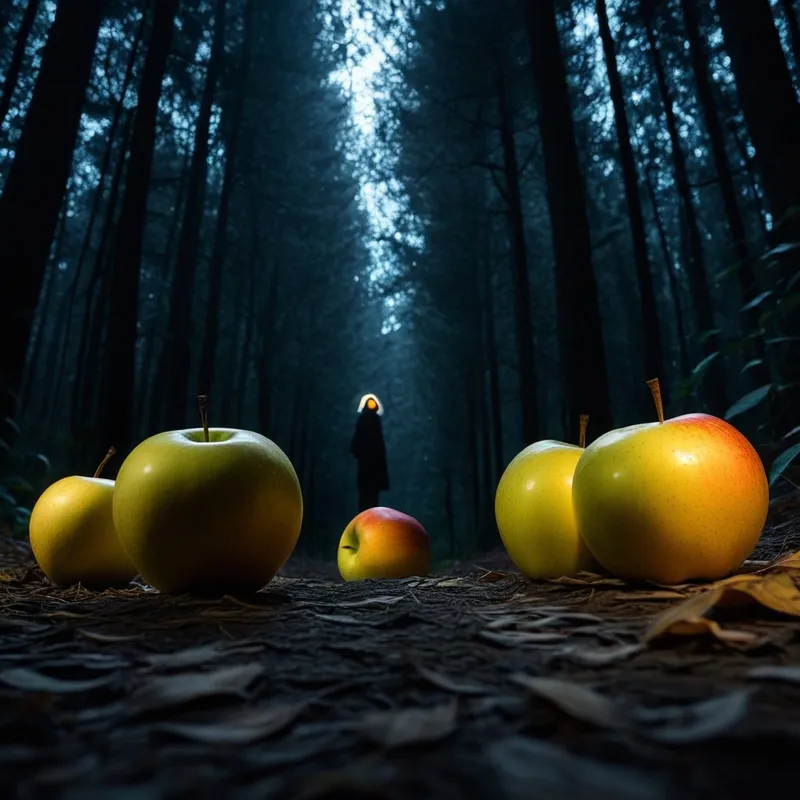
Then came Hippomenes (or some say Melanion). He did not trust in his speed alone. He prayed to Aphrodite, the power Atalanta had spurned. The goddess, slighted, yet intrigued, gave him three apples from the gardens of the Hesperides. They were not food; they were pure, molten desire made solid gold.
The race began. Atalanta flew, a shadow on the earth. Hippomenes lagged. Then he let fall the first apple. It rolled, glowing, a captured sunset. Atalanta’s rhythm broke. A longing, deeper than thought, seized her. She swerved, snatched the apple, and lost a step. Again he fell behind, again a golden sphere tumbled. Again she was drawn away. The finish line neared. With the last of his breath, he cast the third apple far to the side. She hesitated, torn between her vow and the irresistible gleam. She chose the gleam.
She lost the race. She won a husband.
But the story does not end at the altar. Consumed by passion, the couple desecrated a sacred temple of Cybele (or Zeus). For their impiety, the goddess transformed them. No longer huntress and hero, they became a lion and lioness, yoked forever to pull the chariot of the gods, their human voices lost to roars.
Cultural Origins & Context
The myth of Atalanta is a composite, woven from threads of Arcadian and Boeotian folklore, most famously compiled in the Bibliotheca of Pseudo-Apollodorus and immortalized in Ovid’s Metamorphoses. She is a figure of the borderlands—between human society and the wild, between the divine mandates of Artemis (chastity, independence) and Aphrodite (union, desire). In a culture where a woman’s primary societal function was as a wife and mother, Atalanta’s narrative served as a potent, subversive folktale. It was a story told not just to reinforce norms, but to explore the terrifying and fascinating power of the feminine untamed.
Her myth functioned as a cultural dream. It allowed the patriarchal Greek world to simultaneously admire a woman of superlative, “heroic” capability and to ultimately neutralize that threat through a narrative of domestication. The racing contest itself ritualizes the dangerous transition of a woman from her father’s house to a husband’s, with failure meaning death. Atalanta’s defeat is not by superior strength, but by cunning (metis) and a divine intervention that speaks to a force—erotic love—that even the wildest soul cannot ultimately outrun.
Symbolic Architecture
Atalanta is the archetype of the Wild Self. She represents the psyche in its natural, undomesticated state: autonomous, instinct-guided, and fiercely protective of its sovereignty. Her bear-nursing signifies a kinship with the raw, nurturing, and potentially ferocious instincts of the unconscious.
The race is not against another, but against the binding expectations of the world. To win is to remain forever separate; to lose is to be captured by life.
The golden apples are the supreme symbol. They are not mere distractions; they are the radiant, irresistible allure of life’s own possibilities—love, connection, embodiment, experience itself. To follow the pure, linear path of the autonomous will (the race) is to reject life’s tantalizing, nonlinear beauty. Hippomenes, aided by Aphrodite, represents the cunning of the life force, which does not confront the wild self directly but seduces it into participation.
The final metamorphosis into lions is the deepest alchemy. It is not a punishment, but a symbolic resolution. The human conflict—between wild independence and bonded relationship—is transcended. They become sacred, archetypal animals, united in a powerful, instinctual pairing. They are no longer human individuals struggling with roles, but eternal symbols of potent, coupled instinct.
The Dreamer's Resonance
When the pattern of Atalanta stirs in the modern dreamer, it signals a critical juncture between the ego’s drive for control and the soul’s desire for engagement. Dreaming of relentless running, especially in a forest or away from a vague pursuit, echoes Atalanta’s race. The somatic feeling is one of breathless autonomy, a fear of being caught that is also a loneliness.
To dream of radiant, forbidden fruit or lost, precious objects dropped in one’s path points to the “golden apples.” These are the opportunities, relationships, or creative impulses the dreamer’s conscious mind has vowed to avoid (for reasons of safety, career, or a rigid self-image) but which the unconscious deems essential for life. The dream presents them as irresistibly beautiful, forcing a choice: maintain the sterile safety of the vow, or swerve into the unknown richness of desire. The figure of the suitor may appear as an alluring stranger, a familiar person in a new light, or even as an aspect of the dreamer’s own self, offering the apples.

Alchemical Translation
The individuation process modeled by Atalanta’s myth is the transmutation of fierce independence into conscious relatedness. Initially, the psyche identifies wholly with the animus as a principle of action, achievement, and separation (the huntress). This is a necessary stage of developing a strong ego and personal boundaries.
The crisis comes when this mode becomes a prison. The vow to remain “unbeaten” becomes a vow against life. The alchemical agent of change is Aphrodite’s gold—the sudden, irrational eruption of Eros, of feeling, connection, and embodied desire. This force does not argue; it enchants.
The psyche’s wholeness requires not the victory of the wild over the domestic, or the domestic over the wild, but their sacred marriage, their metamorphosis into a third, transcendent thing.
The conscious ego (Hippomenes) must learn to use this golden, irrational force not as a trick, but as a sacred tool to engage the runaway Self. The “loss” of the race is the death of the old, rigid identity. The subsequent “impiety”—the passionate union in a sacred space—is the necessary inflation that precedes transformation. The final stage is not a regression to beastliness, but an evolution into a numinous partnership. The lion and lioness represent the integration of powerful instinct (the wild) into a purposeful, divine service (the yoked chariot). The individuated Self is no longer just the solitary runner or the domesticated spouse, but a creature of majestic, coupled power, carrying a divine purpose forward.
Associated Symbols
Explore related symbols from the CaleaDream lexicon: