
Asteria Myth Meaning & Symbolism
A Titan goddess, pursued by Zeus, transforms into a quail and then an island, becoming a sanctuary for her sister and a beacon of oracular night.
The Tale of Asteria
Listen, and hear the story written not on parchment, but in the silent spaces between the stars.
Before the reign of Zeus was absolute, when the cosmos still remembered the breath of the old Titans, there shone Asteria. Her dominion was the velvet cloak of night, not its emptiness, but its secret life: the sudden, streaking fire of a meteor, the whispered truth that rides on the tail of a dream. She was the daughter of Coeus and Phoebe, a creature of celestial lineage and oracular sight.
But the new order, thunderous and insatiable, cast its gaze upon her. Zeus, the cloud-gatherer, desired her. His pursuit was not of gentle courtship but of conquest, a claiming of the night’s mysteries for his own burgeoning pantheon. He chased her across the star-fields, his thunder a discordant rhythm against the music of the spheres.
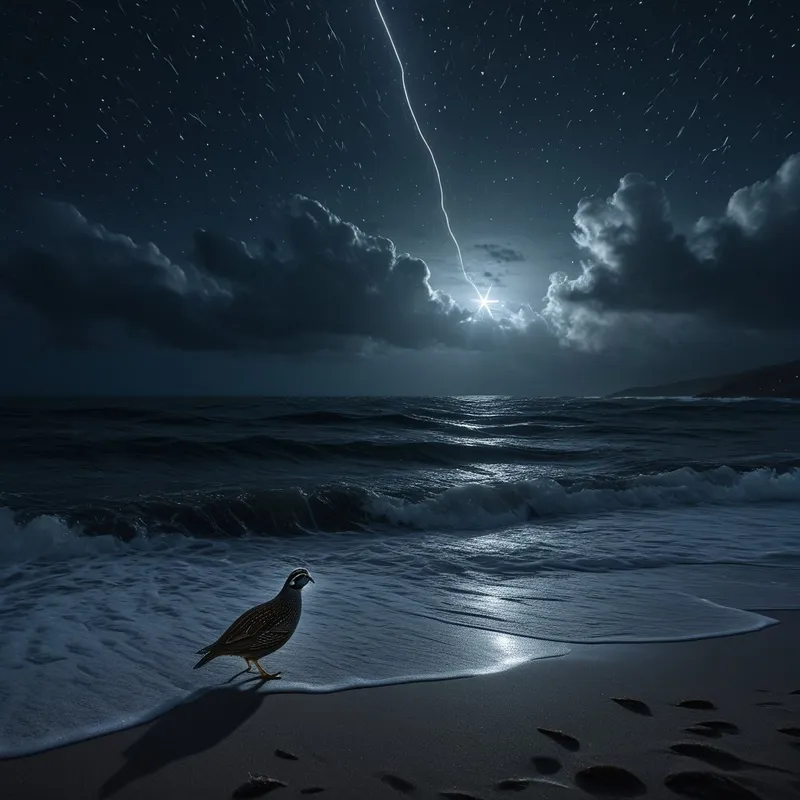
Asteria, whose soul was woven from freedom and foresight, would not be captured. She saw the trap of Olympus, the gilded cage of being just another consort in the court of the sky-king. So, she called upon the deepest magic of her nature—the magic of transformation, of becoming. As Zeus reached for her, she did not fight; she changed. Her celestial form dissolved, condensing into a small, swift, earth-bound creature: a quail. With a desperate beat of wings, she dropped from the heavens, a falling star made flesh, plummeting not in defeat, but in a deliberate, radical escape.
Down, down she fell, through the cool air, past the realm of gods and into the domain of Poseidon. The sea, seeing this strange gift from the sky, rose to meet her. But Asteria was not done. As she struck the dark, wine-faced waters, she performed a second, even more profound metamorphosis. The quail was gone. In its place, from the foam and the deep, an island arose. Not a lush, welcoming isle, but a rugged, floating rock—Ortygia. It was a piece of the solid earth, yet unmoored, a sanctuary born of refusal.
Years later, when her sister Leto, pregnant with Zeus’s children and hounded by the wrath of Hera, wandered the earth with no place to rest, it was this forgotten island that answered her call. Ortygia, the transformed Asteria, anchored itself to the seabed. It became Delos, the “Shining One,” the stable, hallowed ground where Apollo and Artemis could be born. The one who fled became the foundation. The refugee became the refuge.
Cultural Origins & Context
The fragments of Asteria’s story reach us primarily through the poets, the weavers of divine genealogies and cosmic histories. Hesiod, in his Theogony, places her in the lineage of Titans, establishing her as a bridge between the old cosmic order and the new. Later sources, like the Homeric Hymn to Apollo and the works of Pseudo-Apollodorus, flesh out the narrative of her transformation and her island’s pivotal role.
This myth functioned as an etiological tale, explaining the origin and sacred nature of the island of Delos, one of the most important religious centers in the ancient Greek world. But its transmission was not merely explanatory; it was devotional. It framed Delos not as a random rock, but as a divine being who chose to become a sanctuary. The myth elevated the island’s status, making it a direct participant in the drama of the gods, a literal embodiment of sacrificial protection. It was a story told by priests and pilgrims to sanctify the very ground they stood upon, linking the physical geography to a timeless, celestial narrative.
Symbolic Architecture
Asteria’s myth is a profound map of a very specific kind of empowerment: the power of radical receptivity and transformative descent. She embodies the principle that is not conquest, but escape into essence.
To save one’s soul, one must sometimes consent to fall from heaven and become solid ground for another.
Her first symbol is the falling star. She is the luminous idea, the divine inspiration, that must leave its accustomed sphere to find its true purpose. Her pursuit by Zeus represents any crushing, external pressure—tyrannical authority, overwhelming desire, societal expectation—that seeks to fix a free spirit into a predetermined role.
Her transformations are masterclasses in psychic agility. The quail is a creature of the earth, elusive, camouflaged, connected to the feminine and the oracular in Mediterranean tradition. It signifies the willingness to become small, unnoticed, and humble to preserve autonomy. The plunge into the sea is a baptism into the unconscious, the realm of Poseidon’s raw, emotional chaos.
The final form, the floating island (Ortygia/Delos), is the ultimate symbol. It is the self that has solidified through ordeal. It is not a fortress, but a sanctuary; not aggressive, but receptive. It is autonomous (“floating”) yet becomes foundational (“anchored”) when called upon by genuine need. Asteria does not become a warrior; she becomes a place. She transforms from a pursued object into an unshakable subject, a haven born entirely from her own act of self-preservation.

The Dreamer's Resonance
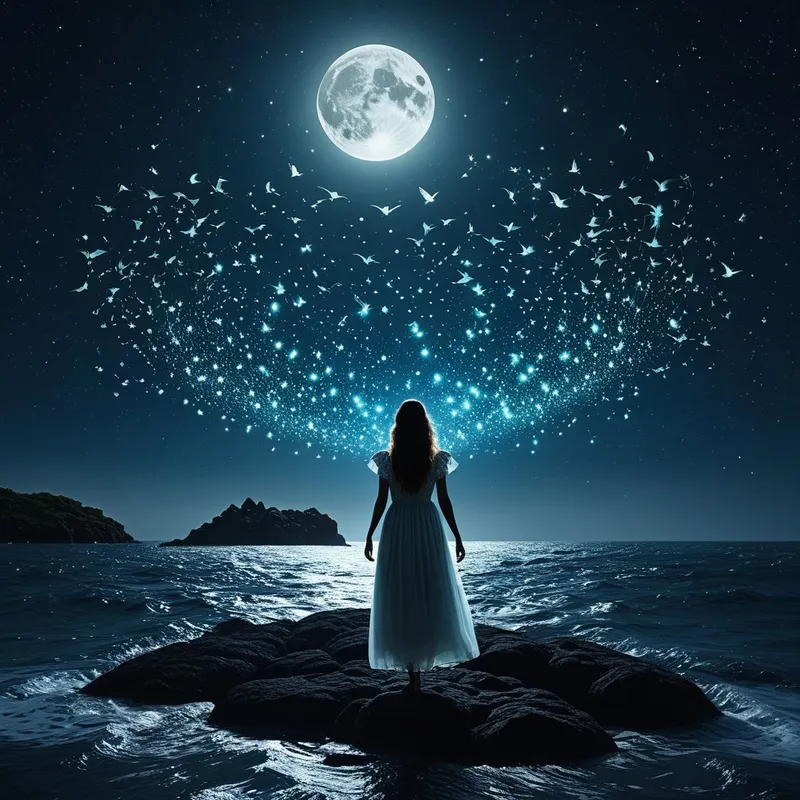
When the pattern of Asteria stirs in the modern psyche, it often manifests in dreams of urgent escape and profound grounding. You may dream of fleeing a powerful, oppressive force—a figure of authority, a looming shadow, a consuming light. The flight feels desperate, and the solution is never to turn and fight, but to undergo a shocking change: shrinking into an animal, diving into deep water, or feeling your body transform into landscape—stone, earth, or tree.
Somnially, this signals a critical phase of psychic retreat. The conscious ego is under a pressure it cannot withstand or reason with (the “Zeus” complex). The Self, the total psyche, initiates an emergency descent. The somatic feeling upon waking may be one of heavy solidity, of being weighted, or conversely, of eerie calm. The psyche is enacting Asteria’s alchemy: it is abandoning a doomed position in the conscious world to reconstitute itself at a deeper, more elemental level. It is the dream of the introvert finding power in withdrawal, of the creative person rejecting commercial demands to preserve their inner voice, of anyone choosing integrity over capture, even if it means becoming “an island.”
Alchemical Translation
The individuation process modeled by Asteria is not the heroic journey outwards, but the sacred collapse inwards. Her myth charts the opus contra naturam—the work against one’s current nature—required when one’s spiritual nature is threatened with assimilation.
The alchemical gold is not found in the king’s court, but in the dark sea where the rejected stone transforms into the cornerstone.
The first stage, Nigredo, is the dark pursuit and the fall. It is the feeling of being hounded, of having your essence threatened. The conscious attitude (aligned with Zeus’s possessive sky-logic) must fail. The second stage, Albedo, is the purification through transformation into the quail and the sea-plunge. This is the whitening, the shedding of the celestial identity for an earthly, instinctual one. It is a humbling, a washing in the waters of the unconscious.
The final and most crucial stage is Rubedo, the reddening, the achievement of the philosopher’s stone. This is not a return to the sky, but the becoming of the island. It is the point where the transformed self, having integrated the darkness of the sea (the unconscious), achieves a new, solid state. This “stone” is the enduring, resilient personality that emerges from crisis. It is no longer fugitive, but foundational. The Asteria process teaches that our deepest power often lies not in expansion, but in conscious contraction; not in being a brilliant light in another’s constellation, but in becoming the stable, sacred ground from which new life—our own authentic creations (Apollo/Artemis)—can finally be born. We become a sanctuary first for ourselves, and then, organically, for the world.
Associated Symbols
Explore related symbols from the CaleaDream lexicon: