
Assiah the World of Action Myth Meaning & Symbolism
The final world of divine emanation where spirit descends into dense matter, demanding sacred action to complete the cosmic circuit of creation.
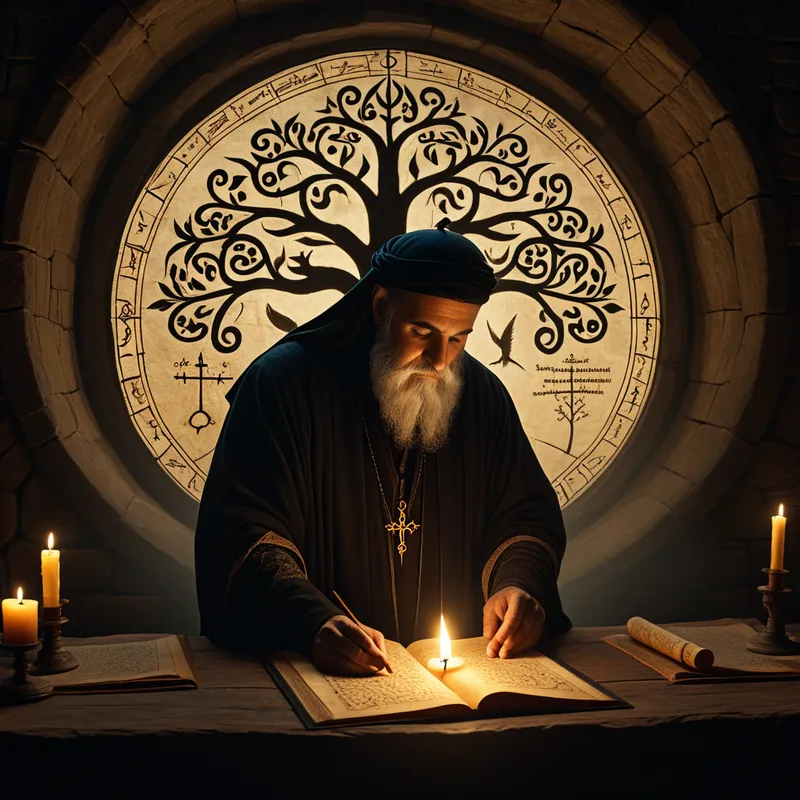
The Tale of Assiah the World of Action
Listen, and let the story settle in your bones. Before time was counted, before the first breath was drawn, there existed a thought so perfect, a light so boundless, it could not be contained. This was Ein Sof. And from its boundless stillness, a desire stirred—a desire to be known. Thus began the great contraction, the Tzimtzum, a retreat of light to make a hollow, a womb for worlds.
Into this hollow, a ray of that primordial light poured forth, cascading through vessels of increasing density. First came Atziluth, the world of nearness, where idea and source are one. Then Briah, where blueprints of all things are etched in fire. Then Yetzirah, where forms take shape from the breath of angels. Each world a step further from the source, a garment woven over the naked light.
But the journey was not complete. The light sought a final embrace, a consummation in the most distant, most real of brides: the world of substance, of grit and grain, of blood and stone. This is the tale of that descent, the forging of Assiah.
The divine river, now a torrent of searing sparks, reached the final barrier—the sieve of matter. Here, the vessels could not hold. They shattered, in a cataclysm heard as silence. The Shevirat HaKelim. Holy sparks, fragments of the original radiance, were flung far and wide. They fell, like burning stars, into the depths of the nascent world. They lodged in the heart of mountains, in the roots of trees, in the marrow of beasts, and in the clay from which humankind would be formed.
Assiah was born from this sacred catastrophe. It is not a world of pure light, but a world of hidden light. It is the kingdom of shells, of Kelipot, that seem coarse and separate. The sky here is not a transparent veil to heaven, but a firmament. The earth does not sing openly, but holds its song deep within. This is the world of action, for here, the light does not simply be; it must be released. It must be sought, recognized, and lifted through deed, through intention, through the sweat of the brow and the focus of the heart.
The myth tells of a great promise: the Tikkun Olam. The divine sparks wait, slumbering in every stone, in every act of kindness, in every moment of true perception. The inhabitants of Assiah—humanity—are born with a shard of that original light as their soul. Their holy task, their deepest destiny, is to move through this dense, beautiful, broken world and perform the great lifting. With every ethical action, every creative act, every gesture of love that pierces the shell of isolation, a spark is freed. It ascends, rejoining the great river, mending a fracture in the cosmos.
Thus, Assiah is not a prison, but the crucible of completion. It is where the divine dream becomes flesh, where the abstract becomes accountable. The story ends not with an ascension out of the world, but with the sanctification of the world. When enough sparks are gathered, the myth whispers, the shells themselves will become translucent, and Assiah will shine forth as the final, most glorious vessel of all—a world of action transformed into a world of perfected revelation.
Cultural Origins & Context
The myth of the Four Worlds, with Assiah as the final and most dense, is not a single narrative with characters but a profound metaphysical map central to Kabbalah, particularly as it crystallized in the medieval period. Its most famous articulation is found in the Zohar (13th century Spain) and was systemized by Rabbi Isaac Luria (the Ari) in 16th-century Safed following the trauma of the Jewish expulsion from Spain.
This was not a story told around a fire for entertainment, but a secret, transmitted orally from master to carefully prepared disciple (Talmid Chacham). Its societal function was dual. For the scholarly mystic, it provided a cosmic rationale for exile and suffering (the shattered vessels) and a empowering mission for life (the gathering of sparks). It transformed every mundane act into a potentially cosmic repair. For the culture at large, even in its popularized forms, it instilled a deep sense of purpose and sanctity in everyday life, asserting that the physical world is not separate from God but is the very arena of divine completion.
Symbolic Architecture
Psychologically, the myth of Assiah maps the descent of consciousness from pure potential into embodied reality. Atziluth represents the unconscious itself, the realm of archetypal potentials. Briah is the birth of an idea or image in the mind. Yetzirah is the emotional and psychic energy that forms around that idea. Assiah is the final, often difficult, stage of manifestation: bringing that inner reality into the outer world through concrete action.
The greatest spiritual temptation is to remain in the world of idea, in the safety of formation. Assiah demands the risk of incarnation.
The Shattering of the Vessels symbolizes the necessary fragmentation of the Self as it encounters the hard edges of reality. Our wholeness (the primordial light) is broken by life’s experiences, trauma, and the demands of society (the shells). We feel our potential is scattered, trapped in memories, unlived lives, and unrealized dreams. The Kelipot are not evil, but the necessary density of the psyche—our defenses, our habits, our ego-structures that both protect and imprison the light within.
Thus, the human soul (Nitzotz) is both a fragment of the divine and a seeker on a quest to reunite with other fragments, both within itself and in the world.

The Dreamer's Resonance
When this mythic pattern activates in the modern psyche, it often manifests in dreams of searching, digging, or repairing. You may dream of sifting through rubble after a catastrophe, looking for precious, glowing fragments. You may dream of a familiar house or city where you discover hidden, sealed rooms filled with forgotten light. You may be tasked with fixing a complex, broken machine, or feeding a starved, luminous creature trapped in a cellar.
Somatically, this process feels like a profound grounding—or a frustrating heaviness. It is the pressure to "make it real." You may feel a creative impulse (a spark from Yetzirah) that causes anxiety because it demands action in Assiah: to write the book, start the business, have the difficult conversation, or build the relationship. The dream is signaling that a phase of inner formation is complete. The psychic energy is now ripe and must be directed into the world of matter, of consequence, of action. The conflict in the dream mirrors the resistance of the ego, which fears the shattering vulnerability of manifestation.

Alchemical Translation
The individuation process, the journey toward psychological wholeness, is perfectly modeled by the descent into and redemption of Assiah. It is the "alchemical translation" of spirit into substance. Many spiritual bypasses tempt us to flee from Assiah—to seek enlightenment as an escape from the messy, physical, and relational world. Kabbalah insists the opposite: enlightenment is found through the world.
Individuation is not achieved by escaping the material self, but by fully incarnating the spiritual self within it.
The first stage is Contraction (Tzimtzum): making space in a life cluttered with shells (identifications, routines, distractions) for the authentic impulse to emerge. Then comes Descent: courageously allowing your inner truth to take form in the real world, accepting that it will be fragmented and misunderstood (the Shattering). Your beautiful, inner vision will meet the resistance of matter—your own limitations, others' opinions, practical constraints.
The core work of psychic transmutation is Gathering (Tikkun). This is the slow, patient, often mundane work of therapy, creative practice, relationship-building, and civic engagement. It is lifting the spark from the shell of a childhood wound through understanding. It is lifting the spark from the shell of a toxic habit by replacing it with a conscious ritual. It is lifting the spark from a conflict by speaking a truth with love. Each act is a Mitzvah, a commandment, but in psychological terms, it is an act of integrity that redeems a lost piece of the Self.
The ultimate goal is not to leave Assiah for a "higher" world, but to perform the alchemy that makes Assiah itself sacred. The integrated individual walks the same earth, but perceives it as a network of hidden light. Their actions are no longer just personal; they are cosmological. They have become a conscious agent of Tikkun Olam, repairing their own soul and, in doing so, repairing a corner of the world.
Associated Symbols
Explore related symbols from the CaleaDream lexicon:
- Act — The fundamental unit of existence in Assiah, where intention is tested and made real; every conscious deed is a tool for gathering divine light.
- Action — The dynamic, creative force that shapes the dense world of matter, representing the human partnership with the divine in the ongoing work of creation.
- Earth — The foundational element of Assiah, symbolizing the physical body, material reality, and the grounding vessel that receives and conceals the spiritual sparks.
- Stone — The quintessential substance of Assiah, representing density, permanence, and the hardened shell that both protects and imprisons the inner, luminous truth.
- Key — The tool for unlocking the shells of the world, representing knowledge, ethical action, and conscious intention that can liberate the trapped sparks within matter.
- Temple — The archetype of sacred space within Assiah, representing the human body, a community, or a crafted work that becomes a vessel for gathered and elevated light.
- Work — The sacred labor of Tikkun Olam, the diligent, often mundane process of sorting, refining, and lifting the scattered fragments of wholeness.
- Shadow — The psychological counterpart to the Kelipot, the hidden, denied, or rejected aspects of the self that contain trapped energy and light awaiting integration.
- Light — The primordial divine essence, the soul, and the goal of the quest; it exists both as a distant source and as fragmented sparks hidden within all things.
- Root — The deep, hidden connection that anchors the world of Assiah to the higher worlds, symbolizing the unconscious link between our actions and their archetypal origins.
- Seed — The potential hidden within the shell of Assiah, containing the complete blueprint (Briah) for what it can become when acted upon with care and intention.
- Journey — The endless path through the world of action, a pilgrimage not to a distant place, but into the depth of matter and moment to perform the sacred work of finding and freeing.