Asklepios Myth Meaning & Symbolism
A mortal son of Apollo becomes the god of healing, wielding a serpent-entwined staff, only to be struck down for defying the boundary between life and death.
The Tale of Asklepios
Listen, and hear the tale of the one who learned the language of pain and spoke the word that ends it.
In the wild, fragrant hills of Thessaly, a story was born from fire and grief. The radiant Apollo, his heart pierced by a mortal woman’s beauty, lay with Coronis. But her heart strayed, and from his golden throne, Apollo saw. His sister, the fierce huntress Artemis, loosed a storm of arrows, and Coronis fell, her life bleeding into the earth. As the pyre was built, Apollo’s rage turned to a father’s sorrow. From the flames, he snatched the unborn child from his mother’s womb, a boy saved from the very fire of death. He named him Asklepios, and gave him to the wise centaur Chiron, to be raised in the shadow of Mount Pelion.
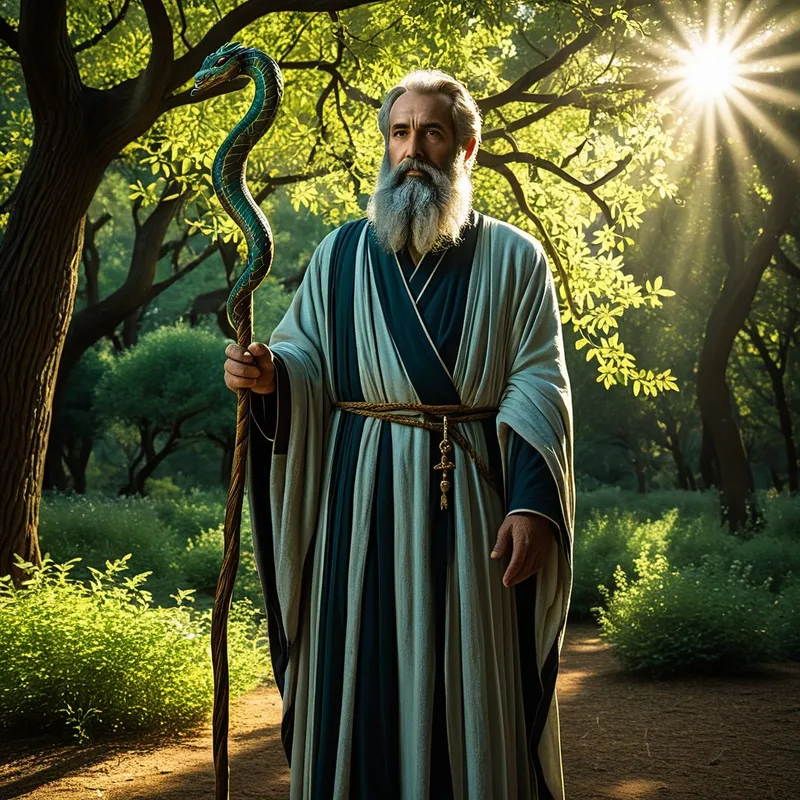
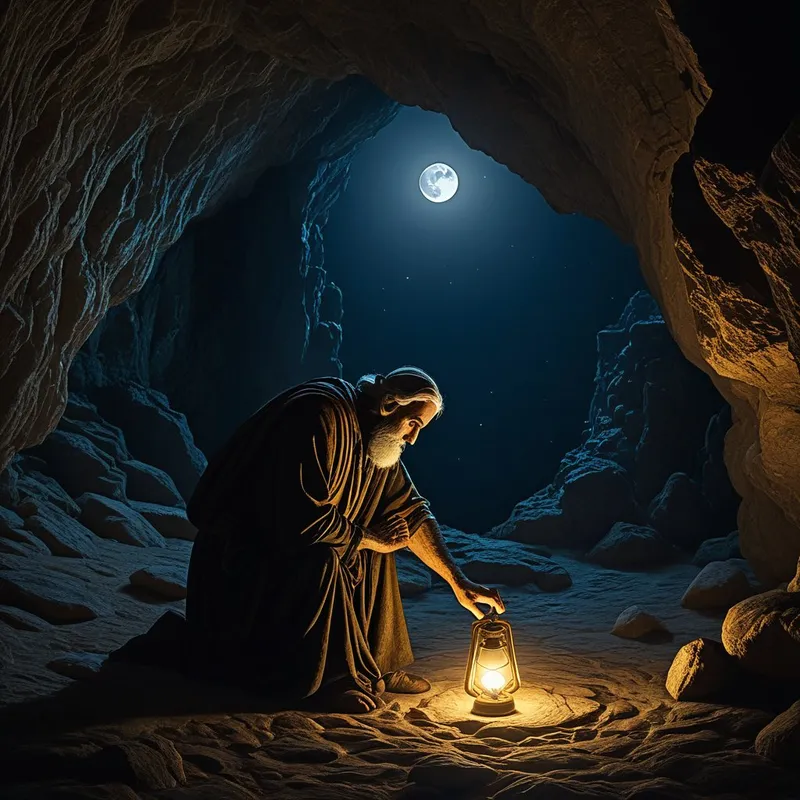
In Chiron’s cave, the air smelled of damp earth and drying herbs. The boy did not learn the arts of war, but the deeper magic of the world. He learned the songs of roots, the whispers of leaves, the secret pulse in the veins of all living things. Chiron, the wounded healer himself, taught him that to understand sickness, one must first know the shape of suffering. Asklepios’s hands grew skilled, his sight piercing flesh to see the dance of humors and the shadow of disease. But his greatest teacher came not from his mentor, but from the dust. One day, as he pondered a hopeless case, a serpent—a creature of the deep earth, of rebirth and cunning—slithered near. It placed a certain herb into the mouth of another, dead serpent, and life returned. In that moment, Asklepios understood: the power to kill and the power to cure are two heads of the same beast. He took the serpent as his companion, winding it around his simple staff.
His fame spread like a healing wind across Hellas. The lame walked. The blind saw. The fevered found cool rest. He built sanctuaries, Asklepieia, where the sick would sleep, hoping the god would visit their dreams with a cure. But his power grew too great, his compassion too deep. He looked upon the stillness of death and saw it not as an end, but as the ultimate disease to be challenged. When the great hunter Herakles brought his friend Hippolytus, torn apart by his own horses, Asklepios did not turn away. In a chamber heavy with incense and desperate hope, he called upon arts unknown to mortals. He applied herbs of such potency they seemed stolen from another world, and chanted words that stirred the silent blood. And Hippolytus drew breath.
In the misty halls of Hades, the boatman Charon found his river empty of a destined soul. The lord of the dead, Hades, rose in dark wrath and went before his brother, the thunderer Zeus. "The natural order is undone!" he cried. "This mortal plays at godhood, stealing what is mine. If this stands, the boundary between your world and mine will crumble." Zeus looked down upon the earth, upon the healer who had robbed death itself. The balance of the cosmos was at stake. With a heavy heart, for he saw the virtue in Asklepios, Zeus raised his hand. A single, blinding bolt of lightning split the sky, finding the healer in his sanctuary, and struck him down.
But from ash, life returns. Apollo raged, but could not undo the will of Zeus. Instead, in honor of his son’s divine skill and tragic hubris, Zeus placed Asklepios among the stars. The healer became a god, his serpent-entwined staff an eternal symbol. For in his tale, the Greeks understood a terrible, beautiful truth: the greatest healing touches the edge of a sacred law, and wisdom is born from the ashes of transgression.
Cultural Origins & Context
The myth of Asklepios is not merely a story; it is the narrative soul of Greek medicine. Its origins are deeply rooted in the pre-Olympian chthonic world, where healing was associated with earth deities and serpent spirits. By the 5th century BCE, his cult had become one of the most widespread and influential in the Greek world. The primary sources are the poets: Hesiod mentions his birth, and Pindar elaborates the tale in a majestic ode. Later, tragedians like Euripides referenced him, and the travel writer Pausanias meticulously described his sanctuaries centuries later.
The myth was performed, not just read. It was told by priests at the hundreds of Asklepieia, the most famous being at Epidaurus. Here, the myth provided the sacred context for the practice of incubation. Sufferers would make pilgrimages, offer sacrifices, and sleep in the abaton (the dormitory), believing Asklepios would visit them in a dream to diagnose, prescribe, or even perform a miraculous cure. The myth thus functioned as a foundational charter, explaining the divine origin of medical art, its limits as defined by the gods, and establishing a direct, experiential link between the suffering individual and the divine healer. It reconciled the hope for miraculous intervention with the growing rational practice of Hippocratic medicine, positioning Asklepios as the patron of both.
Symbolic Architecture
At its core, the myth of Asklepios is an alchemical drama of the Wounded Healer. He is literally saved from the wound of his mother’s death, and raised by Chiron, a centaur suffering an incurable wound. His authority does not come from invulnerability, but from a profound intimacy with vulnerability.
The serpent does not represent the disease, but the intelligence of the disease—the transformative wisdom hidden within the crisis itself.
The Rod of Asklepios is the central symbol. The staff represents support, the axis of the world, the spine. The serpent is multifaceted: it is a creature of the earth (chthonic wisdom), it sheds its skin (rebirth), and its venom can kill or cure (the dual nature of potent forces). Their union symbolizes the integration of conscious, structured healing (the staff) with the unconscious, instinctual, and potentially dangerous forces of life and transformation (the serpent).
His transgression—raising the dead—is the critical symbolic moment. It represents the healer’s inevitable confrontation with the ultimate boundary. Psychologically, it speaks to the desire to heal not just symptoms, but the very condition of existential suffering, to cure the soul of its mortality. His punishment by Zeus is not a condemnation of healing, but a delineation of its realm. It establishes a sacred law: healing operates within the cycle of life and death; to seek to abolish death is to disrupt the cosmic order and incur the wrath of the Self (Zeus).
The Dreamer's Resonance
When the archetype of Asklepios stirs in the modern unconscious, it often manifests in dreams of healing, but of a specific kind. One may not dream of the god himself, but of his symbols and landscapes.
Dreaming of a serene, knowledgeable doctor or guide in a place that is both hospital and temple suggests the Asklepian energy is active. More commonly, the serpent appears—not as a threat, but as a curious, observing presence in a sickroom or beside the dreamer’s bed. This signals that the unconscious is offering not just solace, but a specific, instinctual intelligence regarding an illness or life-crisis. Dreams of miraculous cures, or conversely, of healing tools breaking or failing, reflect the dreamer’s negotiation with hope and limitation around a profound ailment—be it physical, psychological, or spiritual.
Somatically, this process can feel like a deep, sometimes feverish, inward turning. The body itself becomes the Asklepieion. The "incubation" is the period of illness or deep psychological distress, where the conscious ego is forced to rest, and the deeper, serpentine wisdom of the body-psyche is allowed to speak through symptoms, dreams, and intuitions. The dreamer is undergoing a process where the very structure of their life or health is being questioned and potentially reconfigured at a foundational level.

Alchemical Translation
The myth of Asklepios provides a profound map for the process of psychic individuation, framed as the journey to become a healer of one’s own soul.
The first stage (Calcinatio) is the fiery birth from the pyre of Coronis. This is the initial, often traumatic, wounding that sets the journey in motion—the realization of one’s own suffering, fragmentation, or "dis-ease." It is the burning away of naive wholeness.
The second stage (Solutio) is the apprenticeship with Chiron. This is the long, often humble, work of education and introspection. One must dissolve rigid attitudes, learn the "herb-lore" of the psyche—understanding complexes, shadows, and patterns. It involves accepting mentorship and facing one’s own woundedness without being defined by it.
The lightning bolt of Zeus is not merely punishment; it is the numinous shock that forever separates the healed personality from identification with the divine power itself. It creates a sacred wound of humility.
The critical operation (Coniunctio) is the integration of the serpent. This is the moment of breakthrough, where conscious effort (the staff) allies with a transformative insight from the unconscious (the serpent). It might be a powerful dream, a sudden understanding of an old pattern, or the acceptance of a previously rejected part of the self. This union grants real healing power.
The final, transcendent stage (Mortificatio & Sublimatio) is the confrontation with the ultimate boundary and the transformation into a guiding principle. The ego’s inflation—the desire to "fix" everything, to avoid all death (of relationships, ideas, life phases)—must be "struck down" by the greater Self (Zeus). This mortification is essential. It kills the healer’s hubris, allowing the archetype itself to be sublimated. One does not become the immortal healer; one becomes a vessel for the healing principle. The individual learns to serve the process of life, death, and rebirth within themselves and others, carrying the staff not as a weapon against fate, but as a compass through it. The wound of limitation becomes the source of true compassion, and the healed healer takes their place in the inner constellation of the soul.
Associated Symbols
Explore related symbols from the CaleaDream lexicon: