Asha and Druj Myth Meaning & Symbolism
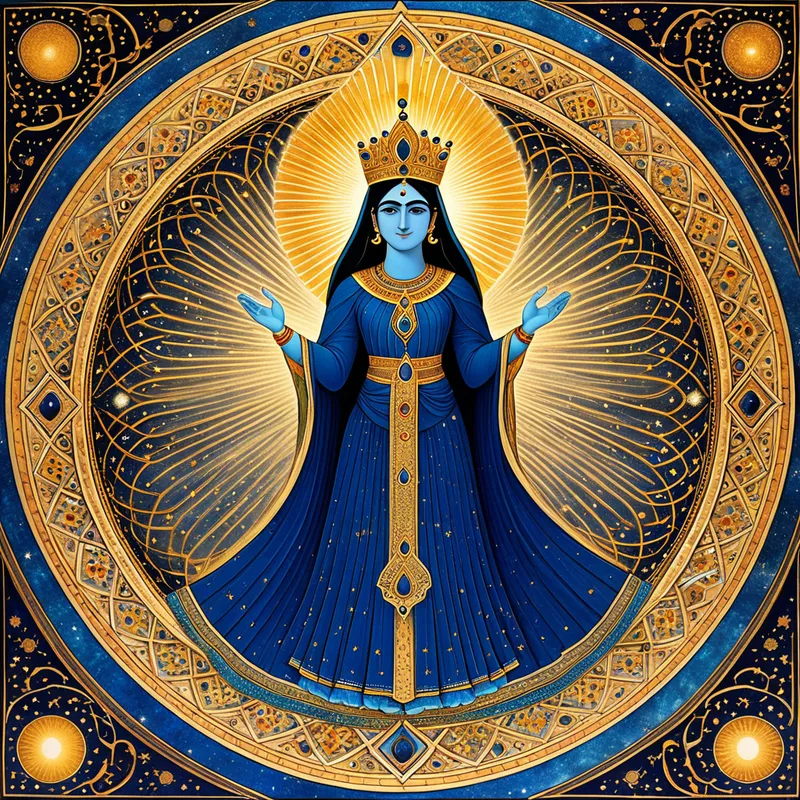
The eternal struggle between cosmic truth, Asha, and the lie of chaos, Druj, forming the foundation of Persian cosmology and the human psyche.
The Tale of Asha and Druj
In the time before time, when the world was a thought in the mind of the boundless Ahura Mazda, there existed only two primal breaths. One was the Breath of Truth, a song of perfect, radiant order. The other was the Whisper of the Lie, a hiss of restless, hungry chaos. They were not yet at war, for war requires a field of battle, and the field did not exist.
Then, Ahura Mazda, in his wisdom, sang the universe into being. With each note of his divine song, the Breath of Truth took form. It became the Asha—the straight path of the stars, the unwavering cycle of the seasons, the law of growth in the seed, the promise of dawn after darkness. Asha was not a god to be worshipped from afar, but the very fabric of a cosmos that was meant to be: harmonious, truthful, and progressing toward a state of perfect, luminous goodness.
But the song of creation echoed into the void, and the Whisper heard it. It stirred, not with understanding, but with a corrosive desire to undo. It became the Druj. Where Asha was the straight path, Druj was the twisting, overgrown track leading into swamps of confusion. Where Asha was the nourishing rain, Druj was the drought that cracked the earth and the flood that washed life away. Druj was not mere evil; it was the active principle of anti-creation, the entropy that says "this order is a lie, all things must fall apart."
The battlefield was set: the entire cosmos. The first skirmish was in the heart of the first man, Gayomard. Asha spoke to him of stewardship, of tending the Spenta Mainyu, of aligning his thoughts, words, and deeds with the fundamental truth of existence. Druj slithered into his ear, whispering of dominion through destruction, of truth as a shackle, of the sweet power of deceit. Every human choice, from the king on his throne to the farmer in his field, became a microcosm of this war. To till the soil was an act of Asha; to salt it, an act of Druj. To speak a promise and keep it was to build the world; to break it was to wound creation itself.
This is not a myth with a single hero and a final battle. It is the myth of the world's condition. The great savior, Saoshyant, is prophesied to one day lead humanity in a final renovation, Frashokereti, where Druj will be utterly vanquished and the world restored to its pristine state of Asha. But until that dawn, the tale is told in every sunrise that fights back the night, in every just law enacted, in every truthful word spoken against the cacophony of the lie. The war is eternal, and every soul is a soldier on the field of choice.
Cultural Origins & Context
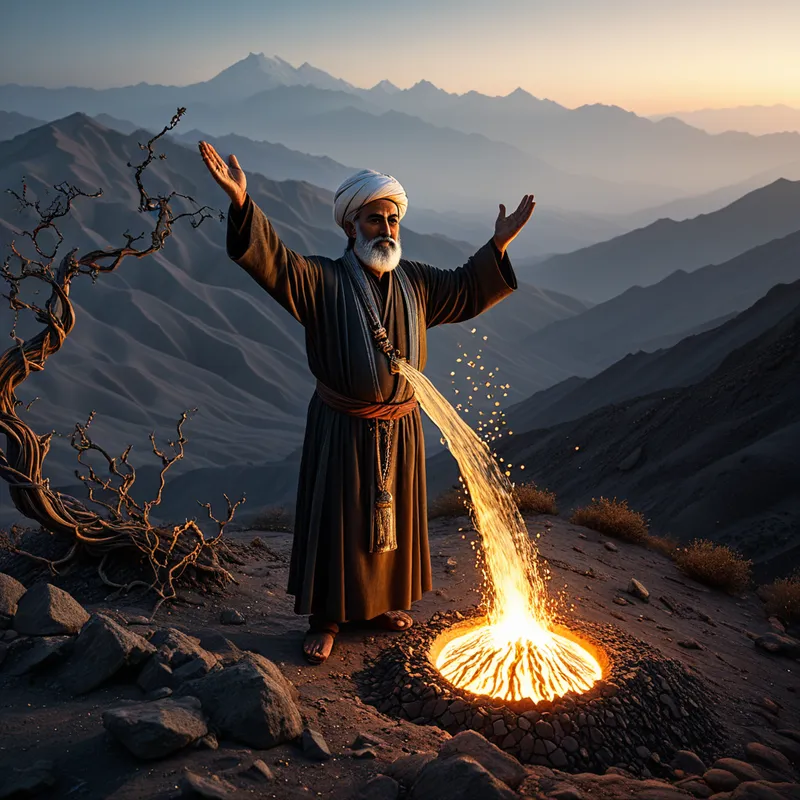
This cosmic drama is the foundational axis of Zoroastrianism, the ancient pre-Islamic religion of Persia. It is preserved most sacredly in the Avesta, particularly in the Gathas, which are attributed to the prophet Zarathustra himself. This was not merely a story for priests; it was the operating system of an empire. The mighty Achaemenid kings, like Darius the Great, saw themselves as agents of Asha, their rule a divine mandate to establish truth and order (arta in Old Persian) against the chaos of falsehood and rebellion (drauga).
The myth was passed down through a rigorous oral and ritual tradition by the priestly class, the Magi, before being committed to writing. Its societal function was profound: it provided a complete cosmic ethical framework. It answered why the world contained both beauty and suffering, and placed the responsibility for cosmic progress squarely on human agency. Every fire temple, with its ever-burning flame, was a fortress of Asha in the material world, a symbolic beacon against the Druj of darkness and ignorance.
Symbolic Architecture
At its heart, the myth of Asha and Druj is a grand archetypal map of consciousness. Asha represents the transcendent function of the psyche—the innate pull toward meaning, integrity, and wholeness. It is the Self, as Carl Jung defined it, the organizing principle that strives to unify the personality. Druj is not merely the personal shadow (our repressed weaknesses), but the archetypal Shadow—the impersonal, destructive force of entropy within the psyche, the compulsion to sabotage, deceive, and fragment.
The struggle is not between good and evil as moral absolutes, but between cosmos and chaos, between the impulse to create a coherent Self and the pull toward psychic disintegration.
Asha is the principle of authentic being. Its symbol is the straight line, the plumb line, the unwavering flame. Druj is the principle of inauthenticity. Its symbol is the maze, the mirage, the rust that corrupts. In psychological terms, every time we act from a place of inner truth, aligning our actions with our deepest values, we embody Asha. Every time we act from fear, deceit, or self-illusion, we give power to Druj within our own psychic economy.
The Dreamer's Resonance
When this myth stirs in the modern dreamer, it often manifests as dreams of profound structural conflict. One does not simply dream of a monster named Druj. Instead, one dreams of a house where the foundations are cracking for no reason (Asha's order undermined). One dreams of speaking vital truths that come out as gibberish or lies (Druj corrupting communication). One dreams of trying to follow a map or a set of instructions that constantly change and contradict themselves.
Somatically, this process can feel like a deep, internal corrosion—a fatigue that is not of the body but of the spirit, a sense of being "out of true" like a warped wheel. Psychologically, it is the experience of a life lived out of alignment. The dreamer is in a state where the conscious persona and the unconscious values are at war. The dream images are the psyche's attempt to dramatize this civil war, showing the cost of the lie (Druj) and the yearning for the foundational truth (Asha) of one's own being.

Alchemical Translation
The individuation process—the journey toward becoming a psychologically integrated individual—is the modern Frashokereti. It is the long, slow work of renovating the self. In this alchemy, Druj cannot be ignored or annihilated outright, for it is part of the psychic substance. The goal is not to destroy chaos, but to transmute its energy through the containing vessel of Asha.
The first alchemical step is Vohu Manah—Good Mind. This is the commitment to see the truth of oneself, to confront the inner Druj of self-deception without flinching. It is the analysis of dreams, the honest journaling, the therapy session.
The second is Asha Vahishta—Best Truth. This is the active realignment. Having seen the lie (the neglected talent, the toxic pattern, the inauthentic life path), one must begin the arduous task of rebuilding thought, word, and deed in accordance with the deeper truth. This is the repair of the cracked foundation in the dream-house.
Finally, there is Spenta Armaiti—Holy Devotion. This is the sustained, patient commitment to this new order. It is the daily practice, the repeated choice for integrity, which gradually "heals the world" of the psyche. The chaotic, destructive energy of the personal Druj (like raw anger or creative blockage) is not expelled; it is harnessed and given a true form and purpose within the larger architecture of the Self. The war becomes a creative tension, the dynamo that powers the soul's progress toward its own promised wholeness.
Associated Symbols
Explore related symbols from the CaleaDream lexicon:
- Fire — The supreme symbol of Asha, representing pure, transformative truth, divine wisdom, and the eternal light of consciousness that burns away the obscuring fog of Druj.
- Order — The fundamental nature of Asha, manifesting as cosmic law, ethical structure, and the innate psychic tendency toward integration and wholeness.
- Chaos — The fundamental nature of Druj, representing primordial entropy, psychic fragmentation, and the compulsive force of deception and decay.
- Light — The active, revealing principle of Asha, which illuminates the straight path and exposes the twisting falsehoods of Druj's shadows.
- Shadow — The psychological embodiment of Druj within the individual, the repository of repressed truths and destructive potentials that must be integrated, not fought.
- Truth — The essential substance of Asha, not as a factual statement but as the bedrock of cosmic and psychic reality, the alignment of being with its deepest purpose.
- Journey — The human life as the battlefield of this myth, where each step is a choice toward the order of Asha or the chaos of Druj, leading toward the destination of Frashokereti.
- Hero — The archetype embodied by every individual who consciously engages in the inner struggle, choosing to confront their inner Druj and labor to build their inner Asha.
- Temple — The human psyche or soul as the sacred space where this cosmic battle is waged, which must be maintained and purified to house the divine flame of truth.
- Circle — The symbol of the completed Self, the state of Frashokereti where Asha has fully integrated and contained all elements, leaving no outside for Druj to exist.
- Key — The principle of Asha Vahishta (Best Truth), which unlocks the prison of self-deception (Druj) and opens the door to an authentic, aligned life.
- Sacrifice — The necessary offering of the old, inauthentic self (the lies of Druj) on the altar of truth to fuel the transformation and renewal promised by Asha.