Ash Wednesday Myth Meaning & Symbolism
A sacred day marking the start of Lent, where ashes symbolize mortality and repentance, inviting a 40-day journey of spiritual purification and renewal.
The Tale of Ash Wednesday
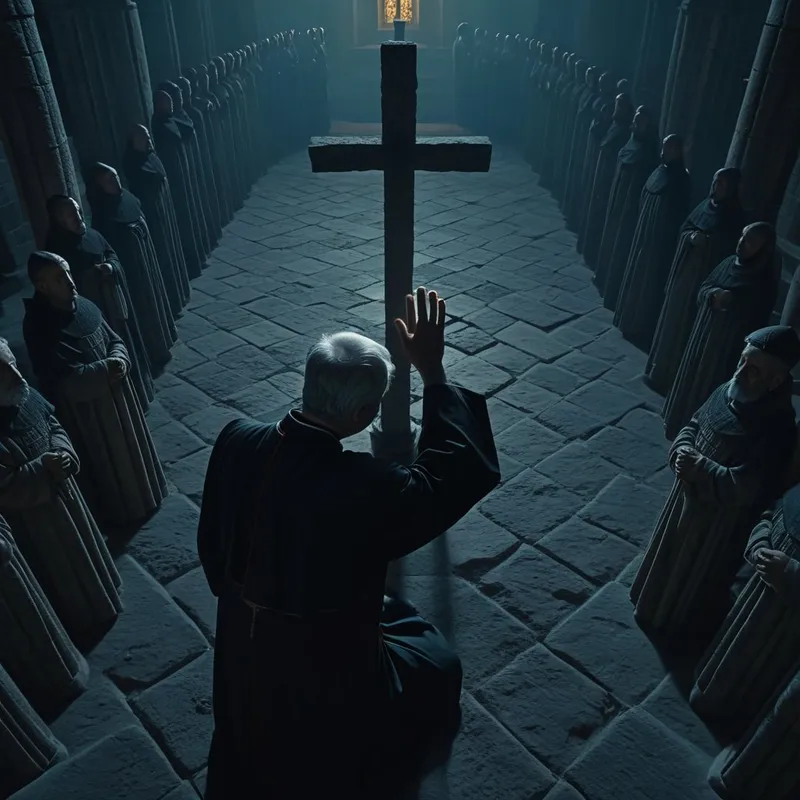
Listen, and feel the turn of the year. The carnival’s bright fire has guttered out; the masks of revelry lie discarded, hollow-eyed. A great, collective breath is held. The world holds still in the thin, grey light of a late winter dawn.
This is the day of the ash. Not the ash of a hearth, warm and spent, but the ash of the sacred pyre. It is the residue of last year’s palms, those green fronds of triumph now burnt black and ground to a fine, solemn dust. The priest, a figure of the threshold, takes this dust and mingles it with the oil of anointing. His hands, which will later raise the bread of life, are now stained with the grit of endings.
The people come. Not in festal robes, but in the clothes of everyday toil. They form a silent river flowing toward the sanctuary’s mouth. One by one, they kneel—the merchant with his ledgers, the mother with her worries, the child wide-eyed at the solemnity. No fanfare sounds. Only the whisper of wool on stone, the sigh of a bowed head.
The priest’s thumb, dipped in the gritty paste, descends. It is not a caress, but a seal. It touches the forehead, the seat of identity and thought, and traces upon it the starkest of signs: the cross. The touch is cool, granular. “Remember,” the voice intones, ancient and heavy as stone, “that you are dust, and to dust you shall return.”
The words hang in the air, a truth as physical as the mark itself. For a moment, each person wears their own mortality not as a distant fear, but as a present, sacred fact etched upon their skin. They feel the grit, smell the faint, smoky scent of burnt things. They rise, marked. The smudged cross is a public confession, a badge of humility that says, I am finite. I am flawed. I began from the clay of the earth.
And with this marking, the gate swings open. Not to a celebration, but to a wilderness. Forty days stretch ahead—a mirror of the forty days Christ spent in the desert, tested and hungry. This is Lent. The marked ones now turn their faces toward the interior desert, toward the silent confrontation with all that is not divine within them. The ashes are the first step on the long road back to the garden, a road that must pass through the acknowledgement of the dust from which we came, and to which we will, one day, return.

Cultural Origins & Context
The ritual of Ash Wednesday finds its roots not in a single moment of invention, but in a slow, deep sedimentation of ancient human practice. Its direct Christian lineage emerges from the early Church’s practice of public penance. In the first centuries, those who had committed grave, public sins were enrolled in a “order of penitents.” They would be sprinkled with ashes, dressed in sackcloth, and excluded from the Eucharist, living a life of prayer and fasting until they were reconciled on Maundy Thursday.
By the 11th century, this practice had evolved and expanded. What was once a rite for the grievously fallen became a rite for all the faithful, recognizing a universal human condition of sin and mortality. The blessing and imposition of ashes was formalized in the Roman liturgy. The ashes, specifically from the burnt palms of the previous year’s Palm Sunday, created a powerful liturgical loop—the symbols of triumphal entry become the symbols of penitential humility, connecting the cycle of the liturgical year into a coherent story of fall and redemption.
Societally, its function was profound. In an age where life was visibly fragile, Ash Wednesday served as a collective memento mori, a sanctioned space for the entire community to confront death together, thereby defanging its terror through shared ritual. It leveled social hierarchies; before the ashen cross, king and peasant shared the same mortal fate. It was the great societal pivot from the external excess of winter (Carnival) to the internal austerity of spring (Lent), aligning the human community with the rhythms of nature and the narrative of salvation.
Symbolic Architecture
The myth of Ash Wednesday is built upon a foundation of profound, paradoxical symbols. It is a ritual of confronting the ultimate limit to find the door to the infinite.
The acknowledgment of death is the first condition for truly living. To wear one’s ashes is to declare allegiance to reality itself.
The Ash is the primary symbol. It is the ultimate product of fire—the element of transformation and purification. It represents what remains when all that is volatile, illusory, and non-essential has been burned away. It is the bare, mineral truth of our physical existence. Yet, this truth is not left as a barren fact. It is mixed with Oil, the ancient symbol of the Holy Spirit, of consecration, healing, and kingship. The mixture creates a sacred paste: mortality anointed with spirit, limit infused with potential.
The Forehead is the place of imposition. It is the seat of the mind, identity, and will. To mark the forehead is to impress this truth upon the very organ of self-consciousness. It is a conscious, willing acceptance of one’s nature and limits.
The Cross drawn with this paste is the masterstroke of symbolic alchemy. It takes the symbol of ultimate humiliation and torture in the Roman world and transforms it, through Christ’s resurrection, into the symbol of victory over the very death the ashes proclaim. The ashen cross is thus a perfect paradox: it is the sign of death drawn with the substance of death, yet it points to the conquest of death. It is a map of the journey—through the valley of the shadow, toward the dawn.

The Dreamer's Resonance
When the imagery of Ash Wednesday surfaces in modern dreams, it rarely appears as a church ritual. Instead, it manifests as the underlying psychological process the ritual encodes. To dream of ash smeared on one’s skin, of being marked with a gritty substance, or of confronting a solemn figure who speaks of dust, is to dream of a profound moment of ego-reckoning.
The dreamer is likely at a point of existential inventory. Perhaps a lifestyle, relationship, or self-image has run its course, its energy “burnt out,” leaving only the “ash” of its memory and consequence. The dream marks the beginning of a necessary, if uncomfortable, period of introspection—a psychic Lent. The somatic feeling is often one of grit, dryness, or being soiled. This reflects the psyche’s registration of confronting shadow material, the “dirty” or “dead” aspects of oneself one has avoided.
This dream motif signals that the conscious personality is being called to acknowledge its own finitude and flaws. It is the unconscious insisting, “You are not the perfect, eternal persona you project. Something must be released, must die, for new growth to occur.” The dream is an invitation to a voluntary descent, to stop running from the facts of one’s limitations and instead, to sanctify them by making them conscious.

Alchemical Translation
The journey of Ash Wednesday models the initial, crucial phase of psychic individuation: the nigredo, or blackening. In alchemical terms, this is the stage of putrefaction and mortification, where the base material is broken down to its essential components. For the modern individual, this is the conscious, willing descent into one’s own shadow.
The alchemist does not flee from the blackness of the nigredo; they understand it as the fertile soil from which the gold will grow. So too must the psyche embrace its own ashes.
The ritual provides a container for this terrifying process. First, one must present oneself (kneeling before the priest/conscience). Then, one must receive the mark (consciously accept the truth of one’s mortality and moral complexity). This acceptance is not nihilism; it is the gritty, raw material of transformation. The ashen cross on the forehead is the ego’s agreement to undertake the work.
The subsequent forty days of Lent translate to the sustained discipline of introspection, fasting from psychic inflation (pride, greed, illusion), and feeding on the sparse but potent nutrients of self-honesty and prayer (dialogue with the Self). The goal is Easter—the albedo (whitening) and rubedo (reddening)—which in psychological terms is the integration of the shadow and the conscious realization of a more complete, authentic Self, reborn from the acknowledged dust.
Thus, the myth of Ash Wednesday teaches that enlightenment does not begin with light, but with the courageous embrace of the dark, fertile dust of our own being. We are not called to escape our humanity, but to pass through its very heart, anointed with the ashes of our truth, to find the divinity woven into the fabric of the dust itself.
Associated Symbols
Explore related symbols from the CaleaDream lexicon: