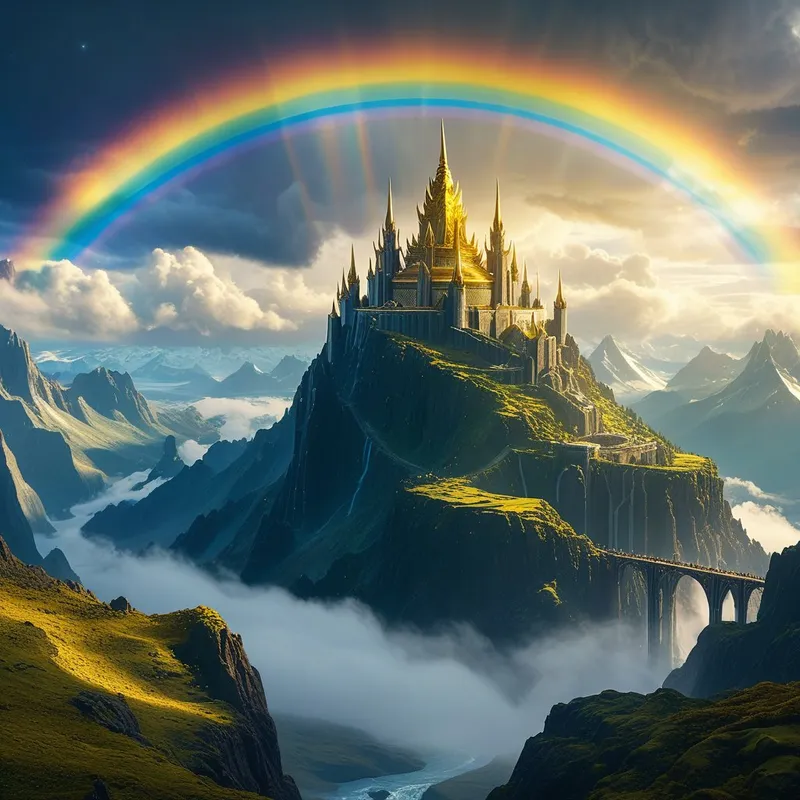
Asgard Myth Meaning & Symbolism
The celestial fortress of the Aesir gods, a realm of divine order, wisdom, and power, destined to fall in a final, world-renewing battle.
The Tale of Asgard
Listen, and hear of the realm that hangs in the high branches of the Yggdrasil, where the roots of the world drink from wells of memory and fate. It is not a place for mortal feet. It is Asgard, the Enclosure of the Aesir, a citadel of power and wisdom raised from the very bones of the earth.
In the dawn of things, after the gods had shaped the world from the giant Ymir, they built their fortress. Its walls were to be the mightiest in all the Nine Worlds, a bulwark against the chaos of Jotunheim and the slow gnawing of time itself. But the task was beyond even their strength. Then came a stranger, a master builder from the lands of the giants, who offered a bargain: build me the walls in one winter, and my price is the sun, the moon, and the goddess Freyja as my bride.
The Aesir laughed, thinking the task impossible. But Loki, ever the whisperer, convinced them to agree, adding one condition: the builder could use no man’s help. The stranger agreed, and the work began. To the gods’ dread, his stallion, Svadilfari, hauled stones of such size and with such speed that as the final days of winter approached, the walls neared completion. Panic seized Asgard. They had gambled the very lights of the sky and the heart of their kin.
The gods turned on Loki, who had made the pact. “Fix this,” they commanded, their voices like cracking ice. So Loki transformed into a sleek, alluring mare and lured the mighty stallion away into the dark woods. The builder, robbed of his strength, flew into a giant’s rage, revealing his true nature. And in that moment, Odin called for Thor, whose hammer Mjolnir fell like the first and last thunder, shattering the giant’s skull. The walls stood, incomplete but impregnable, paid for in deception and blood.
Thus Asgard stood complete, a realm of shining halls: Valhalla, where the chosen dead feast; Folkvangr; and Himinbjorg, where the watchman Heimdall stands eternal guard at the gate. It is connected to the world of men by the trembling, rainbow bridge Bifrost. Here, the gods hold council at the Well of Urd, drinking from the mead of poetry and wrestling with prophecies whispered by the Norns. They know, in their golden halls, that their order is not eternal. They feel the chill breath of Ragnarok in the air, hear the howling of the bound wolf Fenrir, and see the serpent Jormungandr stirring in the deep. Asgard is a glory, a triumph of will over chaos, but it is a glory awaiting its twilight.
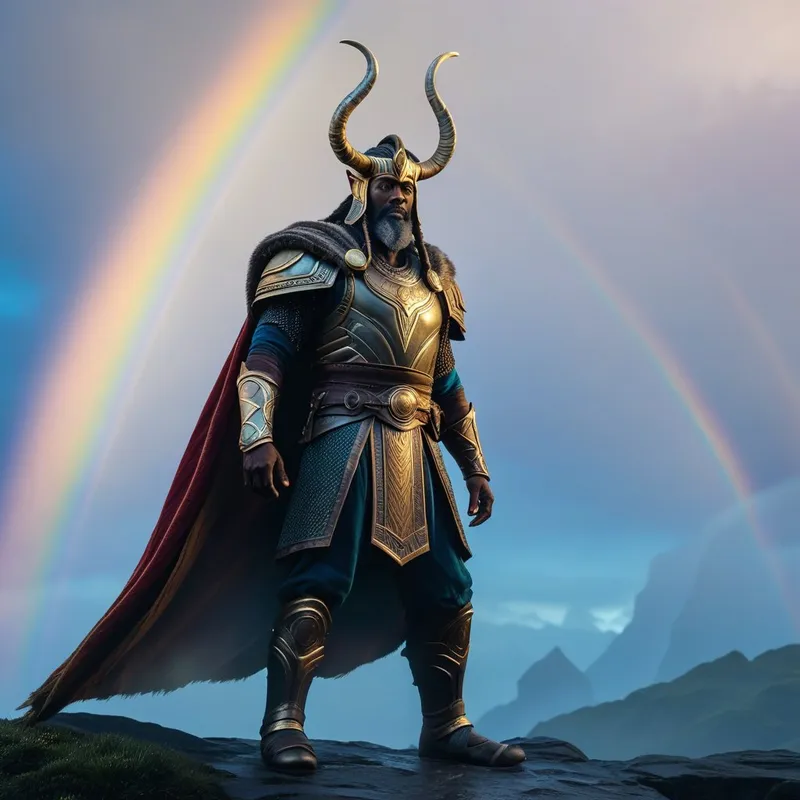
Cultural Origins & Context
The myth of Asgard was not scripture, but living breath and fire, passed down through the oral traditions of the Viking Age and earlier Germanic peoples. It was told by skalds—poet-historians—in mead halls flickering with torchlight, their verses weaving history, law, and cosmic principle into one tapestry. These stories functioned as a cultural compass. Asgard, the divine fortress, modeled the ideal of the garðr—the enclosed, ordered homestead—projected onto a cosmic scale. It reflected a society that valued strength, wisdom, cunning, community, and a clear demarcation between the inner circle (innangard) and the outer wilderness (utangard).
The primary sources, the Poetic Edda and the later Prose Edda by Snorri Sturluson, were recorded in 13th-century Iceland, a Christian society preserving its pagan past. This context is crucial; the myths were already becoming history, their ritual function fading, but their symbolic power enduring. Asgard’s story served to explain the nature of divine authority (flawed, contractual, maintained by force and guile), the inevitability of conflict, and the sober, tragic understanding that even the highest order must one day face its dissolution.
Symbolic Architecture
Asgard is not merely a place; it is a psychic structure. It represents the pinnacle of conscious achievement—the fortified citadel of the ego and the cultural superego. Its high walls symbolize the boundaries we erect to define self, values, and civilization against the undifferentiated chaos of the unconscious (the giants, the wilds of Ginnungagap).
The fortress, built on a broken bargain, reminds us that no conscious order is born purely. It is always founded on some repressed force, some exiled instinct—here, the raw strength of the giant and his steed, tricked and destroyed.
The gods themselves are archetypal functions within this psychic citadel: Odin is the questing intellect and sovereign will; Thor is the potent force of action and defense; Heimdall is the acute faculty of perception and warning. Yet, their home is incomplete, its foundation stained by the betrayal of Loki, the archetype of the shadow—the trickster, the chaotic, inventive, and amoral energy necessary for survival but impossible to fully integrate into the walls of polite consciousness. Asgard thus embodies a profound psychological truth: the ego-complex, however glorious, is inherently unstable, aware of its own contested origins and its inevitable confrontation with the suppressed elements it walls out.

The Dreamer's Resonance
When Asgard appears in modern dreams, it rarely manifests as a literal Viking fortress. Instead, one may dream of an impossibly pristine skyscraper, a flawless institution, a perfect family home, or an idealized self-image—any structure that represents a hard-won, highly defended state of order and identity. The dream narrative often involves threats to this structure: cracks in the walls, invaders at the gate, or an internal sense of the foundation being unsound.
Somatically, this can correlate with feelings of rigidity, armoring, or chronic anxiety—a hyper-vigilance guarding a perceived integrity. Psychologically, the dreamer is experiencing the strain of maintaining a conscious attitude that has outlived its adaptability. The "giants" at the gate are often unruly emotions, neglected talents, or life changes that the old "walls" cannot withstand. The dream of Asgard under siege is the psyche’s announcement that a period of defended stability is ending; the unconscious is demanding recognition, and a re-negotiation of the boundaries of the self is imminent.
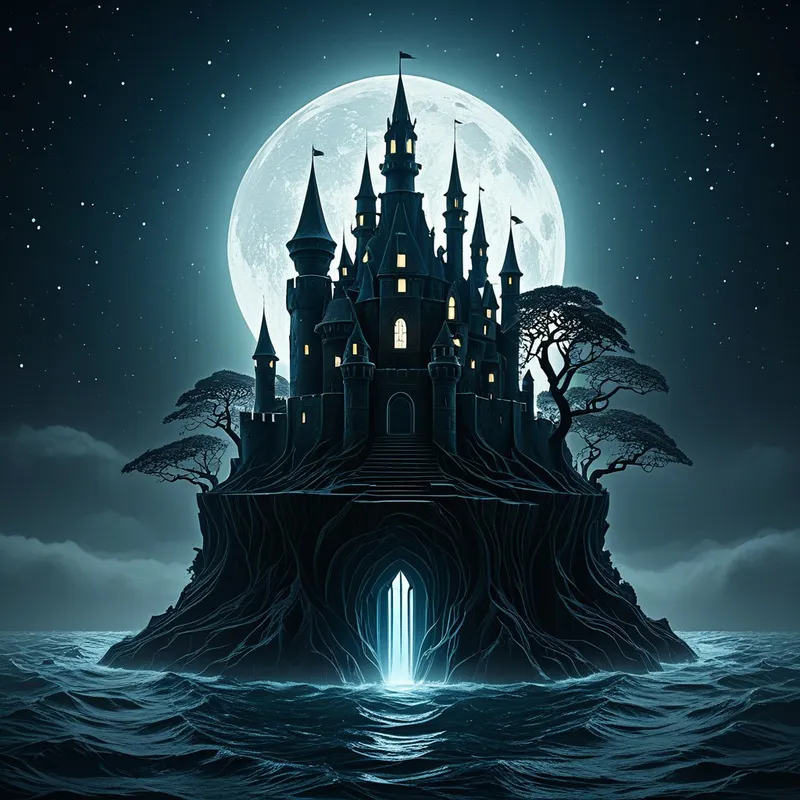
Alchemical Translation
The myth of Asgard models the alchemical process of psychic transmutation, specifically the stage of coagulatio—the formation of a stable, conscious structure—and its necessary dissolution in the mortificatio that precedes renewal. The individual’s journey is not to build an eternal Asgard, but to learn the cycle of building, dwelling, and surrendering.
First, we must build our citadel: establish a coherent identity, values, and life structure. This is necessary work. But the myth warns us to acknowledge the shadow (Loki’s bargain) in its construction—the compromises, denials, and raw instincts we used as fuel. Then, we must dwell within it not in naive security, but like Odin at the Well of Urd, with one eye on the depths of fate, aware of its temporality.
True individuation requires the courage to be Heimdall, to sound the horn not only at the final battle, but at the first sign of inner rigidity, calling the self to its own necessary transformation.
The ultimate alchemical lesson of Asgard is in its destiny: Ragnarok. The fortress falls, the gods battle their shadows, and the world is consumed by water and fire—only to be reborn, green and new. Psychically, this translates to the collapse of an outmoded ego-structure in a period of profound crisis. It is not failure, but a horrific, necessary descent that clears space for a more authentic, more inclusive consciousness to emerge from the waters. We are not meant to be eternal rulers of a static realm, but participants in an eternal cycle of ordering, dissolving, and re-ordering—building our Asgards, knowing we must one day, for the sake of new life, let them burn.
Associated Symbols
Explore related symbols from the CaleaDream lexicon: