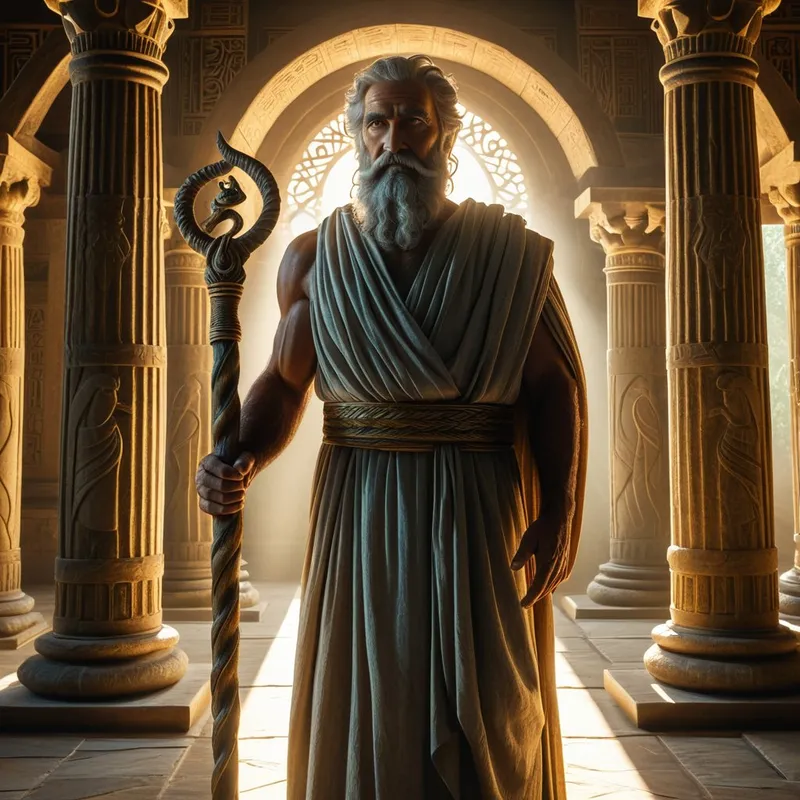
Asclepius' Staff Myth Meaning & Symbolism
The myth of the divine healer Asclepius and his staff entwined with a serpent, a symbol of sacred medicine born from transgression and divine wrath.
The Tale of Asclepius' Staff
Hear now the tale not of a blade that cleaves, but of a staff that binds. It begins not in the golden halls of Olympus, but in the mortal realm, stained with blood and the scent of crushed herbs. It begins with a cry—the cry of a mother, Coronis, pierced by the arrows of Artemis, her betrayal of the great Apollo laid bare. From her funeral pyre, as the flames licked the sky, the god of light himself reached in. He did not seek a weapon, but a promise. From the womb of the dying woman, he plucked the unborn child, Asclepius.
The boy was given to the centaur Chiron, not to learn the arts of war, but the deeper arts of the earth. In the shadowy caves of Mount Pelion, Chiron taught him the language of roots and leaves, the whispers of the blood, the songs of mending bone. Asclepius listened with more than his ears; he listened with his hands, his spirit. He learned that life and death were not kingdoms, but a single, flowing river. And in his hand, he carried a simple staff, a walking stick of gnarled wood, a companion for his journeys to the sick and wounded.
But the pupil’s thirst outgrew the master’s wisdom. Asclepius walked the line between the realms. He did not just ease passing; he halted it. A potion here, a whispered incantation there, and the breath would return to stilled lungs. The dead walked again. The river of souls, which must only flow one way, began to eddy and swirl backwards at his touch. The Lord of the Dead looked up from his silent throne, his halls growing no fuller. A fundamental law was being broken. The balance of the world itself trembled.
The complaint reached the ear of Zeus. The Father of Gods and Men looked down upon the healer, this mortal-born demigod who dared to steal from the final treasury. There was no malice in Asclepius, only a compassion so vast it became a transgression. For the order of the cosmos, for the necessary boundary between what is and what was, Zeus raised his hand. A single, blinding bolt of thunder cleaved the sky. It found Asclepius on the island of Kos, perhaps in the very act of lifting a soul back into the light. The healer fell, his staff clattering to the stone beside him.
Yet, the story does not end in ash. In the wake of wrath, there is often apotheosis. Moved by the pure intent of his son, Apollo pleaded, and Zeus, in his sovereign wisdom, relented. Asclepius was lifted from the realm of men, his essence placed among the stars as the constellation Ophiuchus, the Serpent-Bearer. And his staff? It was never just wood. It was the axis of his wisdom. And to it, a serpent—the very creature that had taught him the secret of a resurrecting herb by bringing another serpent back to life—came and coiled itself, not as a threat, but as an eternal companion. The staff became the symbol. Not of death defied, but of the sacred, perilous, and transformative power of healing that walks the razor’s edge between life and the great mystery.

Cultural Origins & Context
The myth of Asclepius is not a singular tale from one poet, but a living tradition that grew from the deep soil of Greek religious practice. It was told and retold in the hymns of poets, in the teachings of priests at his healing sanctuaries, the Asclepieia. The most famous of these were at Epidaurus, Kos, and Pergamon. Here, the myth was not mere entertainment; it was a foundational charter. It explained the divine origin of the healing arts and established the god’s authority, born of both Apollo’s lineage and Chiron’s tutelage.
The story was passed down through ritual. Sufferers would undergo katharsis, make offerings, and then sleep in the sacred abaton. In their dreams, Asclepius or his sacred serpent might appear, offering a diagnosis or cure. The myth provided the framework for this incubatio, explaining why this god, who had himself transcended death, held the power to mediate between sickness and health. His staff, often depicted with a single serpent, stood as the central icon of this cult—a symbol of safe passage, divine knowledge, and the thin, permeable veil between the mortal body and the forces that sustain or afflict it.
Symbolic Architecture
At its core, the myth presents a profound paradox: the healer must be destroyed to be fully realized. The staff is the axis of this symbolism.
The Staff itself represents stability, support, and the vertical axis connecting the human realm to the divine. It is the backbone of the healer, the walking aid for a long journey, and the rod of authority. It is structure, tradition, and the conscious application of learned skill.
The Serpent is the quintessential symbol of transformation, rebirth, and chthonic wisdom. It sheds its skin, it moves between worlds (above and below ground), and in its venom lies both death and, in the right measure, the antidote. It represents the unconscious, instinctual, cyclical forces of life that defy linear, rational order.
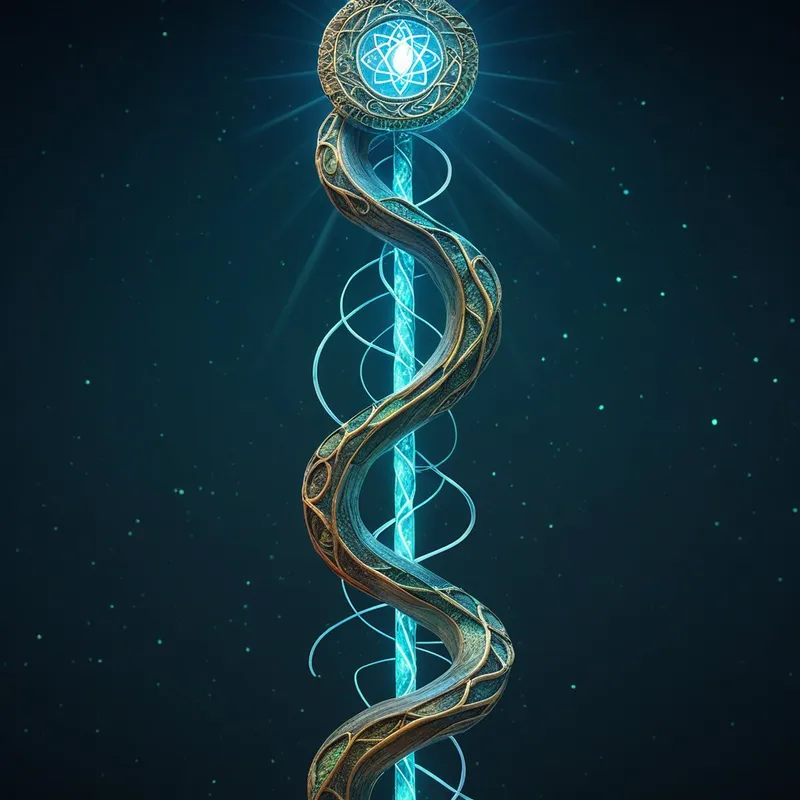
The Rod of Asclepius is the sacred marriage of the vertical and the spiral, the conscious skill and the unconscious life-force, the law and the transgression that renews it.
Asclepius’s Transgression—raising the dead—is not evil, but hubris born of ultimate compassion. It symbolizes the healer’s dangerous identification with the healing power, believing oneself to be the source rather than the vessel. The Thunderbolt of Zeus is the necessary correction, the brutal re-establishment of cosmic law. It is the shattering of the ego that believes it can conquer death, making way for a more profound, integrated wisdom. His Apotheosis signifies that the true healing principle is not personal, but archetypal; it becomes a eternal force available to all who approach with reverence, not a personal power to be wielded.
The Dreamer's Resonance
When this myth stirs in the modern dreamer, it often signals a profound process of psychic healing that feels both sacred and perilous. To dream of the staff, especially with the serpent, may indicate the dreamer is attempting to integrate a powerful, instinctual, or previously hidden (chthonic) aspect of themselves into their conscious identity—their own "healing wisdom."
Dreams of being struck by lightning in a context of helping or curing may reflect the shock of realizing one’s own limits, the burnout of the caregiver who has over-identified with their role. Dreams of encountering a serpent that is not threatening, but observant or entwined, can point to the emergence of transformative energy from the unconscious, offering the potential for renewal if approached without fear. The dream may be somatic, featuring sensations of spinal alignment (the staff) or skin shedding (the serpent), marking a physical correlate of psychological integration. The core resonance is the tension between the drive to make whole (to heal, to fix, to save) and the crushing, necessary acceptance of natural law, limitation, and the ultimate mystery that defines our mortal condition.
Alchemical Translation
For the individual on the path of individuation, the myth of Asclepius’s staff models the alchemical process of solve et coagula—dissolve and coagulate. The initial stage is the Apprenticeship (Coagula): we learn the skills, build the ego-structure (the staff), and develop our conscious capacity to manage life’s wounds. This is our work with Chiron, our personal centaur, integrating worldly knowledge and discipline.
The crucial, dangerous stage is the Transgressive Healing (Solve): identified with our healing power, we attempt the impossible—to resurrect the dead parts of our psyche (old traumas, lost potentials) by sheer will or technique. We try to "fix" the unfixable, deny necessary endings, or carry burdens that are not ours to bear. This inflation invites the lightning bolt: a crisis, a devastating failure, a depression, an illness—a shattering of the ego’s pretensions.
The lightning bolt does not destroy the healer; it forges the archetype. It dissolves the personal claim to the power, so the power itself can shine through.
The final stage is Sacred Integration: the apotheosis. The shattered ego, humbled, becomes a vessel. The staff remains, but now the serpent of transformative, unconscious wisdom is permanently coiled around it. The healer within is no longer a personal hero, but an inner archetype of the Senex connected to the life force. We no longer "play god" with healing; we create a sacred space (the inner Asclepieion) where the conflicting forces of life and death, conscious and unconscious, can commune, and where transformation is allowed to proceed according to a deeper, more mysterious law than our will. The staff becomes our inner compass, and the serpent, our guide into the depths where true wholeness is born.
Associated Symbols
Explore related symbols from the CaleaDream lexicon: