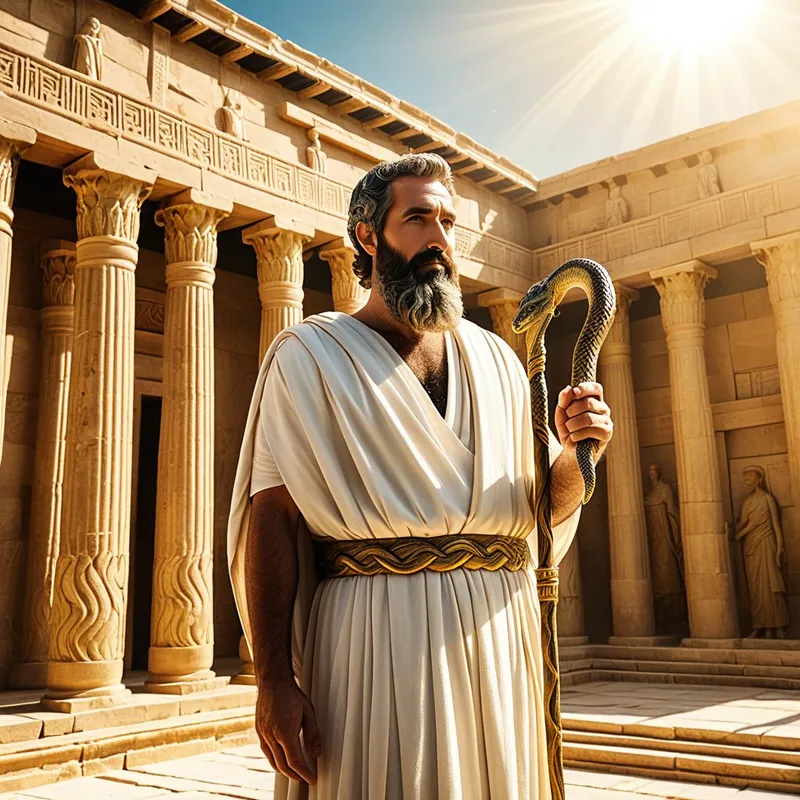
Asclepius' Caduceus Myth Meaning & Symbolism
The story of the divine healer Asclepius, his serpent-entwined staff, and the forbidden power to restore life, bridging mortality and divinity.
The Tale of Asclepius' Caduceus
Hear now the tale of the staff that holds life and death in its coil, a story whispered in the steam of medicinal springs and carved into the walls of dreaming sanctuaries. It begins not with a man, but with a cry of pain—the cry of Coronis, struck down by the silver arrows of Artemis for her betrayal. From her funeral pyre, the great Apollo snatched his unborn son, Asclepius, and delivered him into the hands of the wise centaur, Chiron, in the shadowy depths of Mount Pelion.
There, in a cave smelling of damp earth and drying herbs, the boy grew. He learned the songs of the body from Chiron—the language of fever, the poetry of pulse, the secret names of every root and leaf that could soothe or sting. His hands became sensitive to the hum of life beneath the skin. Yet, for all his skill, death remained the final, silent master, the boundary he could not cross.
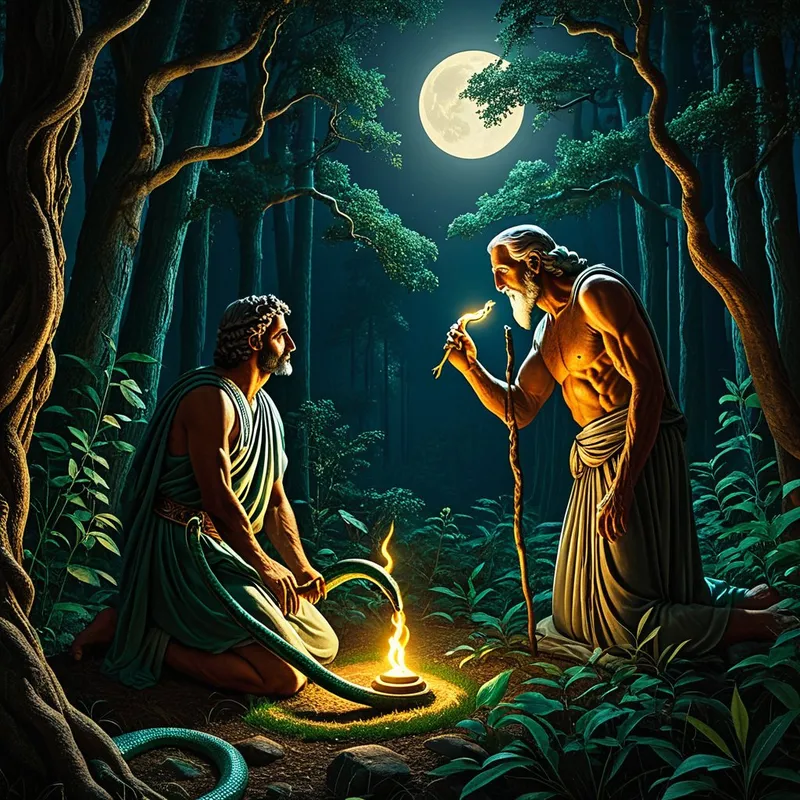
The turning point came not in the cave, but in a twilight grove. Asclepius walked, pondering a hopeless case, when his eye caught a glint of scale. A serpent, a creature of the earth, slid toward its companion, which lay stiff and lifeless. In its mouth, it carried a strange, dark herb. Gently, it placed the herb in the dead serpent’s mouth. Moments stretched. Then, a shudder, a ripple of muscle, and the lifeless serpent stirred, sloughing off its old skin to emerge reborn. In that sacred, silent transaction, Asclepius witnessed the mystery: death was not an end, but a skin to be shed. Life could be recalled.
From that day, the serpent coiled itself around his rough-hewn staff, not as decoration, but as a living partner. With this Caduceus in hand, Asclepius’s power transcended. He did not merely treat; he resurrected. The news spread like wildfire—the healer in Epidaurus could call souls back from the misty banks of the Styx. The lame walked. The blind saw. And some, it was said, awoke from death’s cold sleep.
This was the glory, and this was the trespass. The cosmic order trembled. Hades, lord of the silent majority, stood before the throne of Zeus, his voice a hollow echo of grievance. “My realm is plundered! The balance between your bright Olympus and my dark kingdom is broken.” Zeus, arbiter of all fate, looked down. The healer’s gift had become a challenge to the very architecture of mortality. In a flash of world-shattering light, a thunderbolt forged in divine necessity descended. It found Asclepius, his Caduceus raised not in defiance, but in a final, futile act of preservation.
The healer fell. Yet, from the smoke and sorrow, Zeus, in a moment of paradoxical mercy, lifted the slain man’s essence and placed it among the stars, as the constellation Ophiuchus. The serpent-entwined staff remained, a symbol forever caught between the miracle of life recalled and the ultimate law of life surrendered.
Cultural Origins & Context
This myth was not merely a story for the ancient Greeks; it was a lived reality centered in the Asclepieia. These were the hospitals and psychotherapy centers of their time, most famously at Epidaurus, Cos, and Pergamon. The myth was propagated through ritual, votive offerings, and sacred dramas performed for pilgrims seeking healing. It was told by priests and iamata—stone inscriptions detailing miraculous cures—to validate the god’s power and guide the hopeful.
Its societal function was profound. It provided a theological framework for medicine, positioning healing as a divine art learned from chthonic (earthly) wisdom (the serpent) and celestial order (Apollo). It also managed the existential terror of death by offering a narrative where the boundary could be challenged, yet ultimately reaffirmed the supreme authority of Zeus’s cosmic law. The myth thus served as a container for hope, a explanation for limitation, and a sacred legitimization of the emerging medical arts.
Symbolic Architecture
At its core, the Caduceus is an axis mundi—a world pillar—around which the great paradox of existence spirals. The staff is the spine of the healer, his unwavering principle and grounded skill. The single serpent is the embodiment of the chthonic, cyclical wisdom of the earth: healing, regeneration, and the poison that, in correct measure, becomes the cure.
The serpent does not conquer the staff, nor the staff the serpent. They exist in a dynamic embrace, a sacred marriage of structure and fluidity, consciousness and instinct.
Asclepius himself represents the archetype of the Wounded Healer par excellence. Born from death (his mother’s pyre), his entire vocation is a compensation for that primal wound. His quest to defeat death is ultimately a quest to heal his own origin. His transgression is not of malice, but of excessive compassion—the caregiver’s shadow, where the desire to save oversteps the natural order and incurs the necessary, tragic correction from the ruling principle (Zeus).
The Dreamer's Resonance
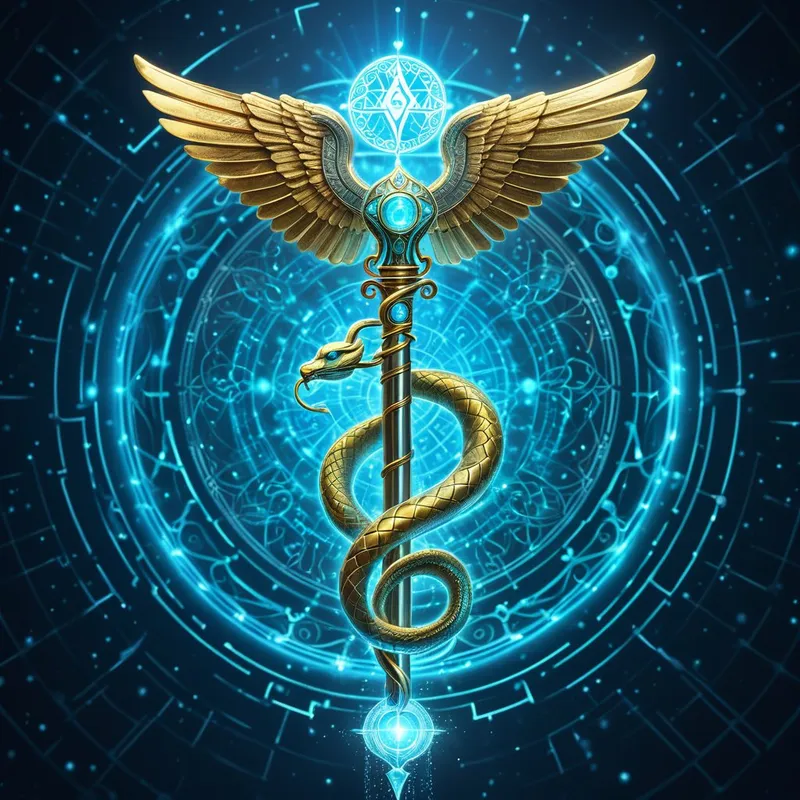
To dream of Asclepius’ Caduceus is to dream of a profound somatic and psychological crisis point. The dreamer is likely in a state of acute illness, deep grief, or facing a “death” of an old identity, relationship, or life phase. The serpent coiled around the staff in the dreamscape signals that the healing intelligence is already at work within the unconscious, often in ways that feel alien or unsettling (the serpentine).
The dream may present images of shedding skin, finding a staff or rod in a wilderness, or encountering a serene, authoritative healer figure. This is the psyche’s own incubation ritual, akin to those in the Asclepieia. The process is somatic: the body-mind is attempting to slough off what is dead (depression, addiction, trauma) to make way for a renewed state of being. The danger mirrored in the myth is the dreamer’s potential identification with the healer archetype—a narcissistic belief that they can or should “cure” everything, including the necessary endings in their own life or the lives of others, without paying the price.
Alchemical Translation
The myth of Asclepius models the alchemical process of individuation—the journey toward psychic wholeness—with startling precision. The initial nigredo, or blackening, is the death of Coronis and Asclepius’s wounded origin. His apprenticeship with Chiron represents the albedo, the whitening, where conscious skills (the staff) are painstakingly learned.
The crucial turn is the citrinitas, the yellowing, symbolized by the grove revelation. This is the moment of insight where the conscious mind (Asclepius) humbly observes the autonomous, instinctive wisdom of the unconscious (the serpent) performing the miracle of regeneration. Integrating this insight—coiling the serpent around the staff—is the act of uniting the ego with the transformative power of the deep Self.
The thunderbolt of Zeus is not merely punishment, but the necessary mortificatio that prevents inflation. It is the realization that total control over life’s processes—including one’s own neuroses, suffering, and eventual death—is an illusion. The final stage, the rubedo or reddening, is his catasterism as Ophiuchus. The healed healer is not destroyed but elevated, integrated into a larger, cosmic order. His power is no longer personal but archetypal.
For the modern individual, this translates to the healing journey. We must develop our staff (our discipline, our therapy, our practice), but we must also learn to listen for the serpentine wisdom of the body and the unconscious, which works in cycles of death and rebirth. The ultimate triumph is not in cheating death, but in achieving the symbolic immortality of wholeness—accepting our place in the great cycle, having fully served the healing principle, even within our own mortal limits.
Associated Symbols
Explore related symbols from the CaleaDream lexicon: