As Above, So Below Myth Meaning & Symbolism
The axiom that the cosmos is mirrored in the soul, and the soul in the cosmos, revealing the path of psychic wholeness through symbolic reflection.
The Tale of As Above, So Below
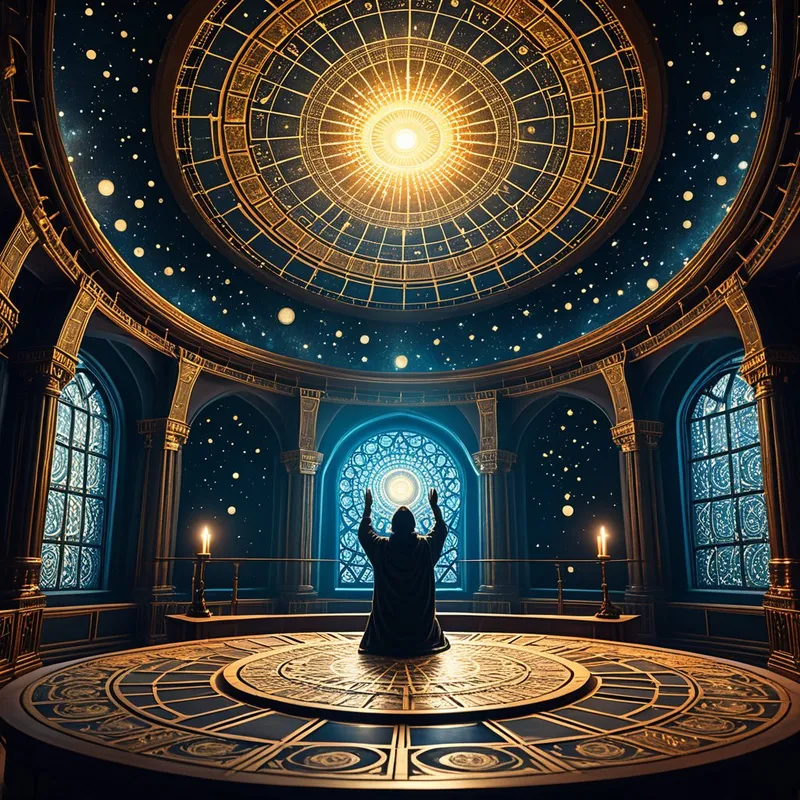
Listen, and hear the whisper that binds the All. It does not begin with a king or a battle, but with a silence so deep it becomes a hum—the primordial vibration between the Above and the Below. In a chamber lit only by the cold fire of stars through an oculus and the warm glow of a crucible, the Adept works. The air is thick with the scent of sulfur and longing, of mercury and memory.
The Adept’s quest is not for gold, but for the Key. The world is fractured. The heavens wheel in majestic, indifferent silence. The earth groans with weight and decay. The human soul, a spark caught between, feels this schism as a perpetual ache. The Adept gazes upward, tracing the paths of the Wandering Stars. They see order, music, divine mathematics. They look downward into the Alembic, where base matter seethes in chaos—a dark, formless Prima Materia.
For years, this is the rhythm: observation, separation, failure. The Above remains distant; the Below, stubborn. Then, on a night when Saturn conjoins with the Moon in the sign of the Rebis, a moment of exhaustion becomes revelation. The Adept, polishing the concave mirror used to catch starlight, sees not his own weary face, but a perfect, miniature inversion of the constellation above him captured in the bowl of the instrument.
A shock, electric and silent, courses through the stone chamber. The Adept understands. He does not need to reach for the stars nor force the earth. He must become the mirror. He takes the volatile Sulfur and the fixed Salt, and in the mediating bath of Mercury, he witnesses it. The reaction in the flask below does not mimic the stars—it is the same pattern, writ small. The spiraling ascent of vapors is the same as the descent of celestial influence. The coagulation of the Red Tincture is the birth of a new star within the dark earth of the vessel.
The conflict was an illusion of perspective. The resolution is the still point of recognition. The axiom is not commanded but revealed: That which is above is as that which is below, and that which is below is as that which is above, for the performance of the miracles of the One Thing. The chamber hasn’t changed, but the Adept sees it anew. Every cobweb in the high corner echoes a nebula. Every root cracking the foundation stone below mirrors a branching lightning bolt in the sky. The schism heals in the perception. The work is complete not when the stone is made, but when the world is seen as whole.
Cultural Origins & Context
The dictum “As Above, So Below” is the foundational principle of Hermeticism, crystallized in the opening lines of the Emerald Tablet. Its origins are shrouded in the syncretic cultures of Hellenistic Egypt, where Greek philosophy, Egyptian temple wisdom, and Near Eastern astral lore fermented together. It was not a myth told in bardic circles but a secret doctrine passed from teacher to initiate in the twilight spaces between temple, library, and workshop.
The “Alchemical” culture referenced here is not of a single nation, but a transnational fraternity of the mind—the practitioners of the Magnum Opus. They were often monks, physicians, and natural philosophers operating at the edges of sanctioned knowledge. The myth was transmitted through encoded manuscripts, symbolic illustrations (Mutus Liber), and oral tradition. Its societal function was subversive and integrative: it provided a holistic model of reality that challenged the growing Cartesian split between spirit and matter. It asserted that the laws governing the cosmos were the same laws governing the human soul and the growth of a plant—a radical doctrine of unity in an age increasingly fond of categories and divisions.
Symbolic Architecture
The myth’s power lies in its elegant, recursive symbolism. It presents a model of reality not as a hierarchy but as a hologram, where every part contains the pattern of the whole.
The microcosm is not a slave to the macrocosm, but its living signature. To know one is to know the other.
The Above symbolizes the realm of archetypes, cosmic patterns, the collective unconscious, and the ordering principles of the mind (Logos). The Below symbolizes the realm of manifestation, the body, the personal unconscious, the chthonic depths, and the raw material of experience (Eros). The Adept represents the conscious ego, the mediating principle that feels itself torn between these two poles. The crucible or Alembic is the vas, the sacred vessel of the psyche itself, where this tension is contained and transformed.
The ultimate symbol is the Rebis, the divine hermaphrodite, which is the result of the union. It is the integrated Self, where the celestial and the terrestrial, the masculine and feminine, spirit and matter, are reconciled into a new, conscious entity. The “One Thing” referenced is the unitary substance of reality, the Anima Mundi, in which all apparent dualities participate.
The Dreamer's Resonance
When this myth stirs in the modern unconscious, it often manifests in dreams of mirrored spaces, vertiginous architecture, or profound synchronicity. A dreamer may find themselves in a library where the books on the shelves are galaxies, or in a basement that opens into a vast, star-filled cavern. They may look into a puddle and see not their reflection, but a constellation, or witness two events in the dream—one mundane, one majestic—that unfold in perfect, symbolic parallel.
Psychologically, these dreams signal a process of recognition. The conscious mind (the Adept) is beginning to perceive the deep, isomorphic patterns between an internal psychic state and an external life situation. A conflict at work (Below) may be mirroring an unresolved parental complex (Above). A somatic symptom may be the body’s literal enactment of an emotional truth the mind has refused. The dream is an invitation to stop trying to solve the problem on only one level and to seek the unifying pattern. The disorientation (the infinite corridor) is the necessary dissolution of old, fragmented perception before a new, holistic understanding can coagulate.

Alchemical Translation
For the modern individual, the alchemical translation of this myth is the core of Jungian Individuation. The process is one of psychic transmutation through reflective awareness.
The work is not to ascend out of the body or to perfect the spirit in isolation, but to discover the spirit informed in the body, and the body illumined by the spirit.
First, Observation (Separatio): We must consciously acknowledge the felt split—the spiritual yearning versus earthly burdens, the ideal self versus the shadow, the mind versus the body. This is the Adept seeing the separate stars and the base matter.
Second, Containment (Solutio & Coagulatio): We must hold this tension in the vessel of conscious attention (therapy, meditation, creative work, relationship) without fleeing to one pole or the other. This is the heating and cooling in the Alembic.
Third, Conjunction (Coniunctio): Through sustained reflection, we begin to see the patterns. Why does this relationship dynamic repeat? How is this anxiety mirrored in my posture? This is the moment the star reflects in the mirror. The inner child (Below) and the inner critic (Above) are seen as two expressions of one wound.
Finally, Projection of the Stone: The integrated insight—the “stone”—is then not a physical object, but a new way of being. One acts in the world with the understanding that inner work (Below) alters one’s reality (Above), and that engaging with reality (Above) is the necessary catalyst for inner change (Below). The individual becomes the living embodiment of the axiom, a conscious participant in the miracle of the One Thing, where every choice, every feeling, and every thought is recognized as a note in a symphony that plays simultaneously in the heavens and in the heart.
Associated Symbols
Explore related symbols from the CaleaDream lexicon: