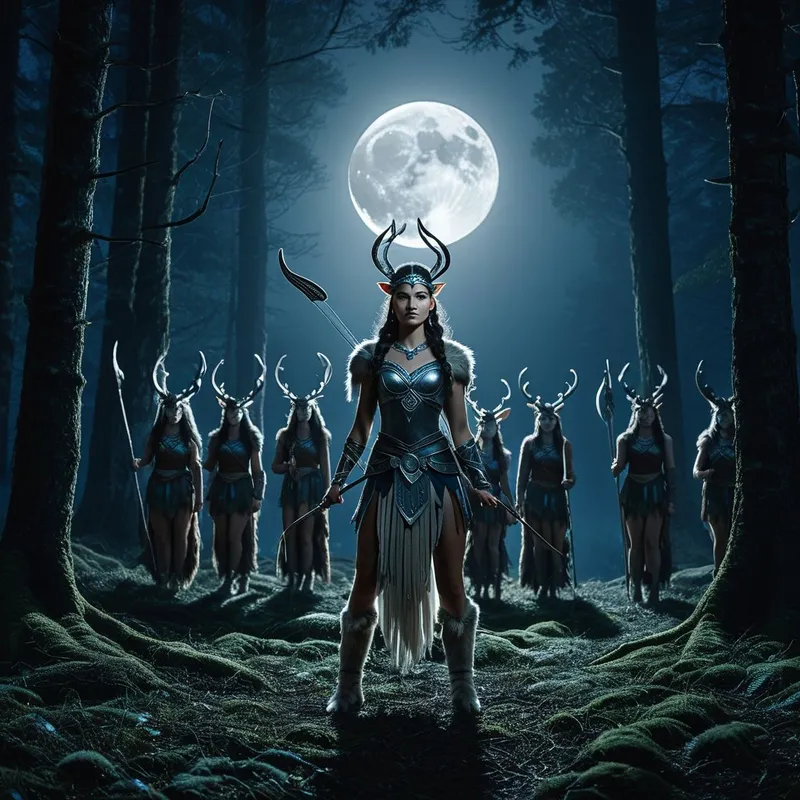
Artemis's Hunters Myth Meaning & Symbolism
A sacred band of nymphs and maidens sworn to Artemis, living in the untamed wild, embodying fierce independence, purity, and the untamed feminine spirit.
The Tale of Artemis's Hunters
Listen, and hear the rustle in the sacred grove. The air is cold and sharp with the scent of pine and damp earth. The moon, Selene, pours her silver milk upon the world, and in her light, a figure moves. She is Artemis, daughter of Zeus and Leto, and she is never alone.
From the whispering streams come the Naiads. From the deep forests step the Dryads, their skin like dappled bark. From the mountain slopes descend mortal maidens, their hearts weary of city walls and the promises of men. They gather around her, a silent, solemn congregation. Artemis lifts her silver bow, an arc of captured moonlight. "Who comes to the wild?" her voice echoes, clear and unforgiving as a mountain spring. "Who chooses the trackless path over the paved road? Who vows to run with the stag, to know the hawk's cry, and to hold your own soul inviolate?"
One by one, they step forward. A princess flees an arranged marriage. A nymph seeks freedom from a pursuing god. A shepherdess whose spirit is too vast for the pasture. They kneel on the moss. The vow is not spoken; it is breathed into the night. It is a promise of independence, of a life untamed and unowned. To remain forever a parthenos. To honor the wild things. To be swift, loyal, and fierce. To belong only to the goddess and the wilderness.
Their days are a rhythm of breath and motion. They run until their lungs burn, tracking the subtle signs—a broken fern, a hoof-print in the mud. They swim in icy pools. They sleep under the stars, their bodies curled against the warm flanks of their hounds. They are the Hunters, and their quarry is not just deer, but a state of being—a perfect, self-contained freedom. The world of men, of Hera's domain and Aphrodite's snares, is a distant murmur. Theirs is the law of the forest: respect, skill, and the clean kill.
But the wilderness is not a sanctuary from consequence; it is its crucible. The tale whispers of Actaeon, torn apart by his own hounds. It murmurs of Orion, whose fate is tangled with the goddess's own complex wrath and grief. For the Hunters, the greatest test is often the self, or the shadow of the world they renounced. A forgotten longing. A moment of hesitation. The piercing arrow of Ate. To break the vow is to be cast out, not into society, but into a profound exile of the soul, forever haunted by the memory of the pure, moonlit chase.

Cultural Origins & Context
This mythic pattern did not originate in a single text, but was woven from countless local cults, hymns, and oral traditions that coalesced around the figure of Artemis. She was one of the most widely venerated deities in the Hellenic world, her worship often centered in the chora, the wild margins beyond the city-state's acropolis. Her sacred bands, whether called "Hunters," nymphs, or arktoi ("bears") in initiation rites, served a vital societal function.
In a culture where a woman's primary destiny was gamos—marriage—the myth of Artemis's band presented a powerful, sanctioned alternative. It represented a liminal phase, a sacred time before integration into the domestic order. For some, it was a metaphor for the maidenhood of all young women. For others, it was a literal vocation for priestesses and those who served at her remote sanctuaries, like Ephesus. The stories were told to reinforce cultural values of chastity and discipline, but also to acknowledge a potent, untamable force of nature that existed outside the patriarchal oikos. They were cautionary tales about transgressing sacred boundaries, and aspirational tales of achieving a self-sufficient, heroic purity.
Symbolic Architecture
At its core, the myth of the Hunters is a profound symbol of the animus-informed feminine spirit in its undeveloped, elemental state. It is not a rejection of power, but a consolidation of it into an autonomous, self-directed form.
The Hunter does not flee society out of weakness, but retreats into the wild to forge a soul that cannot be captured.
Artemis represents the archetypal principle of focused, virginal consciousness. Her "virginity" (partheneia) is psychological: an intact, self-contained psyche that belongs to itself. The wilderness is the unconscious, the vast, uncharted territory of the soul. The Hunt is the disciplined application of consciousness (the bow, the keen eye) to navigate and interact with the depths. The vow is the act of individuation in its earliest, most radical stage: a conscious separation from collective expectations (marriage, city life) to establish an independent ego-complex.
The ever-present danger—from figures like Actaeon or Orion—symbolizes the threat of assimilation. It is the lure of the personal animus in its possessive, devouring form, or the projection of the masculine world that seeks to "see" (possess, define) the mystery of this autonomous feminine spirit. To be "seen" in this mythic context is to be dissolved back into the collective.
The Dreamer's Resonance
When this myth stirs in modern dreams, it signals a profound psychological process: the call to reclaim one's wild integrity. A person may dream of running through forests with preternatural speed, of finding a sacred grove, of being part of a silent, purposeful group, or of facing a choice between a well-lit path and a dark, animal track.
Somatically, this can manifest as a restlessness in the body—a need for intense physical exertion, a craving for solitude in nature, or a visceral rejection of claustrophobic social or professional situations. Psychologically, it is the psyche's rebellion against what feels like a violation of its core boundaries. It is the part of the self that says, "This role, this relationship, this life I have built is a cage. I must remember the vow I made to my own spirit." The dream may also present the shadow: the fear of exile, the loneliness of the path, or the terrifying encounter with the "hunter" that is actually one's own repressed desire or rage.
Alchemical Translation
The alchemical journey modeled by the Hunters is not one of conjunction, but of separatio and sublimatio—separation and sublimation. It is the first, crucial operation in the work of individuation.
The silver of Artemis's bow is the metal of the moon, reflecting the sun's light but remaining cold, distinct, and untarnished. It is the psyche learning to reflect reality without being consumed by it.
The modern individual undergoing this process must first perform the "retreat to the grove." This is a conscious, often difficult, withdrawal of psychic energy from external identifications—career, family roles, social personas—to ask the foundational question: "What vows have I made that are not my own?" The subsequent "hunt" is the disciplined practice of self-knowledge: tracking one's instincts, passions, and fears through the wilderness of the unconscious. The clean kill is the act of discernment, of making conscious choices that serve the integrity of the self, even when they are painful.
This is not a final state. In the full alchemical opus, the pure, separated lunar consciousness of Artemis must eventually encounter the solar, related consciousness of an Apollo. But without this initial, fierce consolidation of the self in its wild, natural state, any later relationship or creation risks being a possession, not a genuine communion. The Hunter's path teaches that one must first belong utterly to oneself before one can truly belong to anything else.
Associated Symbols
Explore related symbols from the CaleaDream lexicon: