Arjuna's Prayer Myth Meaning & Symbolism
A warrior's desperate prayer to Shiva shatters his ego, revealing that true power is not taken, but received through utter humility and grace.
The Tale of Arjuna's Prayer
The air on the mountain was not air, but a blade of ice. It was the roof of the world, where the breath of gods still lingered, untouched by the clamor of kingdoms below. Here, on this desolate shoulder of the Himavat, a man was trying to become nothing.
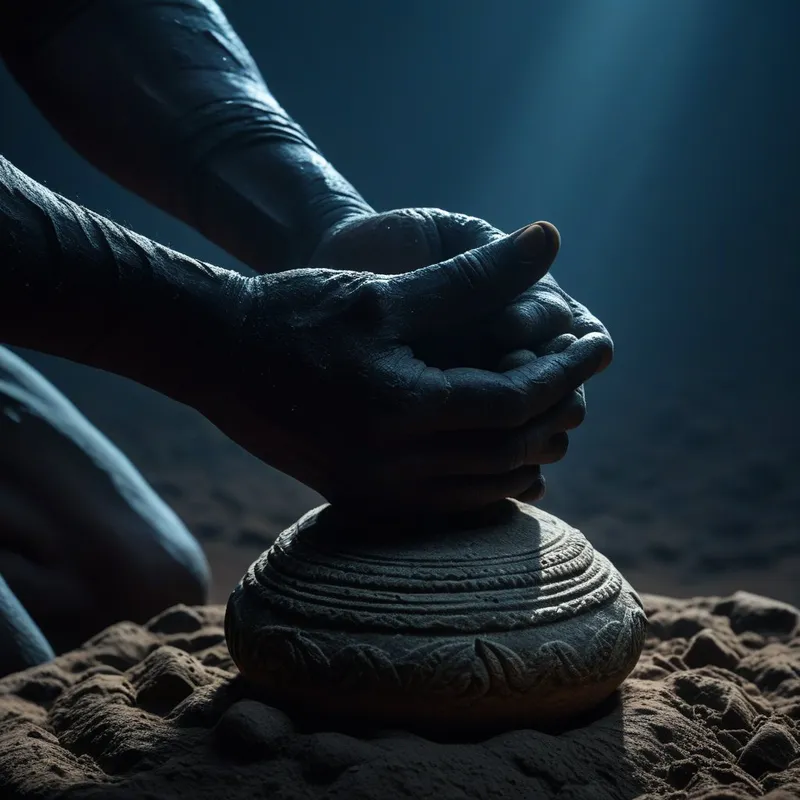
His name was Arjuna, and he was a prince of fire and fame. His bow, the Gandiva, had sung the songs of conquest. But now it lay silent, a forgotten limb beside him. His royal silks were gone, replaced by bark and the patina of grime. His body, once a temple of martial perfection, was a gaunt scaffold of bone and will. He stood on one leg, arms raised to the indifferent stars, his eyes fixed on a simple lump of earth he had shaped with his own hands—a lingam of clay.
Days bled into nights. He chanted the name until his throat was raw, until the syllables lost meaning and became the rhythm of his heartbeat. “Shiva. Shiva. Shiva.” He sought not an army, nor a kingdom, but a weapon. The Pashupatastra. The ultimate power, the destroyer of all destroyers. He sought it for the war to come, the great cataclysm of Kurukshetra, where he would need to pierce the impossible.
But the god did not come. Only the wind answered, scouring his resolve. Hunger hollowed him. Doubt, a more insidious foe than any he had faced, whispered that he was alone. That his pride, his very identity as the world’s greatest archer, was a barrier the divine would not cross.
Then, a tremor in the fabric of the mountain. The forest behind him erupted. A wild boar, monstrous and frothing, charged straight for him, tusks aimed at his heart. In a flash, the warrior awoke within the ascetic. Instinct, older than prayer, took hold. He snatched his bow, nocked an arrow, and let it fly. It struck true. But in the same instant, another arrow, from the shadows of the trees, pierced the beast. It fell dead, two arrows claiming the kill.
From the gloom stepped a hunter, wild and fierce, with his own bow and a band of tribal women. “Why do you shoot my prey, ascetic?” the hunter growled, his voice like grinding stone. Arjuna, his austerity fraying into irritation, defended his claim. An argument flared on the sacred slope, pride clashing with pride. It escalated, as such things do, from words to weapons. The hunter challenged the prince to combat.
And Arjuna, the champion of Svarga, was humiliated. He loosed volley after volley of celestial arrows. The hunter swatted them away like gnats. Arjuna summoned magical weapons, each capable of leveling cities. The hunter absorbed their energy with a laugh. Finally, enraged and desperate, Arjuna charged with his bow as a club. The hunter merely touched him, and all strength fled Arjuna’s limbs. His divine quivers, once inexhaustible, were empty. His legendary bow was useless.
He stood, utterly defeated, not by a demon or a rival king, but by a seemingly ordinary hunter in the woods. In that moment of absolute zero, when every skill, every title, every ounce of his famed prowess had been rendered null, the final vestige of his ego shattered. He fell to his knees, not in tactical surrender, but in soul-annihilating realization. He picked up a flower from the frozen ground—a poor, simple offering. He raised it, and with the last breath of his selfhood, he prayed not to the hunter, but to the source of all. He offered the flower to the clay lingam he had fashioned.
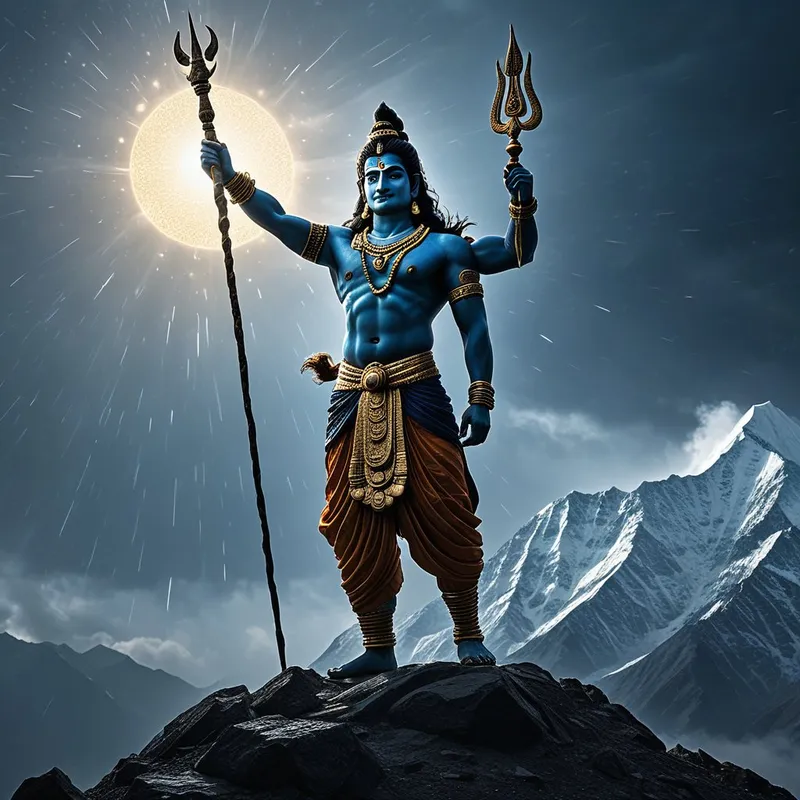
And as he did, a miracle of perception unfolded. His eyes cleared. He saw the hunter’s form shimmer and expand. The simple garb melted into the ash-smeared skin of the Great Yogi. The wild hair held the crescent moon. The eyes held the calm of eternity and the fire of dissolution. It was Pashupati, the Lord of All Beings, who had been before him all along.
The hunter was Shiva. The argument was the test. The defeat was the prerequisite. Arjuna, empty of Arjuna, could finally see. He prostrated himself, not as a prince, but as a devotee. And Shiva, smiling his terrible, benevolent smile, raised him up. He blessed him. He gave him the embrace of a friend. And he bestowed upon him the very weapon he had sought—not as a trophy for a conqueror, but as a sacred trust for a servant who had finally learned that to wield the power of the universe, one must first be broken by it.
Cultural Origins & Context
This myth is a pivotal episode from the Mahabharata, specifically from the Virata Parva and later elaborated in devotional texts like the Shiva Purana. Composed over centuries and crystallized around 400 BCE-400 CE, it was transmitted orally by bards (sutas) and later written by sages like Veda Vyasa.
Its function was multifaceted. On an epic level, it explains how Arjuna acquired the celestial arsenal needed for the righteous war. On a devotional (bhakti) level, it is a cornerstone story illustrating Shiva’s accessible, playful, yet fiercely testing nature. He is not a distant king in heaven but a wild yogi in the forest who engages directly with his devotees, often through disguise and adversity. Societally, it modeled the ideal of the kshatriya (warrior) who must balance immense power with ultimate humility before the divine, ensuring that power remains dharmic (righteous).
Symbolic Architecture
At its core, this is not a myth about acquiring a weapon, but about the annihilation of the egoic self that believes it can own power. Arjuna begins his penance with a transactional mindset: severe austerity in exchange for divine power. He is still the heroic individual, the <abbr title="The conscious ego or sense of "I"">ahamkara, performing a great feat.
The most profound prayer begins not when we ask for what we lack, but when we offer up what we think we possess.
The wild boar represents the untamed, disruptive force of the unconscious—the shadow that charges into our most sanctified spaces of self-image. The hunter is the archetypal Self in its most disguised and challenging form. Shiva-as-hunter is the antaryamin, the inner controller who orchestrates our deepest defeats to force a more authentic consciousness.
Arjuna’s utter defeat—the emptying of his quivers—symbolizes the complete failure of the persona’s tools. His skills, his heritage, his very identity as “the great archer” are rendered meaningless. This is the dark night of the soul, the necessary pralaya (dissolution) that must precede a new creation. Only when he is stripped bare does his prayer transform from a demand into an offering—the simple flower. This is the shift from karma to bhakti, from doing to being, from conquest to surrender.
The Dreamer's Resonance
When this myth stirs in the modern psyche, it often manifests in dreams of profound frustration and humbling. You may dream of a crucial tool failing at the moment of need—a pen that won’t write, a car that won’t start, a voice that won’t sound. You may dream of being argued with or defeated by a mysterious, uncanny figure—a stranger, an animal, a shadow—who exposes your fundamental helplessness.
Somatically, this can feel like a collapse in the chest, a sinking realization, or a weight of futility. Psychologically, it is the process of the conscious ego hitting the immovable wall of a complex or a life situation it cannot solve with its existing toolkit. The dream is not punishing you; it is initiating you. It is forcing a “defeat” of the old, heroic attitude that insists, “I can fix this myself.” The emotional resonance is one of shamed vulnerability giving way, in the moment of absolute surrender within the dream, to a strange, profound relief. The figure who defeats you may, in the dream’s final moments, transform or offer a simple, inexplicable gift—a stone, a key, a glance of recognition.
Alchemical Translation
The alchemy here is the transmutation of the lead of egoic will into the gold of authentic Self-will. Arjuna’s journey models the individuation process perfectly.
The Call & Refined Goal (Penance): The conscious ego (<abbr title="The conscious ego or sense of "I"">ahamkara) recognizes a lack—here, the need for a “weapon” to face a coming life-battle (Kurukshetra). It engages in disciplined, heroic effort (tapas). This is necessary but insufficient.
The Nigredo (The Blackening): The encounter with the hunter is the confrontation with the Shadow, but a Shadow imbued with the numinosity of the Self. The ego’s proudest faculties are systematically dismantled. This is the putrefaction, the dark, chaotic stage where all known structures fail. The ego feels annihilated.
The Surrender (Solve): The kneeling, the offering of the flower—this is the solve (“dissolve”) of the alchemical process. The rigid, metallic identity of the hero is dissolved in the waters of humility and unknowing. The ego consciously yields its central position.
Individuation is not about building a stronger fortress of the self, but about becoming a more permeable vessel for the Self.
The Recognition & Conjunctio (Coagula): The moment Arjuna sees Shiva. This is the coniunctio oppositorum, the sacred marriage. The defeated ego and the divine Other are recognized as not-two. The hunter and the god are one; the seeker and the Sought merge in recognition.
The Bestowal (The Stone): The gift of the Pashupatastra is the lapis philosophorum, the Philosopher’s Stone. It is not merely a tool, but a symbol of integrated, divine power that operates through the individual, not from the individual. The ego, now in service to the Self, is empowered in a true, non-inflated way.
For the modern individual, this myth instructs that our deepest breakthroughs, our most authentic power, do not come from doubling down on our willpower, but from the courageous, humiliating, graceful process of having that will broken open by a reality greater than our self-concept. Our true “weapon” is not our talent, but our capacity for surrender; our true strength is not in never falling, but in knowing to whom, or to what, we offer the flower when we do.
Associated Symbols
Explore related symbols from the CaleaDream lexicon: