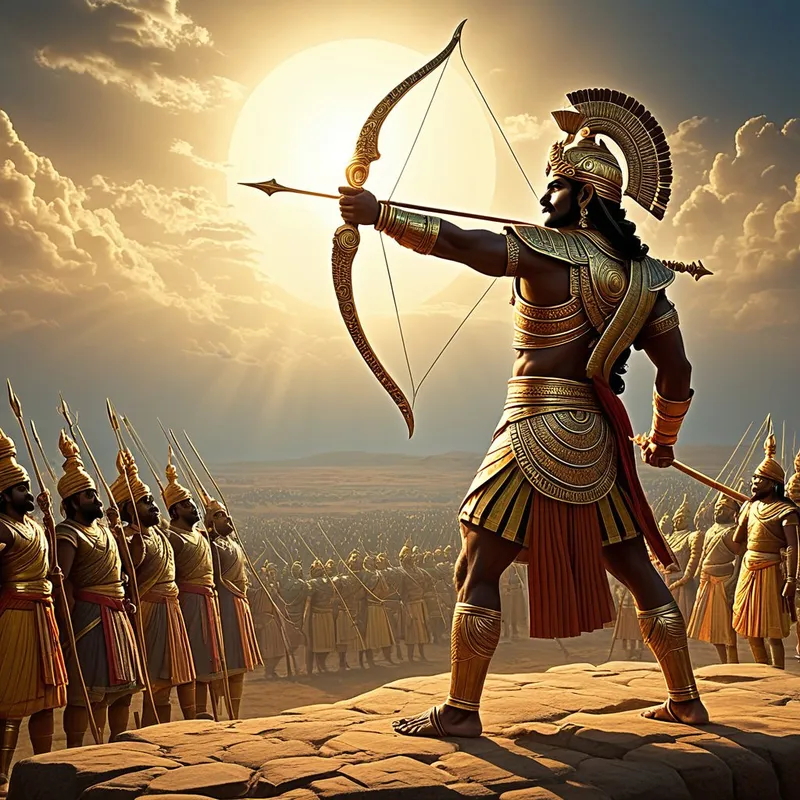
Arjuna's Gandiva bow Myth Meaning & Symbolism
A warrior receives a celestial bow, a tool of cosmic order, to fulfill a sacred duty that demands perfect alignment of action and soul.
The Tale of Arjuna’s Gandiva bow
Hear now the tale of the bow that sang with the voice of thunder and drew its arrows from the well of fate. It was a time when the world held its breath, when the field of Kurukshetra lay fallow under a heavy sky, waiting for the seed of conflict to be sown. Among the Pandavas, Arjuna shone brightest, a prince whose skill with the bow was unmatched by mortal man. Yet his hands were empty of the weapon that could turn the tide of the coming cataclysm.
The air in the great assembly hall of Indra was thick with the scent of celestial flowers and the weight of prophecy. The gods themselves were troubled, for the earth groaned under the burden of adharma—of profound disorder. Vishnu, in his aspect as Krishna, knew the hour had come. A instrument of cosmic balance was needed, a tool to prune the world-tree of its rotten branches. That instrument was Gandiva.
It was not crafted in a mortal forge. It was born in the primal churn of the ocean of milk, a limb of the world-ash, given first to the great god Brahma. It passed through hands of fire—to Indra, and then to the fierce god of the waters, Varuna. It rested in Varuna’s watery vault until the day the fire-god Agni, hungering for a cleansing feast, sought to consume the great Khandava forest. To perform this sacred, destructive act, Agni needed a warrior who could hold back the very gods who sought to protect the woods. He needed Arjuna.
And so, in a swirl of smoke and divine purpose, Krishna brought Arjuna before Varuna. The bow was presented. To touch it was to feel the heartbeat of the cosmos. Its back was the color of a storm cloud, its tips were blazing gold, and its string, when plucked, sounded the note of creation and dissolution. Arjuna took it, and his soul recognized its counterpart. The bow became an extension of his will, his dharma given physical form.
On the field of Kurukshetra, as two great armies seethed like opposing seas, Arjuna’s resolve shattered. He saw his teachers, his kin, arrayed against him. His mighty arms, which could draw Gandiva with ease, fell limp. The bow, once light as a reed, now weighed more than a mountain. It was then that Krishna, his charioteer, spoke the words that would become the Bhagavad Gita. He did not command Arjuna to fight. He reminded him of his nature, his sacred duty—his dharma. As the divine discourse flowed, Arjuna’s confusion burned away. His grip on Gandiva tightened. He lifted the bow, drew the string to his ear, and released the first arrow of the war. The song of Gandiva was no longer just thunder; it was the clear, unwavering note of a soul aligned with its purpose.
Cultural Origins & Context
This myth is woven into the vast epic tapestry of the Mahabharata, a text of monumental scale and philosophical depth. Composed in Sanskrit and evolving over centuries, likely between 400 BCE and 400 CE, it was not merely literature but a cultural and ethical repository. The story of Gandiva was transmitted orally by bards and storytellers (sutas) in royal courts and public gatherings, and later systematized by sages like Vyasa.
Its societal function was multifaceted. On one level, it was a thrilling narrative of divine favor and heroic destiny, reinforcing ideals of kshatriya (warrior) duty and unparalleled skill. On a deeper level, it served as a foundational parable for the Bhagavad Gita, which is embedded within the Mahabharata. The bow Gandiva is the necessary precondition for the Gita’s discourse; it is the tool that makes Arjuna’s dilemma and his role as the agent of cosmic correction not just possible, but inevitable. The myth thus bridges the realm of heroic action with the realm of philosophical and spiritual inquiry, teaching that the highest power must be coupled with the highest wisdom.
Symbolic Architecture
The Gandiva bow is far more than a powerful weapon. It is a profound symbol of integrated consciousness and destined action.
The bow is the tension between potential and release, between the soul’s purpose and its manifestation in the world.
Arjuna represents the human ego, the skilled but conflicted individual. Gandiva represents his svadharma—his unique, divine purpose. The bow is useless without the archer, and the archer is directionless without the bow. Their union signifies the moment the individual ego accepts and wields its innate, cosmic responsibility. The initial heaviness of the bow at Kurukshetra symbolizes the crushing weight of existential doubt, moral confusion, and the shadow of the personal unconscious (represented by his familial opponents). Krishna’s counsel represents the voice of the Self, the archetype of wholeness, which integrates the conflicting parts of the psyche and allows the ego to act as an instrument of a larger order.
The bow’s celestial origin and its chain of divine custodians (Brahma, Indra, Varuna, Agni) signify that true vocation is not a personal invention but a received, sacred trust. It is a fragment of cosmic law (dharma) entrusted to the individual soul for the maintenance of world-order.

The Dreamer’s Resonance
When the Gandiva pattern stirs in the modern dreamscape, it often manifests not as a literal bow, but as a potent, specialized tool or talent that feels both intimately yours and dauntingly heavy. You may dream of a musical instrument you cannot lift, a pen that writes in light but burns your hand, or a master key that fits every lock but terrifies you to use.
Somatically, this can correlate with tension in the shoulders, arms, and hands—the limbs of action. Psychologically, you are in the “Arjuna-at-dawn” state: standing at the precipice of your own Kurukshetra. You have acquired the skill, the position, or the opportunity (the bow), but you are paralyzed by the perceived cost. The dream is highlighting the conflict between your conscious ambition and your unconscious loyalties, fears, and identifications. The shadow—the parts of yourself and your history you are aligned with but must now confront—stands arrayed against you. The hum of the bowstring in the dream is the call of your own destiny, vibrating in the psyche, demanding resolution.

Alchemical Translation
The alchemy modeled by this myth is the transmutation of raw skill into sacred action, and of personal conflict into transpersonal duty. The process begins with the receiving of the tool (Gandiva from Varuna). In individuation, this is the recognition of one’s innate genius or core calling—a gift that feels destined.
The crucial fire is the confrontation with the shadow on the battlefield. This is the depression, anxiety, or paralysis that arises when one must use that gift in a way that severs old attachments, challenges family or social expectations, or destroys outmoded parts of the personality. Arjuna’s despondency is not a weakness; it is the necessary dissolution of the old ego-structure.
The chariot between the armies is the liminal space where the ego, in dialogue with the Self (Krishna), dies to its personal attachments and is reborn as an agent of the greater psyche.
Krishna’s discourse performs the philosophical nigredo, the blackening that precedes enlightenment. He reframes the entire context of action from one of personal gain and loss to one of impersonal, sacred duty. The final alchemical stage is the lifting of the bow. This is the integration. The ego, now aligned with the Self, takes up its purpose without hesitation. Action (karma) becomes a form of worship, skill becomes service, and the individual life becomes a conscious note in the symphony of the whole. The Gandiva, once heavy, is now weightless, for it is no longer carried by the ego alone, but by the entire cosmos acting through the individual.
Associated Symbols
Explore related symbols from the CaleaDream lexicon: