Arjuna's Chariot Myth Meaning & Symbolism
A warrior prince, paralyzed by doubt on the battlefield, receives divine counsel from his charioteer, who is revealed as the Supreme Lord.
The Tale of Arjuna's Chariot
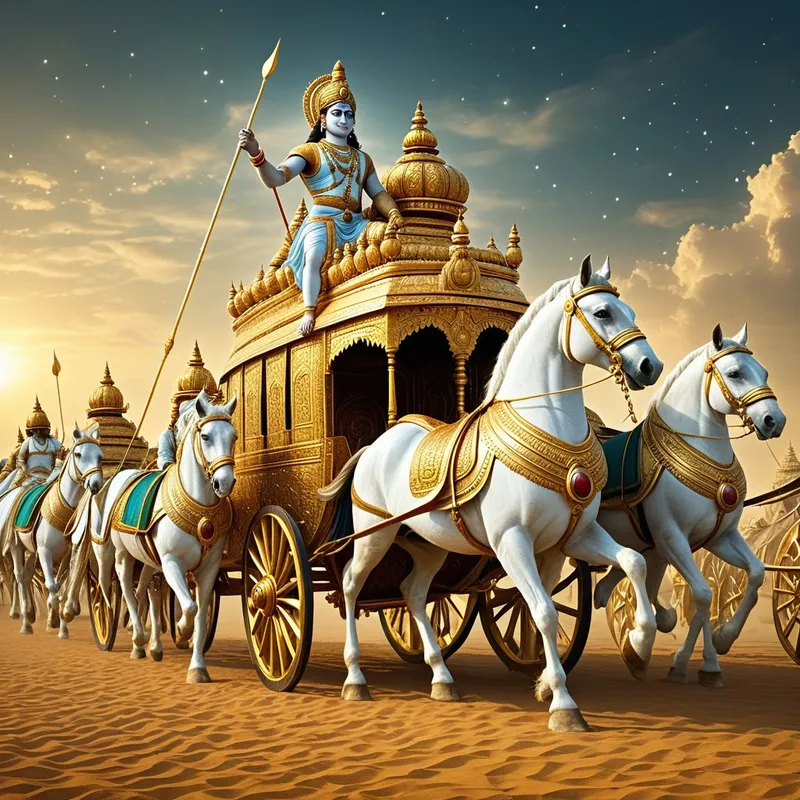
Hear now the tale that echoes from the dawn of time, from the field of sacred duty, Kurukshetra. The air is thick with the scent of dust and destiny, the thunder of conch shells, the restless stamp of a million warriors. In the heart of this poised cataclysm stands a single chariot, its banner bearing the emblem of Hanuman. Within it, the peerless archer Arjuna, his fingers knowing the curve of the divine bow Gandiva as his own soul. Yet his soul is adrift.
"Place my chariot between the two armies, O Keshava," he commands his charioteer, his voice tight. The chariot, drawn by four white steeds, rolls forward. And there, arrayed before him, Arjuna sees them. Not faceless enemies, but grandfathers, teachers, uncles, cousins, beloved friends. The sinews of his duty, the dharma of a Kshatriya, snap like over-taut bowstrings. His vision blurs. The mighty Gandiva becomes a leaden weight; it slips from his grasp, clattering against the chariot floor. A great paralysis seizes him. "I shall not fight," he whispers, then declares, his body sinking to the chariot seat in despair. Victory itself tastes of ash. What kingdom, what joy, purchased with the blood of kin?
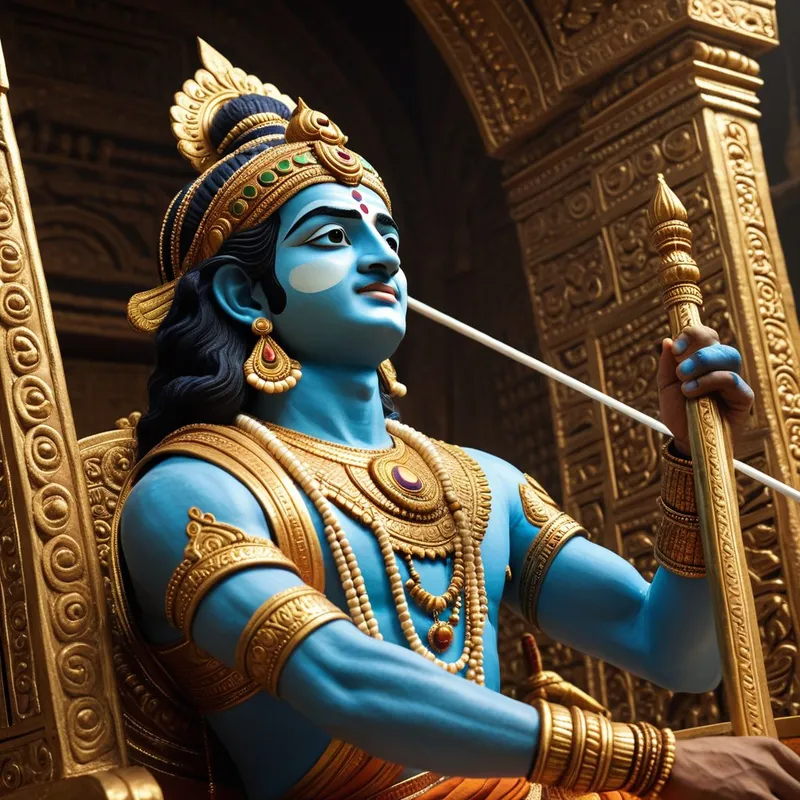
Then, from the seat of the driver, comes a sound—not a rebuke, but a gentle, fathomless calm. The charioteer, his dear friend and cousin Krishna, smiles. It is a smile that contains universes. He has not moved the chariot to safety. He has placed it at the very axis of the conflict. And now, as Arjuna surrenders his will to confusion, Krishna begins to speak. His voice is the sound of creation and dissolution, the murmur of rivers and the silence between stars. He speaks of the eternal soul, the imperishable atman, which no weapon can cleave, no fire burn. He speaks of duty performed without attachment to its fruits. The discourse unfolds, a divine symphony amidst the silent armies—the Bhagavad Gita.
As the teachings reach their zenith, Arjuna, still yearning for a sign, makes a final request: "If You think me capable of beholding it, O Lord, then reveal to me Your immortal Self." Krishna grants the boon. And then, within the confines of the chariot, the cosmos unfolds. Krishna's friendly form dissolves into the Vishvarupa—a terrifying, magnificent vision of all time, all creation, all destruction contained within a single body. Arjuna sees the warriors arrayed on the field rushing into the flaming mouths of this Divine Form, their destinies already consumed. He sees the entire wheel of samsara turning within his charioteer. Overwhelmed, trembling, he begs for the return of the familiar, four-armed form. The vision withdraws, folding back into the smiling Krishna who holds the reins. The chariot has not moved an inch on the earthly plain, but within it, a universe has been born, a warrior has died, and a devotee has been reborn. Arjuna picks up his bow. His doubt is gone, burned away in the cosmic fire of truth. "My delusion is destroyed," he says. "I stand firm, my confusion dispelled. I will act according to Your word."
Cultural Origins & Context
This pivotal episode is the heart of the Mahabharata, an epic of staggering scale composed over centuries, likely between 400 BCE and 400 CE. It was not merely literature but smriti—"that which is remembered"—a cultural, ethical, and philosophical reservoir passed down orally by bards and learned sages. The setting of Kurukshetra is both historical and symbolic, representing the eternal battlefield where dharma confronts adharma.
The Gita's placement is masterful: at the moment of maximum crisis, just as the war begins. It was a teaching for the warrior class, the Kshatriyas, reframing their violent duty as a sacred, selfless sacrifice. But its audience was always broader. For millennia, it has been recited in homes, expounded upon by gurus, and studied by philosophers. It functions as a societal anchor, providing a framework for action in a complex world, teaching that spiritual realization is not separate from worldly engagement, but its very foundation when performed with the right consciousness.
Symbolic Architecture
The chariot is the central, potent symbol—a microcosm of the human being.
The body is the chariot, the senses are the horses, the mind is the reins, and the intellect is the charioteer. The soul is the master of the chariot.
In the myth, this metaphor is made literal and elevated. Arjuna represents the individual human soul, the jivatman, endowed with formidable capacities (his archery) but subject to the storms of emotion, attachment, and existential doubt. The four white horses symbolize the fourfold mind or the restless senses, powerful and needing direction. The battlefield, Kurukshetra, is the field of life itself, the arena of our choices, conflicts, and duties.
The revolutionary genius of the myth is the identity of the charioteer. He is not merely the intellect, but the Supreme Intellect, the Paramatman itself. Krishna as driver signifies that divine consciousness is not a distant ruler, but the intimate guide within the vehicle of our life. The moment of crisis—Arjuna laying down his arms—is the essential prerequisite for wisdom. It is the ego's surrender, the admission of "I do not know." Only when the human will abdicates its frantic control can the divine will, which has been holding the reins all along, be recognized and obeyed.
The Vishvarupa revelation is the ultimate truth of that guidance. It shows that what we perceive as our isolated struggle is part of a vast, cosmic process already in motion. Our duty is not to control the cosmos, but to align our small action with its grand, often inscrutable, rhythm.
The Dreamer's Resonance
When this myth stirs in the modern unconscious, it often manifests as dreams of profound paralysis at a threshold. The dreamer may be in a vehicle (car, train, plane) that is hurtling toward a critical destination, but they are frozen, unable to steer or act. The driver may be a familiar yet strangely authoritative figure—a parent, a mentor, a partner—whose calm demeanor contrasts with the dreamer's panic.
Somatically, this echoes Arjuna's "limbs quivering, mouth drying." It signals a confrontation with a life-choice of immense moral or existential weight: leaving a career, ending a relationship, facing a health crisis, speaking a hard truth. The psyche is staging the conflict between the personal, attached self (which sees only loss and familial bonds, like Arjuna seeing his kin) and the call of a deeper, impersonal destiny or integrity. The dream paralysis is not pathology, but the soul's refusal to let the ego proceed blindly. It is an invitation to stop, to descend into the chariot of the self, and to listen for the guiding voice that has been present all along.
Alchemical Translation
The process modeled here is the alchemy of conscious action, the core of Karma Yoga. The psychic transmutation occurs in three stages.
First, The Descent into the Chariot: This is the conscious withdrawal of projection. The external battle (with colleagues, family, circumstances) is recognized as a reflection of an internal one. The individual, like Arjuna, must turn inward, confronting their own attachments, fears, and sentimentalities that masquerade as virtue. This is a dark night of the soul, where previous certainties crumble.
The first step in individuation is not to conquer the world, but to surrender the illusion that you were ever its sole commander.
Second, The Dialogue with the Divine Driver: This is the engagement with the Self, the inner guru. It is the practice of introspection, meditation, or active imagination where one earnestly questions one's motives and listens for a wisdom deeper than the ego's calculations. It involves discerning between the voice of fear (which often speaks as pragmatic reason) and the voice of dharma (which speaks as quiet, unwavering clarity).
Third, The Resolved Action: This is the rebirth of the hero. Action is taken, but it is no longer your action done for your gain. It is action performed as an instrument of a larger will, free from the fever of expectation. The bow is picked up, but the archer is transformed. He acts with skill, but without personal hatred or desire. The conflict is engaged, but the inner war is over. The individual is no longer a conflicted pawn of circumstance but a conscious, willing participant in the cosmic drama, having realized their true place not as the owner of the chariot, but as the soul within it, forever partnered with the divine.
Associated Symbols
Explore related symbols from the CaleaDream lexicon: