Arjuna's Bow Myth Meaning & Symbolism
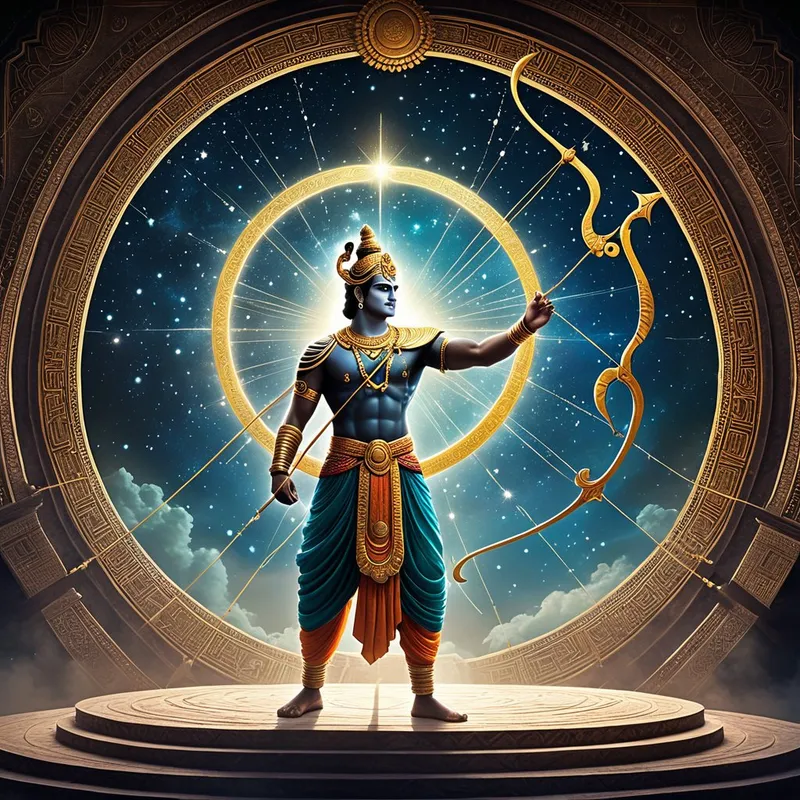
The myth of the celestial bow Gandiva, a divine instrument of focus and destiny, granted to the warrior Arjuna to fulfill his sacred duty.
The Tale of Arjuna's Bow
Hear now the tale of the bow that sang with the voice of destiny. It was not born of wood and sinew, but forged in the heart of a star, cooled in the tears of a river goddess, and strung with the breath of the storm. Its name was Gandiva, and it waited, patient as a mountain, for the one whose soul could answer its silent call.
That call echoed in the halls of Svarga, where the air is perfume and the light has no shadow. It was heard by a prince of the earth, Arjuna, who walked there not as a guest, but as a son. His father, the lord Indra, had summoned him for a trial beyond the ken of mortal kings. Demonic forces, the Asuras, had risen like a black tide, threatening the order of the worlds. The gods needed a champion, but not just any warrior’s arm. They needed an instrument of perfect alignment.
In a grove where trees bore jewels and the grass was emerald silk, the bow was presented. It lay upon an altar of white crystal, humming a low note that vibrated in the bones, not the ears. Other heroes, mighty and proud, had tried to lift it. Their muscles had strained, their brows had poured sweat, but Gandiva was immovable, as if rooted to the core of creation. It rejected them.
Then Arjuna stepped forward. He did not puff his chest or roar. He closed his eyes, and in the inner darkness, he sought not the weapon, but the purpose for which it was made. He saw the coming war, the field of Kurukshetra, stained with the blood of kin. He saw his sacred duty, his Dharma, clear and terrible as a diamond. He saw the face of his charioteer, Krishna, whose counsel would be his true north. Only then did he reach out.
His fingers did not grip; they greeted. The bow did not yield; it awoke. As his palm met the polished heartwood, a sound like a thousand temple bells rang through Svarga. The bow lifted, light as a feather, heavy with destiny. He drew the string, and the air tore with a sound that was both the beginning and the end of things. The assembled gods covered their ears and wept with the beauty of it. With that single, resonant twang, Arjuna was no longer just a prince. He was the Archer, the Dhananjaya, and the bow was his voice. He would carry it through the fire of the great war, and every arrow loosed would be a syllable in the epic of the world.
Cultural Origins & Context
This myth is a vital strand in the immense tapestry of the Mahabharata. Composed in Sanskrit and evolving over centuries, likely between 400 BCE and 400 CE, the epic was preserved and transmitted orally by generations of Brahmins and itinerant bards. The story of Gandiva’s bestowal is not merely an episode of divine armament. It functions as a crucial rite of passage within the narrative, publicly anointing Arjuna as the divinely sanctioned instrument for the cosmic reset that the Kurukshetra war represents.
In a culture deeply structured by the concept of Dharma and divine will, the myth served a profound societal function. It answered a critical question for the audience: by what right does a man take up arms against his own family, teachers, and elders? The answer is encoded in the bow. Gandiva is the tangible symbol of a mandate from the gods themselves. It legitimizes the terrible violence to come, framing it not as personal ambition, but as a sacred, cosmic necessity. The bow transforms a potentially reprehensible civil war into a Dharmayuddha. It tells the listener that true authority and power are not seized, but received when one’s inner nature is perfectly aligned with a transcendent purpose.
Symbolic Architecture
At its core, Arjuna’s bow is a symbol of focused potential. It is the unmanifest power of the self, latent and dormant, awaiting the correct alignment of will, purpose, and skill to become active and effective in the world.
The bow is the tension of the soul, the string is the disciplined mind, and the arrow is the intention released into the fabric of fate.
The bow, Gandiva, represents the complete psychic apparatus of the individual. Its divine origin signifies that our deepest potential is not ego-born; it is an endowment from the larger Self, the collective unconscious or the divine ground. Its refusal to be wielded by anyone but Arjuna speaks to the uniqueness of individual destiny. Your “bow”—your genius, your calling—is yours alone. Others may try to claim it, but it will remain inert, even burdensome, in their hands.
Arjuna’s act of lifting and stringing it symbolizes the integration of shadow. He must acknowledge the coming war, the necessary destruction, his own capacity for violence—all parts of his psyche he might wish to disown—before he can wield the instrument of his destiny. The bow demands wholeness, not purity.
The Dreamer's Resonance
When the symbol of Arjuna’s Bow appears in modern dreams, it seldom manifests as a literal weapon. More often, it is felt as a profound somatic tension—a pulling in the chest, a tautness in the shoulders, a sense of being “strung” and ready but unable to release. The dreamer may be facing a life decision of immense consequence, a “field of Kurukshetra” in their own life: a career change, a moral dilemma, the need to confront a family dynamic.
The dream-bow might appear as a beautiful but heavy object the dreamer is compelled to carry, or a tool they know how to use but are forbidden from touching. This reflects the psychological process of approaching one’s own power. There is often simultaneous attraction and fear. To draw the bow is to commit to a path from which there is no return, to release an arrow that will irrevocably change one’s life landscape. The dream captures the agonizing, potent pause at the brink of action, where potential must finally become act. It is the psyche’s way of rehearsing the alignment of will (the archer), skill (the bow), and destiny (the target).
Alchemical Translation
The myth models the alchemical process of psychic transmutation, or Individuation. The base metal of the unconscious, raw potential, is transmuted into the gold of conscious, purposeful action.
The first stage is Mortificatio: the humbling. The failed attempts of others (and the ego’s own initial failures) to lift the bow. The ego must be stripped of its presumption, understanding that true power is not commanded.
Next is Illuminatio: the revelation. Arjuna’s inner vision of his duty (Dharma) and his guide (Krishna). This is the connection to the Self, the inner divinity that grants purpose. The conscious mind aligns with the deeper, transpersonal will.
Then comes Coniunctio: the sacred marriage. The hand meets the bow. The individual will (Arjuna) is united with its innate, divine instrument (Gandiva). This is the integration of conscious intention with unconscious capacity.
The final release of the arrow is the act of living your truth. It is the moment the inner alignment becomes an outer fact, changing your world and fulfilling your fragment of the cosmic pattern.
For the modern individual, the “bow” is one’s unique vocation, authentic voice, or core talent. The “stringing” is the years of discipline, introspection, and often painful self-confrontation required to make it functional. The “target” is not an enemy, but the embodiment of one’s destiny—the life one is meant to live. To draw the bow is to accept the tremendous tension of being fully who you are. To loose the arrow is to irrevocably commit to your path, trusting that your aim, guided by your deepest wisdom, is true.
Associated Symbols
Explore related symbols from the CaleaDream lexicon: