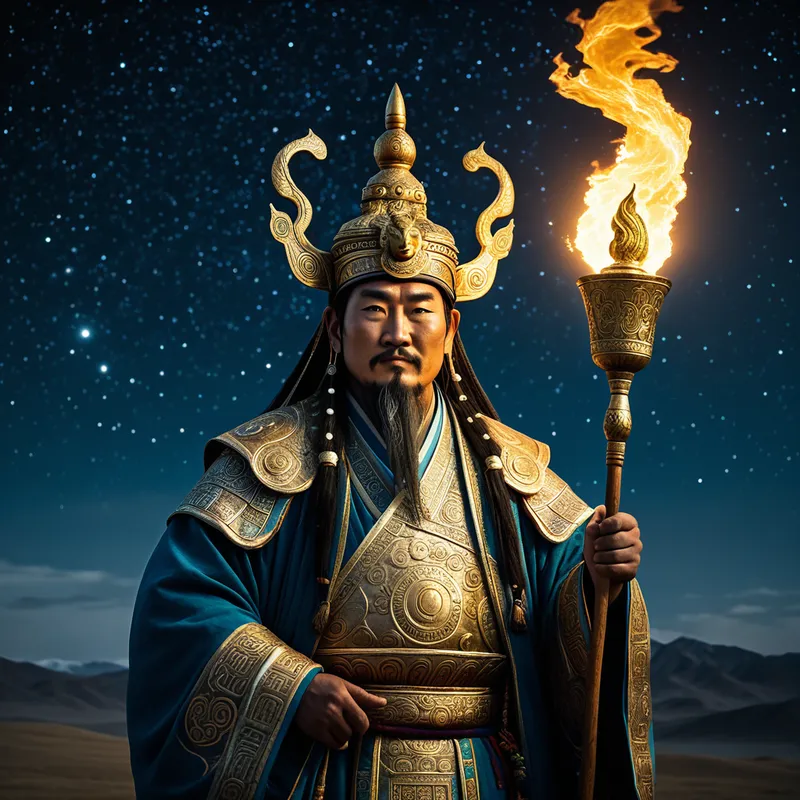
Ariun Gal Sacred Fire Myth Meaning & Symbolism
A myth of the celestial fire stolen from the gods, bringing warmth, spirit, and the sacred duty of tending the inner and outer hearth to humanity.
The Tale of Ariun Gal Sacred Fire
In the time before time, when the world was young and the sky was a vast, cold vault of polished obsidian, humanity huddled in the dark. They knew the sun’s distant, indifferent light, and they knew the moon’s pale, silent reflection. But the deep, bone-chilling cold of the endless steppe night was a constant companion, a shroud that smothered hope and stilled the spirit. They ate their meat raw, their thoughts were slow as frozen rivers, and their dreams were grey and formless.
Above, in the luminous realm of the Tengri, the gods lived in eternal, radiant warmth. At the heart of their celestial court burned the Ariun Gal, the primordial fire. It was not the orange, consuming flame of later ages. This was the first fire, white and gold, singing a silent song of pure energy. It was the essence of life, consciousness, and divine order. To the gods, it was the hearth of creation itself.
But on the earth, a single human heart dared to dream of more than survival. A figure, whose name is lost to the wind but whose deed is eternal, looked not with envy, but with a profound, aching need. He saw his people fading into the cold, their spirits dimming. He heard the silent plea in the eyes of the children. The warmth of the gods was not just comfort; it was the very spark of soul. And so, he resolved on an impossible journey—a theft from heaven itself.
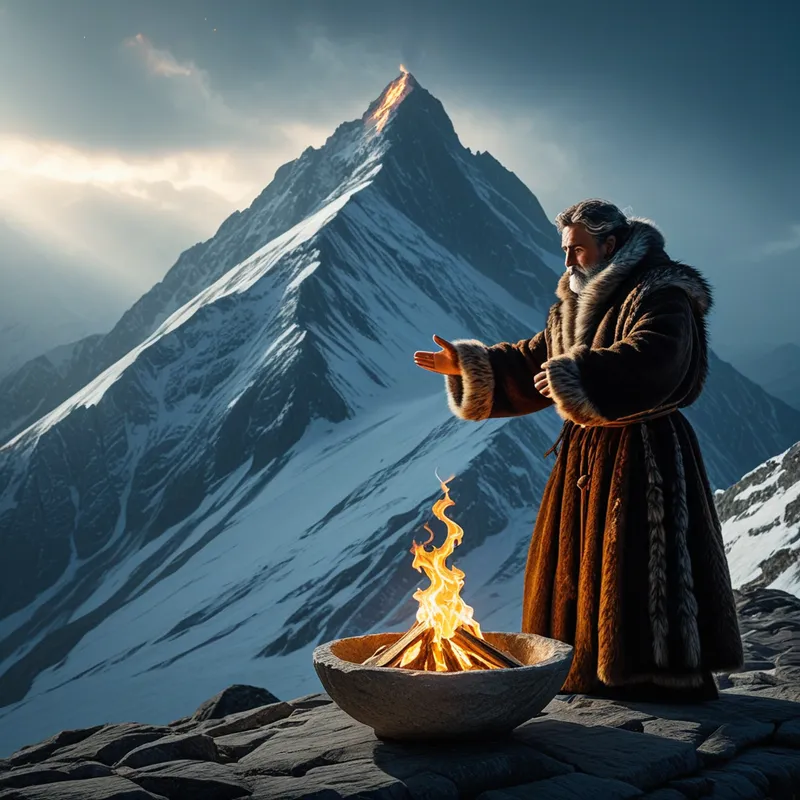
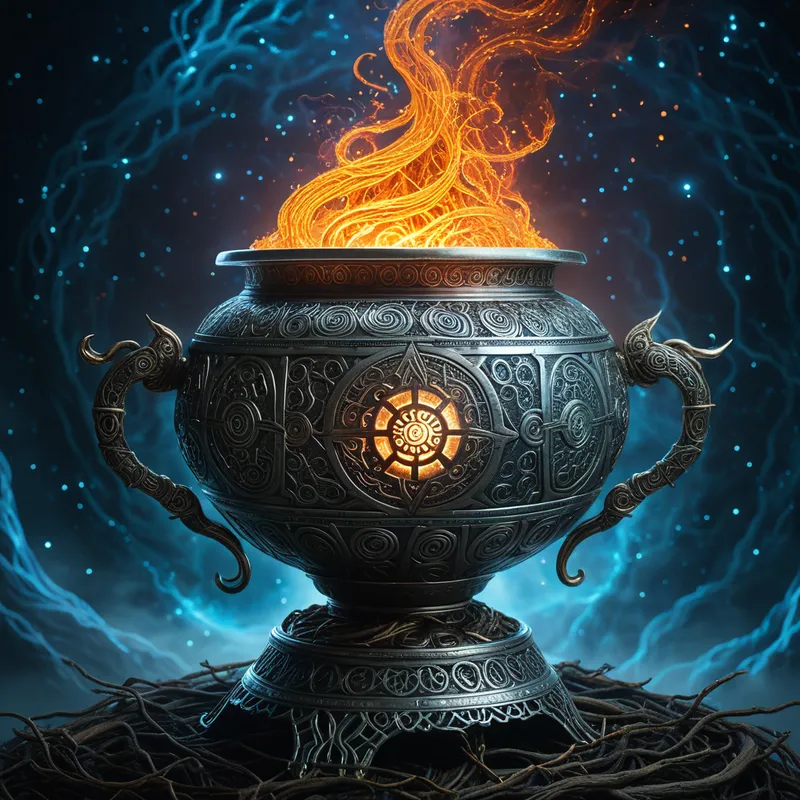
His path was a pilgrimage of endurance. He climbed the Sümbür, the cosmic mountain whose peak pierces the floor of the sky. The air grew thin, biting with a cold that numbed thought. The stars themselves seemed like chips of ice. At the summit, in a bowl of black stone that drank the starlight, danced the Ariun Gal. It was unguarded, for what fool would dare? The fire did not burn the stone; it hovered, a contained sun, a living jewel.
Trembling, not from cold but from the sheer sacrilege of his intent, the hero reached out. His fingers did not sear; they were enveloped in a terrible, beautiful warmth that flowed into his very bones. He cupped the flame. It was both weightless and heavier than the world. As he lifted it, the sky groaned. The Tengri awoke to the violation. Thunder, the voice of divine wrath, rolled across the heavens. Lightning, their grasping fingers, scored the mountain peak.
The descent was a race against divine retribution. He cradled the stolen sun against his chest, its light leaking through his fingers, painting the snow in hues of dawn. The storm pursued him, a furious darkness at his back. He did not run for his life, but for the life of all. Stumbling onto the frozen plain, he fell to his knees before his people. With his last breath, not of fear but of offering, he blew gently upon the Ariun Gal cupped in his hands.
The flame touched the dry grass of the steppe. It did not rage; it awoke. It spread, a ring of gentle, warming light, pushing back the cold night. The people felt its heat on their skin, and for the first time, a different kind of warmth blossomed within—the warmth of wonder, of community, of a spirit kindled. The hero perished then, consumed not by the fire, but by the fulfillment of his task. His body returned to the earth, but the fire, now rooted in the world, burned on. The gods, looking down, saw not just theft, but a transformation. The fire had found a new hearth: the human heart. In silent, solemn acknowledgment, they withdrew their storm. The sacred flame was now humanity’s charge, and its eternal duty.
Cultural Origins & Context
This myth originates from the spiritual bedrock of Mongolia: Tengrism. It is not a story confined to a single epic, but a foundational narrative woven into the fabric of nomadic consciousness, passed down through generations by shamans (böö) and storytellers around the hearth fire itself. The hearth (golomt) was, and remains, the literal and symbolic center of the Mongolian ger. The fire within it was never just for cooking or warmth; it was a living altar, a microcosm of the Ariun Gal.
The myth served a crucial societal function: it sacralized the everyday. It explained why fire was holy, why it must be respected (never stabbed with a knife, never polluted with rubbish), and why the golomtyn eej (the fire mother) held a position of great honor. The story encoded an ecological and spiritual ethic—fire is a loan from the divine, a responsibility. Its telling, often during rituals or gatherings, was an act of remembrance and reverence, binding the community to the cosmos and to the courageous, sacrificial act that made their civilized life possible.
Symbolic Architecture
At its core, the myth of Ariun Gal is a profound allegory for the awakening of consciousness. The primordial cold represents the undifferentiated, instinctual state of being—alive, but without self-awareness or cultural light. The celestial fire is the spark of spirit, intellect, culture, and the divine logos—the principle of order and meaning.
The theft is not a crime, but a necessary individuation. The conscious ego must separate from the unconscious, divine totality (the gods) to establish its own realm of light and order.
The hero represents the pioneering aspect of the psyche that risks the security of unconscious unity for the perils and potentials of self-aware existence. His death is inevitable; the personal, ego-driven will that executes the theft must be sacrificed so that the stolen fire can become a collective, inherited possession—the foundation of culture and the human soul. The fire’s transition from a solitary, heavenly object to a shared, earthly hearth mirrors the journey of a divine potential becoming a human actuality, housed within the vessel of community and tradition.
The Dreamer's Resonance
When this myth stirs in the modern dreamer, it often signals a profound psychological initiation—a call to "steal one's own fire." Dreams may feature themes of a perilous ascent, a confrontation with a radiant but forbidden source of energy or knowledge, or the desperate, sacred guarding of a fragile, newfound light.
Somatically, this can feel like a rising inner heat—anxiety, passion, or creative fervor that feels both vital and dangerous. Psychologically, the dreamer is navigating the conflict between a comfortable, perhaps "cold" or numb, state of being and the terrifying, exhilarating pull towards a more authentic, awakened, and responsible self. The dream may manifest as finding a tiny, precious flame in a vast darkness, or being chased by stormy authorities (internalized parental or societal gods) for possessing a truth that sets one apart. It is the process of claiming one's own authority and spiritual vitality from internalized "gods" of tradition, family complexes, or the collective unconscious.
Alchemical Translation
The myth of Ariun Gal is a perfect map for the alchemical process of individuation. The initial state (nigredo) is the cold, dark steppe of the unexamined life. The call to climb the mountain is the emergence of the Self, urging movement toward wholeness.
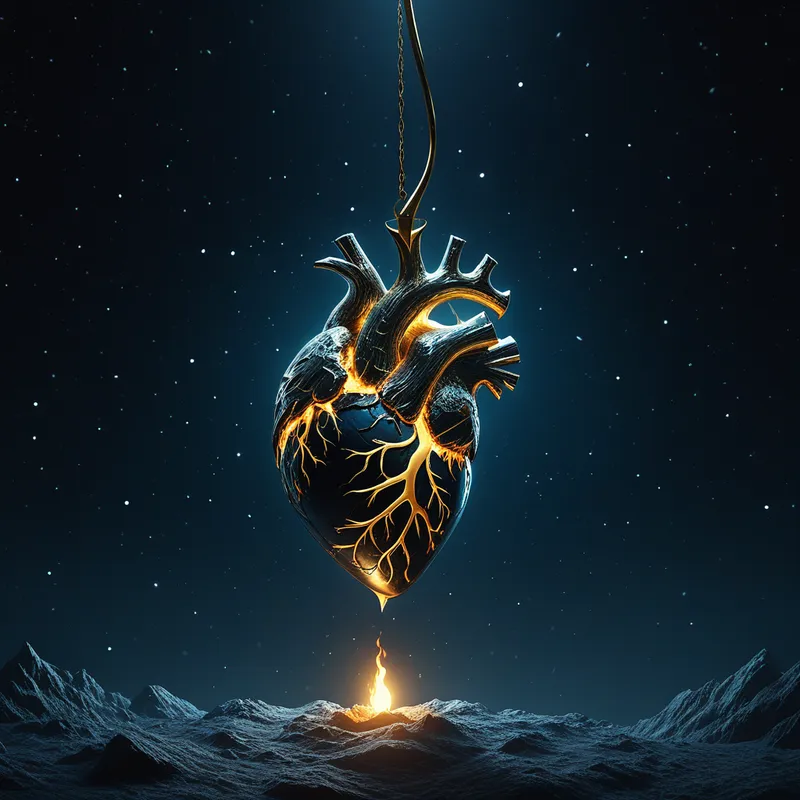
The ascent and theft represent the separatio and solutio—the difficult separation from ingrained patterns and the dissolution of old identities in service of capturing a core, essential truth (the fire). The hero’s death is the crucial stage of mortificatio; the old ego-identity that executed the heroic quest must die for the transformation to be complete.
The final stage is not the possession of the fire by the individual, but its multiplicatio—its kindling in the shared "hearth" of the integrated personality. The sacred fire becomes the living center of one's internal ger, the warm, ordered source from which all conscious life emanates.
For the modern individual, this translates to the lifelong work of tending one's inner flame: protecting one's vital energy, honoring one's unique spirit with discipline (the rituals of the hearth), and using one's awakened consciousness not for selfish grandeur, but to illuminate one's corner of the world and warm the community of one's relationships. The stolen fire becomes the earned wisdom, the sustained creativity, and the compassionate warmth of a life lived consciously.
Associated Symbols
Explore related symbols from the CaleaDream lexicon:
- Fire — The central symbol of divine spirit, consciousness, transformative energy, and sacred warmth stolen from the gods and made the responsibility of humanity.
- Mountain — Represents the axis mundi, the arduous path of ascent toward the divine or the unconscious, the perilous journey required to obtain higher knowledge or spirit.
- Sacrifice — Embodies the essential death of the old self or the individual ego so that the stolen boon (fire/consciousness) can be integrated for the benefit of the whole.
- Hearth Fire — The domesticated, sacred center where the celestial fire now resides; symbolizes the inner self, the home of the soul, and the ritualized care of one's vital energy.
- Thunder — The voice of divine authority and the old order, representing the internalized fears, superego, and collective norms that protest against individual awakening and theft of authority.
- Hero — The archetypal force that undertakes the impossible journey for the sake of the community, modeling the ego's necessary but ultimately sacrificial role in the process of individuation.
- Cold — Symbolizes the pre-conscious state, spiritual numbness, isolation, and the undifferentiated life devoid of the warming light of individual soul and culture.
- Stone — Represents the vessel (the bowl on the mountain, the hearth) that can contain the sacred fire; the durable structure of tradition, ritual, and the physical world necessary to hold spirit.
- Journey — The essential narrative structure of the myth, reflecting the psychological process of leaving a state of need, confronting the unknown, and returning transformed.
- Light — The direct emanation of the sacred fire, representing enlightenment, awareness, hope, and the dispelling of the darkness of ignorance and unconsciousness.
- Spirit — The intangible essence carried by the fire; the animating principle of life, culture, and connection to the divine that becomes accessible to humanity through the mythic act.
- Root — The hidden, anchoring connection of the now-earthly fire to its celestial origin and to the deep, unconscious psyche from which all transformative energy ultimately springs.