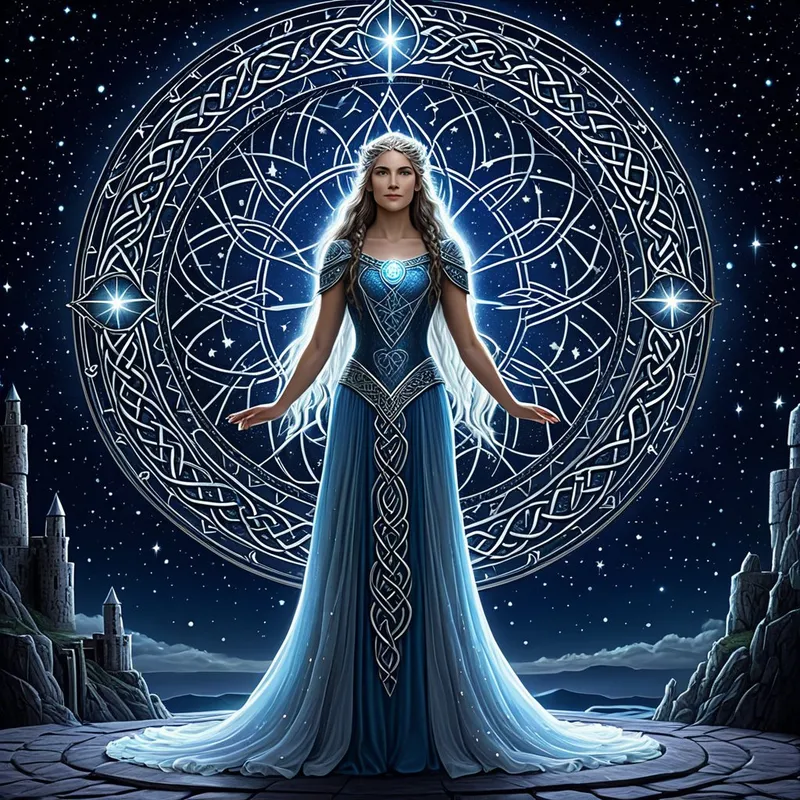
Arianrhod's Silver Wheel Myth Meaning & Symbolism
A goddess's fateful words curse her son, who must overcome impossible tasks to claim his name, arms, and a bride, guided by a silver wheel of stars.
The Tale of Arianrhod's Silver Wheel
Listen, and hear a tale not of earth and stone, but of stars and fate. In the time when the world was younger and magic breathed in the salt air, there stood the court of Math fab Mathonwy, a lord whose feet must rest in the lap of a virgin when not at war. His footholder was betrayed, and a new one was sought. His niece, the proud and radiant Arianrhod, stepped forward and swore she knew no man.
To test this oath, Math wielded his magic. He bade her step over his enchanted wand. But as she did, a great cry pierced the air—she dropped two beings onto the stones. The first was a golden-haired boy. The second was a formless, mysterious thing that was swiftly snatched by her brother, Gwydion, and hidden away. Arianrhod, shamed and wrathful, turned her gaze upon the boy. “He shall have no name,” she declared, her voice like cracking ice, “unless he receives it from me.”
Gwydion, the cunning weaver of illusions, raised the boy in secret. When he was grown, Gwydion disguised them both as shoemakers and journeyed to Arianrhod’s sea-bound fortress, Caer Arianrhod. From her silver-wheel tower, Arianrhod watched the strangers. When the boy—with a skill beyond his years—flung a stone and struck a wren dead between its leg and wing, she cried out in surprise, “With a steady hand, the fair-haired one strikes!” Gwydion threw off the disguise. “You have given him a name!” he proclaimed. “He is Lleu Llaw Gyffes!”
Arianrhod’s fury was a cold storm. “He shall have no arms,” she vowed, “unless I arm him myself.” Undeterred, Gwydion conjured a phantom armada to besiege her fortress. In terror, Arianrhod passed out weapons to the defenders. Among them stood Lleu, and thus she armed him with her own hand, only to see the fleet vanish into sea-mist. Gwydion revealed the trick. “You have armed him!”
Arianrhod’s final curse was the most profound. “He shall have no wife of any race that now inhabits this earth.” This seemed an impossible doom. But Math and Gwydion, pooling their deepest arts, fashioned a woman from the flowers of the oak, the broom, and the meadowsweet. They named her Blodeuwedd, and she was given to Lleu. Yet, from flowers wrought, betrayal grew. Blodeuwedd took a mortal lover and conspired to learn the one, secret way Lleu could be killed—a complex, nearly impossible set of circumstances. In the attempt, Lleu was wounded and transformed into an eagle, flying wounded into the night. Gwydion later found him, restored him, and justice was meted. And Lleu, having endured his mother’s curses and his wife’s betrayal, finally claimed his rightful place as a lord.
But Arianrhod? She retreated to her revolving fortress, Caer Arianrhod, the Silver Wheel Castle in the northern sky, where she turns the wheel of the stars, a distant, luminous sovereign of fate.
Cultural Origins & Context
This myth is preserved in the Pedair Cainc y Mabinogi, specifically the Fourth Branch. While recorded by Christian scribes in the medieval period, its roots sink deep into the pre-Christian Celtic world of Wales. It is a repository of archaic sovereignty myths, where the right to rule is intrinsically tied to a goddess’s blessing or curse. The storytellers were likely bards and cyfarwyddiaid (storytellers), custodians of tribal history, law, and cosmic lore.
The societal function was multifaceted. On one level, it explained the origins of heroes and established dynastic rights. On a deeper, ritual level, it mapped a cosmology. Caer Arianrhod is widely interpreted as the constellation Corona Borealis, the Northern Crown. Thus, the myth connects earthly kingship and heroic trials to a celestial, revolving order. It served as a narrative map for initiatory rites—the passage from nameless boyhood to named, armed, and wedded manhood, a journey overseen by a distant, stellar mother who embodies the immutable, often harsh, laws of destiny.
Symbolic Architecture
At its heart, this is a myth of sovereignty—not just of kingship, but of the Self. Arianrhod is the ultimate withholder. She is the unconscious, archetypal Great Mother in her totality: the virgin, the mother, and the crone who pronounces fate. Her three curses are not mere malice; they are the three impossible tasks that define the heroic journey. The name, the arms, the bride: these are the fundamental pillars of identity, agency, and relationship.
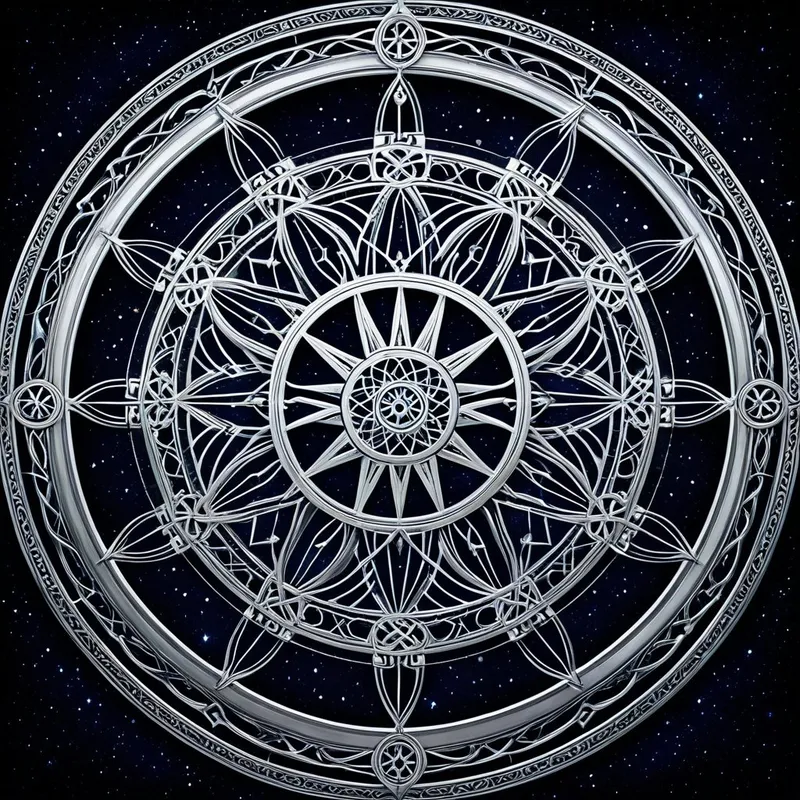
The Silver Wheel is the turning mandala of fate itself. To be born from it is to be cast into its spinning mechanism, subject to its laws.
Lleu’s journey is one of achieving consciousness despite the pronouncements of the unconscious. He is the puer aeternus forced to ground his spirit. Gwydion, the magician-uncle, represents the guiding intellect, cunning, and creative trickster energy necessary to navigate the labyrinth of fate. Blodeuwedd, the flower-wife, symbolizes the anima—the soul-image—in its most natural, beautiful, but ultimately unconscious and treacherous form. Her betrayal forces Lleu’s final, shattering transformation into the wounded eagle, a symbol of spirit brought low, only to be healed and reborn into integrated power.
The Dreamer's Resonance
When this myth stirs in the modern psyche, it often manifests in dreams of profound exclusion or impossible tasks. To dream of a shining, unreachable castle in the sky is to feel the call of Caer Arianrhod—an ideal Self or a state of wholeness that feels fated yet denied. Dreams of being unnamed, or of someone refusing to acknowledge your name, speak directly to Arianrhod’s first curse: a crisis of authentic identity, of not being seen or validated by an internalized maternal or authoritative principle.
Dreams of being unarmed, vulnerable, and unable to defend one’s boundaries mirror the second curse—a somatic feeling of powerlessness. The third curse, the “bride of no earthly race,” manifests in dreams of seeking connection with partners or projects that feel alien, unattainable, or somehow not of this world, reflecting a deep alienation in one’s capacity for eros and relatedness. The dreamer undergoing this pattern is in the throes of a primal initiation, where the old, given structures of identity are being dissolved by a harsh, fateful power, forcing a more conscious and hard-won construction of the Self.
Alchemical Translation
The alchemical process modeled here is the opus contra naturam—the work against nature, or more precisely, against one’s given, unconscious nature. Arianrhod represents the prima materia, the raw, cosmic substance of the soul with all its predetermined patterns (the starry wheel). Lleu is the filius philosophorum, the philosophical child, who must undergo separation, negation, and death to achieve the gold of sovereignty.
The curse is the prima materia; the cunning to overcome it is the alchemical art. Wholeness is not given; it is won through a dialogue with the very power that denies it.
First, the nigredo: the blackening. This is the shame of Arianrhod, the dropping of the child, the pronouncement of the curses—the crushing encounter with the shadow of the Great Mother. Then, the albedo: the whitening. Gwydion’s cunning, the creative intellect, works to extract the light (the name, the arms) from the darkness of the curse. Finally, the rubedo: the reddening. This is the most dangerous phase, symbolized by the creation of Blodeuwedd and the subsequent betrayal. It is the integration of the anima, which brings not bliss but a necessary wounding (the eagle transformation)—a confrontation with one’s own capacity for betrayal and victimhood. The restoration by Gwydion is the final coagulation: the Self, having been utterly dissolved, is reconstituted at a higher level of integration. The individual no longer merely spins on the Silver Wheel of fate but understands its mechanics and, in claiming their place, adds their unique consciousness to its turning.
Associated Symbols
Explore related symbols from the CaleaDream lexicon: