
Argus Panoptes from Greek myth Myth Meaning & Symbolism
A giant with a hundred watchful eyes is tasked with guarding a divine secret, becoming a symbol of ultimate vigilance shattered by a god's trickery.
The Tale of Argus Panoptes from Greek myth
Hear now a tale of vigilance and its undoing, a story woven on the loom of divine jealousy. In the sun-drenched valleys of Argolis, a secret was hidden. It was no ordinary secret, but a white heifer of such breathtaking beauty that the very grass seemed to bow as she passed. This was Io, a mortal woman caught in the crossfire of Olympus, transformed by a guilty Zeus to hide her from the searing gaze of his wife, Hera.
But Hera’s suspicion was a net cast wide. She saw through the bovine disguise, a divine truth shimmering beneath the hide. And so, to guard this living evidence of her husband’s betrayal, she summoned the perfect warden: Argus Panoptes. He was a son of the earth, a giant whose name meant “All-Seeing.” His flesh was not like that of other beings; it was a living tapestry of perception. A hundred eyes, luminous and unblinking, adorned his mighty frame. They were not clustered in two sockets but scattered across his body—upon his arms, his broad back, even lining the nape of his neck. While fifty eyes kept watch on the world, the other fifty rested in a slumber that was never total, a perpetual shift of consciousness that made him the unsleeping sentinel.
Io, in her bovine prison, lowed with a human sorrow, her hoofprints tracing circles of despair in the soft earth. Argus stood, an unmoving mountain of vigilance. He led her to a secluded grove, a green prison under an open sky. His eyes were a constellation upon the earth, their light sweeping the shadows, scanning the horizon, forever fixed upon his charge. The wind carried no secret past him; the rustle of every leaf was noted. He was vigilance incarnate, a living fortress built from sight.
Yet on Olympus, a plan was hatched in the heart of mischief. Zeus, writhing with guilt and desire, called upon his most cunning son, Hermes. “Lull the watcher,” commanded the cloud-gatherer. “Free her from that ceaseless gaze.”
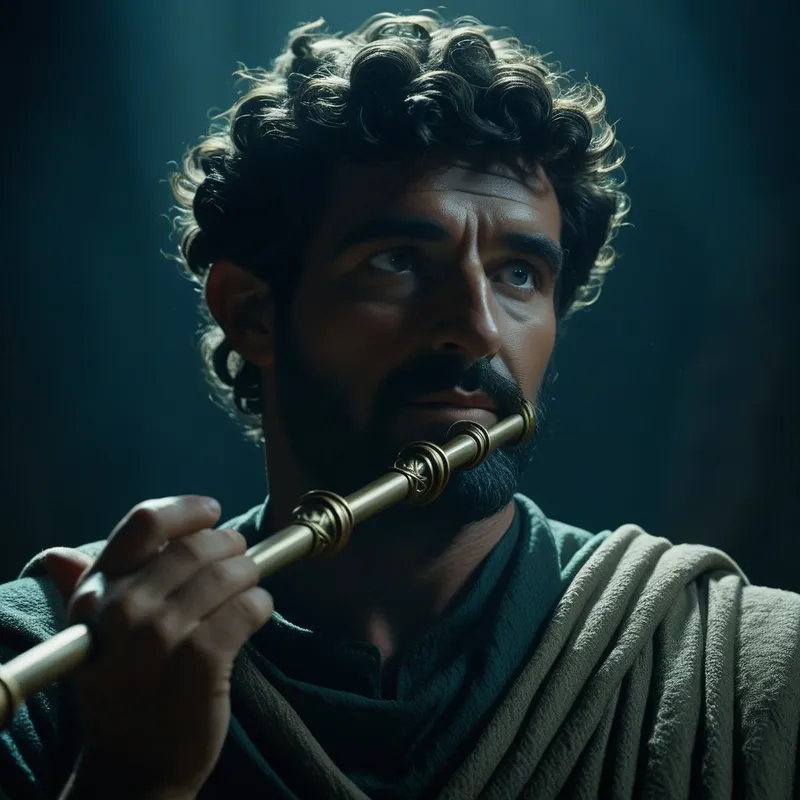
Hermes, the psychopomp, shed his divine radiance. He took the form of a simple goatherd, his feet clad in sandals that whispered against the stone. In his hands, he carried not a caduceus, but a shepherd’s syrinx—a set of hollow reeds bound with wax. He approached the grove not with stealth, but with a casual, melodic confidence. He sat upon a rock near the ever-watchful giant and began to play.
The music was not of this world. It was the sound of rustling leaves given voice, the murmur of a sleepy stream, the distant, comforting bleat of lambs at dusk. He wove tales with his notes—of gentle nymphs and drowsy satyrs, of a world softening into twilight. He spoke, too, in a voice as smooth as worn river stones, telling stories of the pipe’s invention by the god Pan. Argus listened. The giant, whose existence was pure observation, had never known such an assault on his senses, one not of threat, but of profound, enveloping lassitude.
One by one, the brilliant stars of his eyes began to dim. An eye on his shoulder closed. Then one on his wrist. The fifty that were awake grew heavy, their lids sliding shut as if weighed down by the very notes of the melody. Argus fought it; he commanded open eyes on his back to take up the watch. But the lullaby was a tide, and he was a man of stone upon the shore, slowly being submerged. He asked the shepherd to come closer, to play the tune once more, hoping the novelty would revive him, yet it only pulled him deeper into the abyss of sleep. Finally, as the last haunting note hung in the air, the final eye—a great, luminous orb upon his cheek—fluttered and closed. The unsleeping sentinel slept.
In that moment of total vulnerability, the shepherd’s guise fell away. Hermes stood revealed, a glint of cold purpose in his eye. He drew not a sword, but a harvesting sickle, its curve like a slice of moon. In one swift, terrible motion, he struck the sleeping giant’s neck. The hundred eyes were extinguished as one. The guardian fell, his great form crashing to the earth, his vigilance forever silenced. The heifer Io, witnessing the fall of her watcher, let out a cry that was both bovine and profoundly human, a sound of freedom poisoned by horror. And Hera, from her golden throne, felt the death of her servant. In a gesture of bittersweet honor, she descended. She gathered the hundred eyes from the dust and blood and placed them, forever open, upon the tail feathers of her sacred bird, the peacock—a constellation of lost watchfulness, beautiful and eternally unblinking.
Cultural Origins & Context
The myth of Argus Panoptes is a thread in the vast tapestry of archaic Greek mythology, primarily preserved in epic cycles and later synthesized by poets like Hesiod and the Roman writer Ovid. It functioned as an aetiological myth, providing a divine and dramatic origin for the striking “eyes” on a peacock’s tail. This was a common cultural function: to explain the wonders and oddities of the natural world through the actions of gods and heroes.
Beyond simple explanation, the tale was told to illustrate the cosmic dynamics of power on Olympus. It is a story of proxy warfare between Zeus and Hera, where mortals (and beings like Argus) are pawns in their marital strife. Argus represents the ultimate instrument of Hera’s domain—watchfulness over the sacred bonds of marriage. His creation and deployment show her resourcefulness and authority, while his defeat by Hermes underscores the inevitability of Zeus’s will and the potent, subversive power of the trickster archetype. It was a narrative reminder that no vigilance, however perfect, is ultimately impregnable against divine cunning and the forces of change.
Symbolic Architecture
Argus Panoptes is not merely a monster or a guard; he is a profound symbolic entity. He represents the psyche in a state of hyper-vigilant, fragmented awareness. His hundred eyes, never all resting at once, symbolize a consciousness that cannot integrate or find rest. It is perception shattered into a multitude of separate points of focus, a state of paranoid alertness that sees everything and understands nothing in its totality.
He is the embodiment of the watcher who becomes so identified with his watch that he loses his own being. His eyes are not windows for a soul, but the soul itself, scattered and exposed.
His task—to guard the transformed Io—adds deeper layers. Io, the heifer, represents instinctual life, natural vitality, and the divine spark trapped in a base, animal form (a result of divine punishment/transformation). Argus, the all-seeing, is thus the rational, controlling, and paranoid aspect of the psyche tasked with imprisoning the instinctual self. He is the ego’s desperate attempt to monitor and control the wild, divine, or unconscious forces within, a duty that is both immense and ultimately unsustainable.
His defeat by Hermes is the crucial alchemical moment. Hermes, god of boundaries, thresholds, and communication, represents the necessary trickster function that disrupts stagnant systems. His music is not violence, but enchantment—the language of the unconscious, the lure of poetry, dream, and symbol that can bypass the rigid guard of the hyper-rational mind. The sickle is the final, swift cut of differentiation, the necessary “death” of an old, rigid structure of consciousness so that a new pattern (symbolized by the peacock’s tail) can be born.

The Dreamer’s Resonance
When the pattern of Argus Panoptes stirs in the modern dreamscape, it signals a psyche under the strain of excessive vigilance. The dreamer may not see a hundred-eyed giant, but they may dream of being watched by countless cameras, of having eyes on their skin, or of being tasked with an impossible guard duty over something vulnerable. They may dream of a relentless, sleepless anxiety, or of a beautiful, trapped animal they must both protect and confine.
Somatically, this can correlate with states of burnout, adrenal fatigue, insomnia, or generalized anxiety disorder—the body keeping the score of a mind that refuses to rest. Psychologically, it is the process of a consciousness fragmented by trauma, perfectionism, or paranoia. The dream is presenting the cost of this all-seeing posture. The figure of Argus is the dreamer’s own overdeveloped defensive structure, a caregiver archetype twisted into a prison warden, so dedicated to protection that it has become a self-imposed tyranny. The dream asks: What precious, instinctual part of yourself (your Io) are you holding captive under constant surveillance? And what lullaby—what art, therapy, or surrender—must be heard to put the watcher to sleep?

Alchemical Translation
The myth models a critical phase of psychic transmutation: the dismantling of the monolithic guardian complex to liberate the trapped creative or instinctual life. The individuation process requires not the strengthening of our inner Argus, but its intelligent dissolution.
First, we must recognize the Argus within—the part of us that believes total control and ceaseless awareness is possible and necessary. This is the complex that says we must never drop our guard, that every aspect of life and self must be monitored. Then, we must invite the Hermes function: the cunning, creative, and boundary-crossing aspect of psyche. This is not brute force, but guile. It is the willingness to listen to the “pipes”—to engage in therapy, active imagination, artistic expression, or contemplative practice. These are the melodies that can enchant and relax the rigid ego-structure, allowing its vigilant grip to loosen.
The death of Argus is not a murder, but a sacrifice. It is the sacrifice of fragmented, paranoid consciousness to make way for integrated awareness.
The final stage is reintegration, symbolized by Hera’s act. The hundred eyes are not destroyed; they are transplanted. They become the beautiful, ornamental eyes on the peacock’s tail. In the alchemy of the soul, this represents the transformation of paranoid scrutiny into wise perception, of anxious vigilance into panoramic awareness. The eyes are no longer tools of control but emblems of beauty and insight, integrated into a new, more magnificent whole. The liberated Io—our instinctual, creative self—may still have a long journey ahead (as Io did), but she is no longer frozen in the prison of constant watchfulness. The process teaches that true security does not come from an army of unblinking eyes, but from the courage to let the guard sleep, to trust the deeper, guiding rhythms of the psyche, and to allow the fragments of our perception to be reassembled into a pattern of wholeness.
Associated Symbols
Explore related symbols from the CaleaDream lexicon: