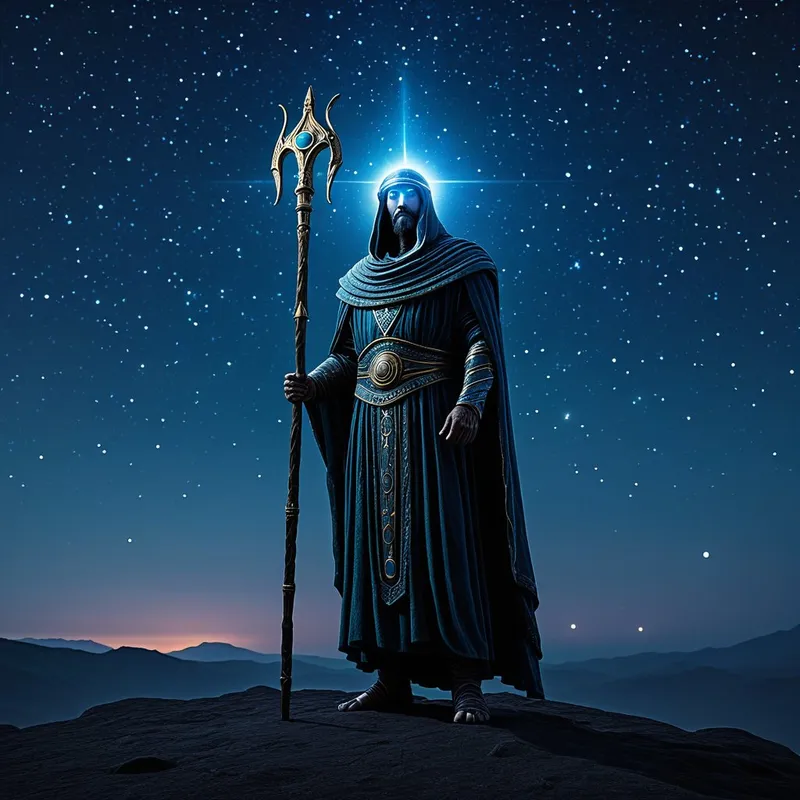
Argus Panoptes Myth Meaning & Symbolism
The tale of the hundred-eyed giant, slain by Hermes to free Io, a story of surveillance, seduction, and the fragmentation of consciousness.
The Tale of Argus Panoptes
Hear now the story of sight and sleep, of a guardian who was a prison, and a prison that became a constellation.
In the age when the gods walked with vengeance in their hearts, a storm brewed in the halls of Olympus. Hera, she of the piercing gaze and unyielding will, had discovered her husband’s latest transgression. For Zeus, in his endless desire, had transformed the priestess Io into a beautiful, white heifer to hide her from his wife’s wrath. But Hera’s suspicion was a scent on the wind, and she demanded the heifer as a gift.
“A fine beast,” Hera declared, her voice like cold marble. “So fine, in fact, that it requires a guardian worthy of its beauty. One whose vigilance is without equal.”
And so she summoned Argus Panoptes. He was a giant, not of brute strength, but of perception. From his shoulders to his heels, a hundred eyes adorned his flesh—luminous orbs of amber, grey, and deepest blue. They did not all sleep at once. While fifty rested, the other fifty remained open, watchful, drinking in the world. He was the perfect sentinel, an unblinking wall of consciousness. To him, Hera entrusted the hapless Io, tethering her in a sacred grove. Day and night, Argus watched. His eyes saw the grass bend, the cloud pass, the tear track its way down the bovine cheek of the trapped maiden within.
Zeus, chafing at this impeccable prison, called upon his most cunning son. “Hermes,” he commanded, “weave a spell of forgetting. Lull the watcher to a sleep from which he will not wake.”
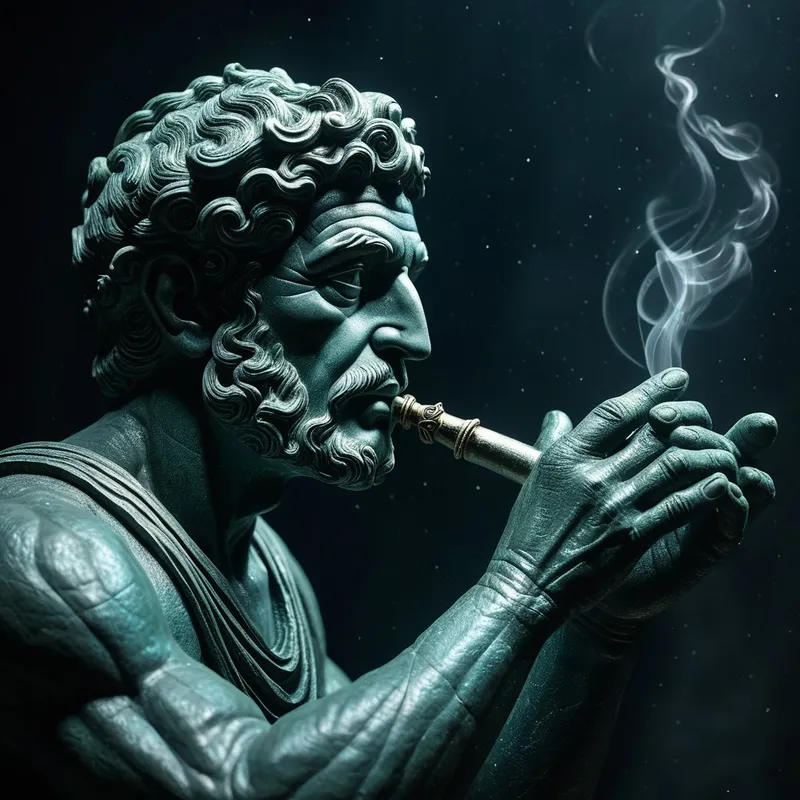
Hermes, the psychopomp, shed his winged sandals and took up the guise of a simple shepherd. He approached the grove, not with stealth, but with sound. From a handful of reeds, he fashioned a syrinx, a pan-pipe, and began to play. The melody was not of this world. It was the sound of distant streams, the sigh of the wind through barley, the deep, slow breath of the earth itself. It was the very music of sleep.
Argus listened. His many eyes turned toward the source of this gentle invasion. One by one, the waking eyes grew heavy. The melody seeped into his being, a soft fog over his brilliant awareness. He invited the shepherd to sit, to play more, to tell tales of far-off flocks. As Hermes spoke, his voice wove with the music, a story of a gentle, endless afternoon. One eye closed. Then another. And another. The giant’s mighty head began to nod.
When the final eye had shuttered, when the fortress of vigilance lay utterly undefended, Hermes acted. In a motion both swift and sorrowful, he drew a sickle-shaped blade and struck. The guardian fell, his hundred lights extinguished into eternal night.
Hera, feeling the death of her servant across the heavens, descended in a fury. But from her wrath came a strange memorial. She took the hundred eyes from her fallen watcher and placed them upon the tail feathers of her sacred bird, the peacock. There they would shine forever, a glittering, watchful fan—a reminder of the guardian who saw all, yet was blind to the lullaby of his own end. And Io, the heifer, was free to begin her long, tortured journey across the world, pursued now by a vengeful gadfly sent by the grieving queen.
Cultural Origins & Context
The myth of Argus Panoptes is a foundational narrative from the corpus of ancient Greek mythology, primarily preserved in epic poetry and later scholarly compilations. Our most detailed account comes from Ovid’s Metamorphoses, a first-century CE Latin epic that systematized and poeticized countless transformation myths. Earlier references appear in fragments of lost Greek epics and in the works of playwrights like Aeschylus, who used the Io-Argus subplot in his Suppliants.
The tale was not mere entertainment; it functioned as a theological and cosmological explanatory narrative. It explained the origin of the peacock’s plumage, a bird sacred to Hera. More profoundly, it explored the dynamics of divine power, jealousy, and the cosmic order. Argus served as an extension of Hera’s own sight—her junonia or vigilant authority. The myth was told by bards and poets as a cautionary episode about the limits of control, the inevitability of deception, and the tragic fate of those caught in the crossfire of divine conflicts. It reinforced the idea that no power, not even perfect surveillance, is immune to the subversive charms of Hermes, the god of thresholds and transitions.
Symbolic Architecture
Argus Panoptes is not merely a monster or a guard. He is the embodiment of total, fragmented consciousness. His hundred eyes represent a psyche that is all-seeing but not whole—awareness split into a multitude of separate, simultaneous points of observation. He is the paranoid mind, the insomniac intellect, the ego attempting to monitor every threat, memory, and desire at once.
The true prison is not the chain that binds the body, but the unblinking eye that binds the soul to a single, terrified point of view.
Io, the heifer, symbolizes the instinctual, creative, or feminine spirit (psyche) trapped and paralyzed by this hyper-vigilant state. She is life force subjected to relentless examination. Hermes, with his enchanting music and swift blade, represents the necessary intervention of the unconscious—the trickster function that dissolves the tyranny of conscious control through metaphor, art, or dream. His lullaby is the call of the deep self, the numinous image that finally allows the exhausting project of total surveillance to cease. The transfer of Argus’s eyes to the peacock’s tail is the final, alchemical symbol: fragmented, paranoid sight is transformed into a unified, beautiful, and displayable pattern—a testament to vigilance, but one that is now part of nature’s decorative order, not its punitive one.

The Dreamer's Resonance
When the pattern of Argus manifests in modern dreams, it signals a profound somatic and psychological process: the exhaustion of the hyper-vigilant ego. The dreamer may experience imagery of being watched by disembodied eyes (cameras, portraits, animals), feeling trapped in a sterile, well-lit place, or struggling with a sense of paralysis under scrutiny.
This is the psyche’s depiction of a life lived under the pressure of constant self-monitoring, performance anxiety, or external surveillance (social, professional, digital). The somatic correlate is often chronic tension, a feeling of being “on” at all times, or insomnia. The dream is presenting the unsustainable nature of this Argus-state. The appearance of a soothing, repetitive sound (like music or water) or a cunning, helpful figure in the dream may be the Hermes-function emerging, initiating the necessary “slaying”—a deep psychological release that feels like a death of an old way of being, followed by a descent into restorative, if frightening, unconsciousness. The dreamer is being shown that their wholeness depends on letting some parts of themselves—some of those watching eyes—close and rest.

Alchemical Translation
The myth models the individuation process as the transmutation of fragmented consciousness into integrated awareness. The initial state is one of inner conflict: the Zeus-force (unconscious desire/impulse) and the Hera-force (conscious structure/judgment) are at war, with the Self (Io) trapped as a beast between them. The ego, in the form of Argus, attempts to manage this by becoming a perfect, multi-perspectival warden. But this is a brittle, exhausting solution.
Individuation begins not with seeing more, but with consenting to see less—to allow the hypnotic melody of the unknown to close the eyes of the knower.
The alchemical work is performed by Hermes, the Mercurius of the psyche. His music is the active imagination, the engagement with symbol, art, or therapy that bypasses rational vigilance. The “slaying” of Argus is a critical, painful dissolution of the ego’s rigid control complex. It feels like a failure, a collapse. This is the nigredo, the darkening. But from this death, Hera—the archetypal principle of relatedness and form—performs the final transmutation. She does not discard the eyes (the capacity for perception) but redecorates them. They become the peacock’s tail: a symbol of the Self in its glorious, integrated complexity. The hundred perspectives are no longer jailers but facets of a magnificent, cohesive whole. The liberated Io must still wander, but she is now moving, on her journey toward eventual restoration. For the modern individual, the myth teaches that wholeness is not achieved through perfect control and observation, but through the courageous, trickster-led surrender of that control, trusting that a deeper, more beautiful pattern will emerge from the fragments.
Associated Symbols
Explore related symbols from the CaleaDream lexicon:
- Attention
- Sight
- Monitor
- Drone
- Eyes in the Back of Head
- Giant Eyeball
- Innocent Bystander
- Astronomical Telescope
- Peering into a Bug's Eye
- Mantis Shrimp
- Chameleon Eyes
- Lizard's Tongue Flick
- Microscope
- Photographer's Camera
- Cameraman's Lens
- Digital Camera
- Magnifying Glass
- Sunlit Telescope
- Dazzling Surveillance Camera
- Drone Controller
- Dystopian Drone
- Furtive Glances
- Cyber Anxiety
- Digital Surveillance
- Surveillance Camera
- Surveillance Capitalism
- Cutaway
- Peripheral
- Radar
- Satellite
- Magnify