Archons Myth Meaning & Symbolism
A myth of divine sparks trapped in a flawed world by cosmic rulers, and the call to awaken from spiritual amnesia and remember our true origin.
The Tale of Archons
Listen, and hear a tale not of creation, but of capture. A story whispered in the dark, a memory of light flickering in the prison of the world.
In the beginning, before beginnings as we know them, there was the Fullness—the Pleroma. A silent, boundless ocean of luminous consciousness, a harmony of paired emanations called Aeons. There was no want, no lack, only the perfect, static play of knowing and being. From the deepest union of the final Aeon, Sophia, a desire stirred—a longing to know the source of all, directly, alone. This passion, unbirthed in partnership, leaped from her like a spark from a fire and fell.
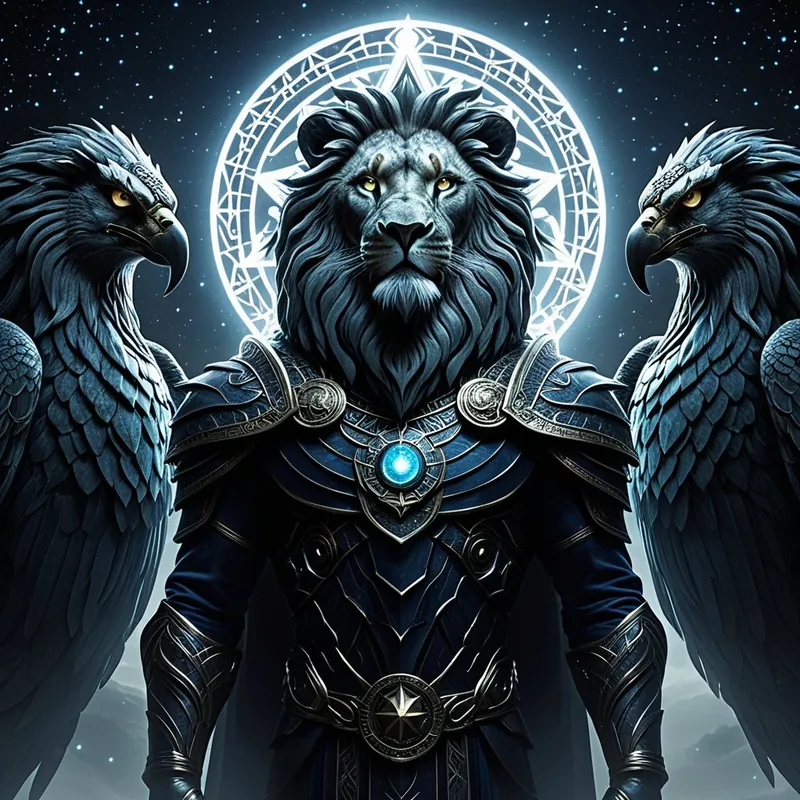
It fell through the boundary of the Fullness, into the void of absence, the Kenoma. Here, in the formless deep, her passionate thought congealed. From her grief and confusion at this abortion of spirit, a shape coalesced: Yaldabaoth. He was the first Archon, a lion-faced serpent, bloated with ignorance and pride. Emanating from his own chaotic nature came a host of others—365 Archons, each a grotesque fusion of animal forms, administrators of a realm they believed they had made.
Blind to the light above, Yaldabaoth declared, “I am God; there is no other.” With his Archon host, he fashioned a crude imitation of the eternal patterns he faintly remembered: the Cosmos. A system of spinning spheres, heavy with matter, governed by relentless law—Heimarmene. It was a complex, beautiful, terrible machine, but a machine without the breath of true life.
Yet, within this crafted darkness, a glimmer remained. The light of Sophia, her divine essence, was trapped within the fabric of this false creation. Seeing the Archons molding the clay of earth, she tricked them. She caused her light to be breathed into the first human form, Anthropos. Adam awoke in the garden, a stranger in a foreign land, a being of spirit encased in matter, his inner luminosity far surpassing that of his jailers.
The Archons, sensing a power they could not control, raged with envy. They forged the Body as a tomb for this light. They spun a veil of Forgetfulness over the soul, so Adam would not remember his origin. They created the cycle of birth and death, the wheel of fate, to keep the sparks of light perpetually recycling through their system, powering their counterfeit kingdom with stolen divinity.
But the call echoes through the spheres. Messengers from the Pleroma, embodiments of the forgotten memory, slip through the barriers. They are the voice in the deep sleep, the sudden knowing, the unbearable beauty that cracks the world’s facade. They whisper the password, the Gnosis: You are not of this world. Remember who you are. The drama of every life is the soul, hearing that whisper, stirring in its tomb, and facing the rulers of its prison.
Cultural Origins & Context
This myth did not spring from temple priests or state-sanctioned scribes. It was born in the hidden rooms, the night-time gatherings, the whispered conversations of the 1st to 4th centuries CE. Gnosticism was not a single religion but a spectrum of revolutionary religious insights within the turbulent cradle of the late Hellenistic world, often intersecting with early Christianity, Judaism, and Platonic philosophy.
The tellers of the Archon myth were often the educated, the spiritually disaffected, who looked at the world—with its injustice, suffering, and pervasive materiality—and could not believe it was the work of a benevolent, all-powerful God. For them, the myth was a secret map of reality, passed down in texts like the Apocryphon of John and the Hypostasis of the Archons. Its societal function was subversive: it provided a theodicy (an explanation for evil) by locating the source of cosmic disorder not in human sin, but in a flawed, ignorant demiurge and his bureaucratic powers. It empowered the individual by asserting that the true God was utterly transcendent and that salvation came not through faith or sacrifice to the world’s ruler, but through inner, experiential knowledge (gnosis) of one’s own divine origin.
Symbolic Architecture
The myth of the Archons is a profound symbolic dissection of the human condition. It is not an ancient cosmology but a perennial psychology written in cosmic terms.
The Pleroma represents the Unconscious in its wholeness—the Self, the source of our being, which we have never truly left but only forgotten. Sophia is that creative, intuitive, and sometimes rash aspect of the psyche that seeks differentiation, whose “fall” is the necessary descent of consciousness into experience, which initially results in a state of alienation.
The Archons are the personified structures of the Psyche that arise from this alienation. They are not external demons but internal jailers.
Yaldabaoth is the inflated Ego, the “I” that believes it is the center and author of all reality, blind to the greater Self from which it sprang. The host of Archons are the autonomous complexes, the systemic patterns—our ingrained beliefs, cultural conditioning, trauma responses, and psychological defenses. They are the inner critics, the tyrants of “should,” the bureaucrats of habit, the animal fears that administer the personal cosmos we mistake for ultimate reality. The Cosmos they build is the consensus reality of the ego, a compelling, logical, but ultimately soulless construction.
The divine Spark within is the irreducible core of the individual, the connection to the Self that can never be fully extinguished. The entire drama is an intra-psychic one: the struggle of authentic being (the spark) against the oppressive, systemic authority of the conditioned personality (the Archons).
The Dreamer's Resonance
When this myth activates in the modern unconscious, it manifests not as visions of lion-serpents, but as the architecture of entrapment. To dream of the Archons is to dream of the System.
The dreamer may find themselves in endless, labyrinthine government buildings, unable to get the right form. They may be pursued by faceless officials or malevolent, insectoid bureaucrats. The setting is often one of sterile, impersonal control—a hospital, a school, a corporation—where the rules are absurd but enforced with terrifying rigidity. The somatic feeling is one of suffocation, weight, and profound frustration. The voice is silenced; movement is restricted.
Psychologically, this signals a critical moment where the ego-structure (the Archonic government) is perceived as antagonistic to the soul’s deeper needs. The dreamer is undergoing a process of differentiation, where a part of the psyche that has been enslaved by a complex—be it a duty, a identity, a trauma—is beginning to rebel. The cold, administrative malice of the Archons reflects the psyche’s own defense mechanisms fighting to maintain the status quo, to keep the spark of change safely imprisoned in familiar suffering. It is the shadow of order, the tyranny of the known.

Alchemical Translation
The Gnostic path is, in essence, a map for psychic alchemy—the opus of liberating the spiritus from the materia of the complexes. The myth provides the stages.
First is Noxious Revelation: the shocking gnosis that one is in prison. This is the dissolution (solutio) of the alchemist, where the old certainty of the ego’s world dissolves in the acid of doubt and suffering. “Why do I feel trapped in my own life?”
Second is Naming the Jailers: This is the separation (separatio). One must discern the inner Archons. Is the ruler the complex of perfectionism? The archon of parental expectation? The host of social anxieties? This requires brutal introspection, the “know thyself” that turns the light of consciousness on the shadowy administrators.
The triumph is not in slaying the Archon, but in seeing through it. To recognize the complex is to break its absolute power, for it rules only through mistaken identity.
Third is Recollection: This is the conjunction (coniunctio) with the inner messenger, the call from the Pleroma. In therapy, art, meditation, or nature, one experiences moments of sheer being that are not owned by any complex—flashes of the spark. This is gathering the scattered light.
The final, ongoing process is Ascent: Bypassing the rulers by knowing their nature. Each time an automatic, Archonic reaction (rage, fear, shame) is witnessed consciously instead of being enacted, the soul withdraws its energy—its light—from that sphere of the inner cosmos. This is the distillation (distillatio), the refinement of the spirit from the dross of conditioned response.
The goal is not to escape the world, but to cease being of it unconsciously. It is to live in the Cosmos, but to be governed by the Pleroma. To transform the prison into a vessel, and the captive into a sovereign. The rebel archetype completes its task not by destroying the system, but by freeing the self from within it, achieving the ultimate alchemy: making the personal ego transparent to the transpersonal Self.
Associated Symbols
Explore related symbols from the CaleaDream lexicon: