Archimedes' Lever Myth Meaning & Symbolism
A tale of a mortal who, through pure intellect, claimed the power to move the Earth itself, challenging the very order of the cosmos.
The Tale of Archimedes’ Lever
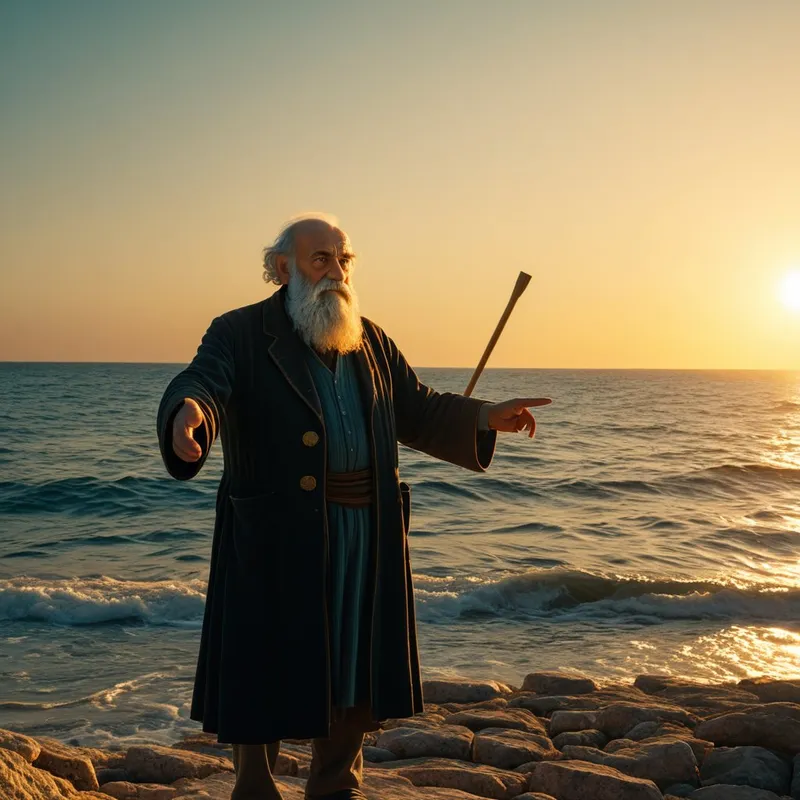
Hear now, a story not of gods clashing on Olympus, but of a mortal mind that dared to touch the machinery of the cosmos. In the sun-baked stone of Syracuse, there lived a man whose kingdom was not of land or gold, but of sand and line and number. His name was [Archimedes](/myths/archimedes “Myth from Greek culture.”/), and his thoughts were labyrinths where even light could lose its way.
King Hieron, his brow heavy with [the crown](/myths/the-crown “Myth from Various culture.”/)’s weight, came to him with a puzzle wrapped in suspicion. A craftsman had forged for him a wreath of purest gold, or so it was promised. But a whisper had entered the king’s ear: had silver, base and pale, been mixed within? The gold was too precious to melt, the wreath too sacred to destroy. “Find the truth,” the king commanded, “without marring a single leaf.”
Archimedes carried this riddle like a stone in his chest. It followed him through the colonnades, haunted his calculations, and stole his sleep. The truth of metal was a truth of weight and space, but how to measure the space within a crown of such intricate, winding form?
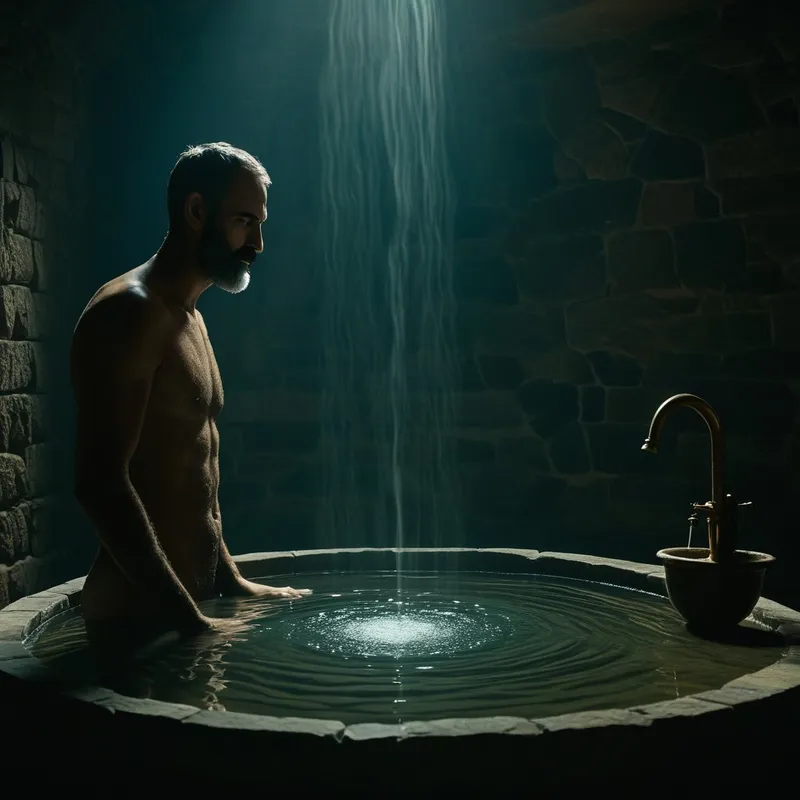
Driven by a fever of the mind, he sought the public baths, a place of steam and murmured gossip, seeking to wash the problem from his skin. As he lowered himself into the brimming basin, the [water](/myths/water “Myth from Chinese culture.”/) rose to meet him, spilling over the stone lip in a grateful sigh. And in that moment, he saw it. His own body, a mass displacing its equal in water. The water that fled the tub was the very shape of the space he occupied.
Eureka!
[The word](/myths/the-word “Myth from Biblical culture.”/) was not a whisper but a cry torn from the soul, a bolt of pure knowing. He did not pause for robe or sandal. Naked, dripping the sacred water of revelation, he ran through the streets of Syracuse, the solution shining upon him like a second sun. The wreath, if pure, would displace water equal to its weight in gold. Any adulteration would betray itself in the measure of the overflow. The truth was held not in the crown, but in the water it rejected.
From this [baptism](/myths/baptism “Myth from Christian culture.”/) in practical truth, a greater vision was born. In his workshop, among spheres and spirals etched in dust, he contemplated the principle that had revealed the king’s fraud: the interplay of force, weight, and point. He saw that with a lever long enough and a place to stand, the application of a small force at a great distance could move an immovable weight. His mind, unbound, scaled this principle to the very limits of the cosmos.
And so he made his declaration, not to a king, but to the universe itself: “Give me a place to stand, and with a lever I will move the Earth.” It was not a boast of muscle, but of mind. He had found the hidden weak point in reality’s armor, the crack where a mortal’s will, if applied with perfect understanding, could insert a tool and shift the foundation of all things.
Cultural Origins & Context
This is not a myth born in the misty age of heroes, but in the clear, rational light of Hellenistic Greece, circa the 3rd [century](/myths/century “Myth from Biblical culture.”/) BCE. It comes to us not from epic poets, but from later historians and engineers like Vitruvius and Plutarch, who recorded the anecdotes of great thinkers. The tale exists in the borderlands between verified history and legendary anecdote, a “scientific myth” that reveals the cultural [psyche](/myths/psyche “Myth from Greek culture.”/) of its time.
Its societal function was multifaceted. For the Greeks, it celebrated [Metis](/myths/metis “Myth from Greek culture.”/)—practical, cunning intelligence—as a divine force. Archimedes was the archetypal theoros, the contemplator, whose insights (theoria) had immense practical (praxis) consequences. The story served to elevate the philosopher-engineer to heroic status, demonstrating that the true power of humanity lay not in pleasing the gods but in deciphering their logical blueprint for the cosmos. It was a foundational narrative for a culture that believed the universe was fundamentally understandable, a cosmos (kosmos) meaning “beautiful order,” waiting for a mind keen enough to find its leverage points.
Symbolic Architecture
At its core, the myth is a supreme [metaphor](/symbols/metaphor “Symbol: A figure of speech where one thing represents another, often revealing hidden connections and deeper truths through symbolic comparison.”/) for the power of [consciousness](/symbols/consciousness “Symbol: Consciousness represents the state of awareness and perception, encompassing thoughts, feelings, and experiences.”/) itself. The [lever](/symbols/lever “Symbol: A tool for applying force to create movement or change, symbolizing agency, control, and the ability to initiate transformation.”/) is [the principle](/symbols/the-principle “Symbol: A fundamental truth, law, or doctrine that serves as a foundation for a system of belief, behavior, or reasoning, often representing moral or ethical standards.”/), the abstract law. The [fulcrum](/symbols/fulcrum “Symbol: A point of support or balance upon which a lever pivots, symbolizing a critical juncture, pivotal decision, or foundational principle that enables transformation.”/) is the point of understanding, the [moment](/symbols/moment “Symbol: The symbol of a ‘moment’ embodies the significance of transient experiences that encapsulate emotional depth or pivotal transformations in life.”/) of Eureka. The [Earth](/symbols/earth “Symbol: The symbol of Earth often represents grounding, stability, and the physical realm, embodying a connection to nature and the innate support it provides.”/) represents the seemingly immovable object: our circumstances, our psyche, the [weight](/symbols/weight “Symbol: Weight symbolizes burdens, responsibilities, and emotional loads one carries in life.”/) of [the world](/myths/the-world “Myth from Tarot culture.”/), or the inertia of [reality](/symbols/reality “Symbol: Reality signifies the state of existence and perception, often reflecting one’s understanding of truth and life experiences.”/).
The lever does not create force; it redirects it. The psyche does not create energy; it finds the point of application.
Archimedes represents the awakened intellect, the part of [the self](/myths/the-self “Myth from Jungian culture.”/) that seeks not to confront weight head-on, but to find the strategic vantage point from which all weights become manageable. His naked run symbolizes the stripping away of preconception, the [vulnerability](/symbols/vulnerability “Symbol: A state of emotional or physical exposure, often involving risk of harm, that reveals authentic self beneath protective layers.”/) and raw authenticity required for true [insight](/symbols/insight “Symbol: A sudden, deep understanding of a complex situation or truth, often arriving unexpectedly and illuminating hidden connections.”/). The bathwater is the [prima materia](/myths/prima-materia “Myth from Alchemical culture.”/) of the [soul](/symbols/soul “Symbol: The soul represents the essence of a person, encompassing their spirit, identity, and connection to the universe.”/), the reflective medium in which the shape of a [problem](/symbols/problem “Symbol: Dreams featuring a ‘problem’ often symbolize internal conflicts or challenging situations that require resolution and self-reflection.”/)—and its [solution](/symbols/solution “Symbol: A solution symbolizes resolution, clarity, and the overcoming of obstacles, often representing a sense of accomplishment.”/)—becomes visible.
The demand for a “place to stand” (pou sto) is the most profound psychological element. It is the [quest](/symbols/quest “Symbol: A quest symbolizes a journey or search for purpose, fulfillment, or knowledge, often representing life’s challenges and adventures.”/) for an inner [foundation](/symbols/foundation “Symbol: A foundation symbolizes the underlying support systems, values, and beliefs that shape one’s life, serving as the bedrock for growth and development.”/) of unshakable certainty, a core self or a fundamental [truth](/symbols/truth “Symbol: Truth represents authenticity, honesty, and the quest for knowledge beyond mere appearances.”/) from which one can operate. Without this inner ground, all [leverage](/symbols/leverage “Symbol: Using a small force to create a large effect; gaining advantage through strategic positioning or influence.”/) is useless; we have nothing to push against.
The Dreamer’s Resonance
When this myth stirs in the modern dreamscape, it often manifests as dreams of discovering hidden mechanisms, secret doorways in solid walls, or finding a simple tool that can accomplish an impossible task. One might dream of trying to move a colossal, dark boulder (a depression, a lifelong burden) and suddenly noticing a small, perfectly placed stone underneath it.
Somatically, the dreamer may be processing a feeling of intellectual or creative breakthrough, a “Eureka” moment that is integrating from the unconscious into conscious life. Alternatively, it may highlight a feeling of powerlessness, where the dreamer is searching for that elusive “place to stand”—a sense of identity, purpose, or ethical ground from which to act. The dream is the psyche’s reassurance: the leverage exists, if you can find the correct point of application and the firm ground within yourself.
Alchemical Translation
The individuation process modeled here is not one of violent conquest, but of elegant, intelligent transmutation. The “base metal” of our chaotic, unconscious impulses and overwhelming life problems (the impure crown, the immovable Earth) is not destroyed; it is understood and rearranged.
[The first stage](/myths/the-first-stage “Myth from Alchemical culture.”/) is immersion in the [solutio](/myths/solutio “Myth from Alchemical culture.”/), symbolized by the bath. This is a necessary surrender, a letting go of egoic striving that allows the unconscious to offer up its truth in the form of symbolic insight (the displaced water). The “Eureka” is the [albedo](/myths/albedo “Myth from Alchemical culture.”/), the whitening, the moment of brilliant clarity.
The goal is not to become the weight, nor the force, but to become the fulcrum—the conscious, stable point around which transformation pivots.
Then comes the application: constructing the lever of principle. This is the conscious effort to formulate the insight into a workable philosophy, a practice, or a new perspective. The final, eternal promise is the [rubedo](/myths/rubedo “Myth from Alchemical culture.”/)—the reddening, the culmination. It is the realization that the self, once grounded in its own being and armed with understanding, is no longer a victim of cosmic forces but a participant in [the great work](/myths/the-great-work “Myth from Alchemical culture.”/) of moving worlds, starting with the world of one’s own psyche. We are all asked to find our lever, our principle, and most importantly, our place to stand.
Associated Symbols
Explore related symbols from the CaleaDream lexicon: