Archimedes Myth Meaning & Symbolism
The story of a mind so brilliant it could defend a city with mirrors and move the world with a lever, yet was undone by the very curiosity that defined it.
The Tale of Archimedes
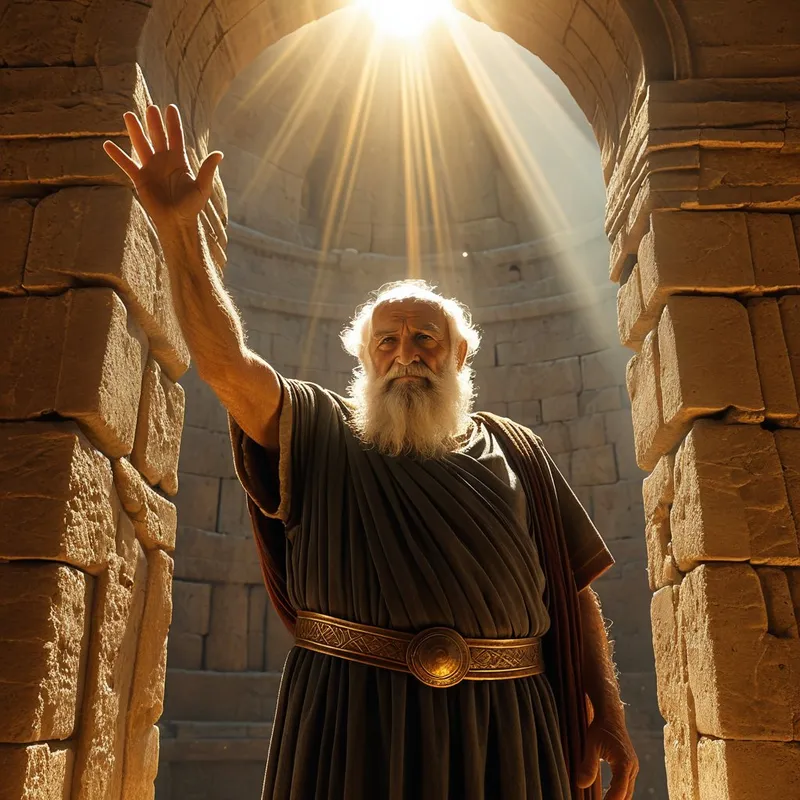
The sun over Syracuse was a tyrant, hammering the white marble and bronze of the city into a blinding glare. In the harbor, the sea itself seemed to boil with the menace of Marcellus's fleet, a forest of hostile masts and painted eyes on prows. The air tasted of salt, fear, and hot stone. And in the midst of this siege, in a room cluttered with papyrus, wax tablets, and strange brass models, an old man forgot the world.
His name was Archimedes. His world was one of lines, curves, and perfect ratios. While soldiers shouted and walls shook, he saw only the purity of a sphere inscribed within a cylinder, the secret proportion he had begged his friends to carve upon his tomb. The practical demands of the king, Hiero, were but trivial puzzles to his boundless nous—mind. The crown’s purity? He discovered it in the public bath, watching the water displaced by his own body, and ran naked through the streets, crying “Eureka!”—I have found it!—a soul possessed not by madness, but by a truth so beautiful it demanded the shedding of all dignity.
But the greatest puzzle was the siege itself. Marcellus brought his “Sambuca” to the walls, a monstrous wooden tower. The people despaired. Archimedes looked, calculated, and built. He devised terrible engines: iron claws that reached from the walls to seize ships and dash them upon the rocks; catapults of uncanny range and power. And then, his most audacious thought: he arrayed polished bronze shields along the battlements, angling them to capture the tyrannical sun itself. He focused its scattered fury into a single, searing point of light, and directed it upon the sails of the approaching fleet. Smoke curled upward, then flame. The sea burned at his command. He had harnessed Helios as a weapon.
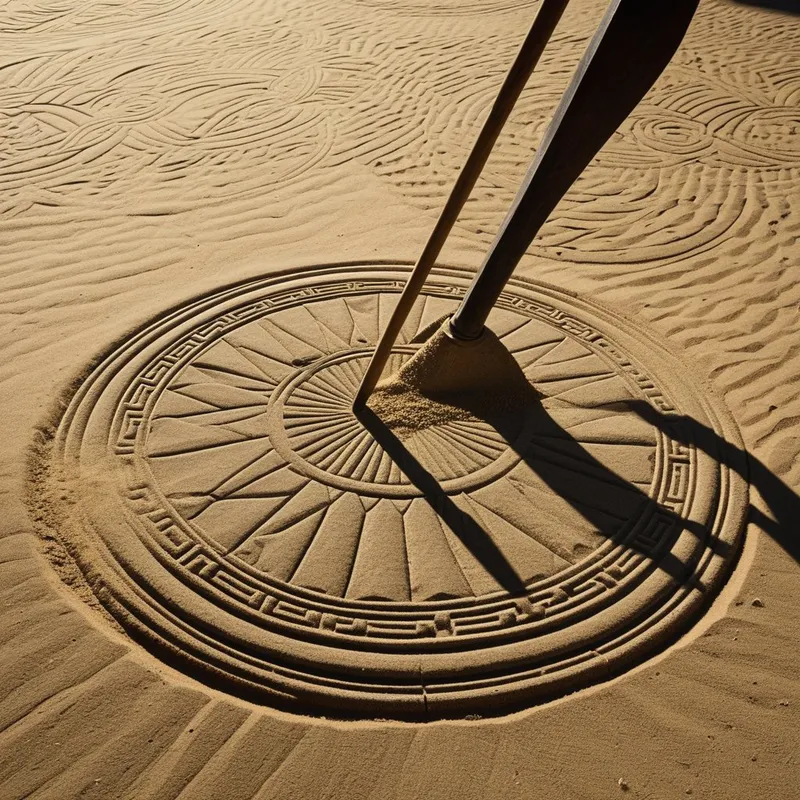
For years, his genius held the mighty Romans at bay. Marcellus himself said they fought not against a man, but a Briareus of geometry. Yet the city’s fate was written by larger forces. During the final sack, chaos reigned. A Roman soldier, bursting into a courtyard, found the old man bent over a diagram drawn in the sand. “Do not disturb my circles,” Archimedes said, not looking up, his mind orbiting a problem beyond life and death. The soldier, understanding nothing but an order disobeyed, drew his sword. The mind that could move the world was stilled by a single, brutal stroke. The circles in the sand were smeared with red, the ultimate, irrational equation.
Cultural Origins & Context
Archimedes was not a god of Olympus, but a historical figure of the 3rd century BCE, a citizen of the vibrant, Hellenistic crossroads of Syracuse in Sicily. His myth, however, was born the moment he died. The primary sources are the historians Plutarch and Polybius, writing centuries later, who already treated him as a legendary figure. They passed down not just his achievements, but the iconic anecdotes—the bath, the lever, the burning mirrors, the fatal command—that transformed the engineer into an archetype.
In the Greek cultural imagination, which venerated sophia (wisdom) and metis (cunning intelligence), Archimedes became the ultimate embodiment of the theoretical mind applied to the material world. He stood at the precipice where Athena’s owl met Hephaestus’s forge. His stories served a societal function: they were parables of the power and peril of pure intellect. They warned that the mind which solves the cosmos can be blind to the sword at its back, and that the state which relies on a single genius is as fragile as the line he draws in the sand.
Symbolic Architecture
Archimedes is the myth of the Intellect as a world-shaping and world-renouncing force. He represents the part of the human psyche that seeks not to conquer through force, but to understand and thus command the fundamental principles of reality.
The lever is not a tool, but a principle: a small, disciplined application of insight can move an unimaginable weight. The mind is the place to stand.
The “Eureka!” moment is the sacred flash of gnosis, where a truth hidden in the mundane (the bathwater) reveals itself, requiring a total, ecstatic surrender of the social self (his naked run). The war machines and burning mirrors symbolize the dangerous marriage of pure knowledge and raw power—the moment the sage’s insight is conscripted by the king, becoming both salvation and a terrifying, impersonal force.
His death is the core of the myth’s symbolic architecture. The undisturbed circles in the sand represent the absolute sovereignty of the inner world, the temenos or sacred precinct of the mind. His command, “Do not disturb my circles,” is the ultimate statement of the psyche’s integrity. The soldier’s sword is the brutal, uncomprehending intrusion of the literal, material world upon this sacred space. The myth tells us that the cosmos the mind builds is perfect, logical, and profoundly vulnerable.
The Dreamer's Resonance
To dream of Archimedes is to dream of one’s own latent, formidable intellect confronting a siege. The dreamer may be facing an overwhelming problem (the Roman fleet) and feel a pressure to produce a miraculous, ingenious solution. The somatic sensation is often one of intense, feverish focus—a brain buzzing with potential energy.
The naked “Eureka!” run in a dream signals a breakthrough so profound it shatters the dreamer’s persona, their dressed-up, social self. It is a moment of embarrassing, glorious authenticity. Dreaming of drawing perfect, defenseless circles in the sand while danger approaches speaks to a deep psychological process: the need to preserve a core of inner truth, creativity, or sanity amidst a life that feels like it is being sacked by external demands. The soldier who kills is the dreamer’s own shadow of brute pragmatism, the part that says, “Stop this foolish thinking and deal with the real world!”—often at the cost of the soul’s most precious work.
Alchemical Translation
The alchemical process modeled by Archimedes is the sublimation of mind: the transmutation of base, chaotic perception into the pure, golden principles of geometry and law. His life is the opus of individuation for the intellectual or creative spirit.
The first stage is solutio (dissolution), represented by the bath. The ego dissolves in the waters of the unconscious, and from that fluid state, the new, fundamental idea (the principle of displacement) is born. The cry of “Eureka!” is the albedo, the whitening, the ecstatic revelation. Then comes the difficult, often coerced, stage of coagulatio (coagulation): the pure idea must be made solid, given form in the world as war machines and mirrors. This is the sage forced into the role of the magician, applying his transcendent knowledge for temporal, defensive ends.
The final and most critical transmutation is the mortificatio: the sacrifice of the identified mind to its own principle. The body is slain by the soldier, but the circles—the perfect, abstract truth—remain as the legacy.
For the modern individual, the myth asks: Where is your lever and fulcrum? What small, precise insight could move the massive weight of your life? It also warns of the hubris of believing your ingenious solutions can forever hold back the tide of fate, or that the world will respect the sacred space of your contemplation. The individuation journey culminates not in building an impervious fortress, but in learning to draw your circles with such conviction that even their destruction becomes part of their meaning. The goal is not to avoid the soldier’s sword, but to have completed the diagram before he arrives.
Associated Symbols
Explore related symbols from the CaleaDream lexicon: