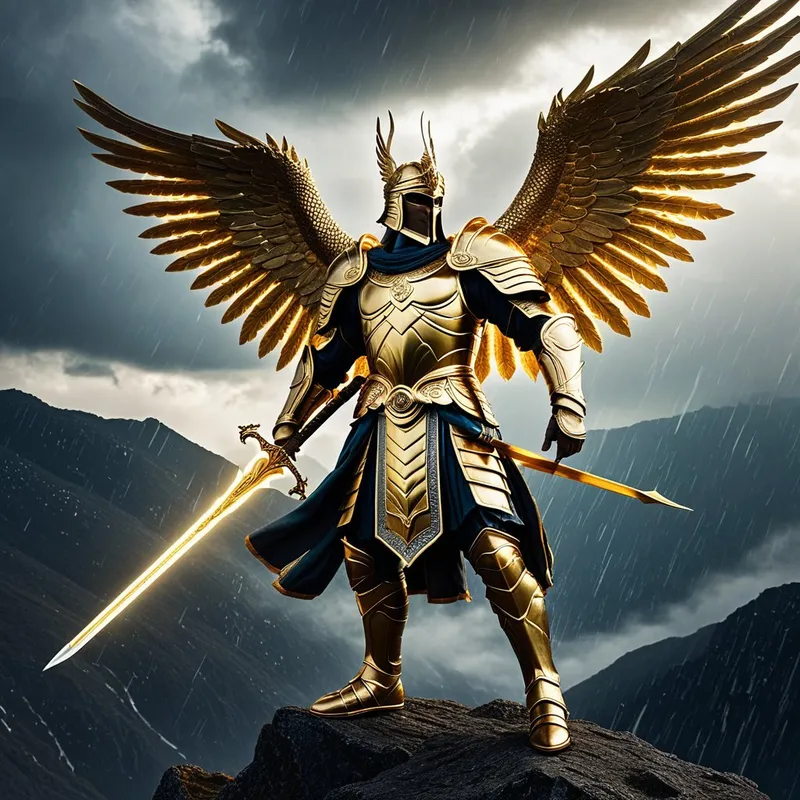
Archangel Michael Myth Meaning & Symbolism
The myth of the celestial warrior who defends divine order against primordial chaos, embodying the archetypal struggle for integrity and righteous sovereignty.
The Tale of Archangel Michael
Before the mountains were born, before the dust of the earth was stirred, there was a war in the heavens. It was a conflict not of flesh, but of essence; a rebellion of light against itself. In that primordial court, a star once bright grew heavy with pride. Lucifer, the Light-Bearer, coveted the throne of the Most High. His beauty curdled into ambition, and a third of the host of heaven turned with him, their radiance dimming to a cold, defiant glare.
And there stood Michael.
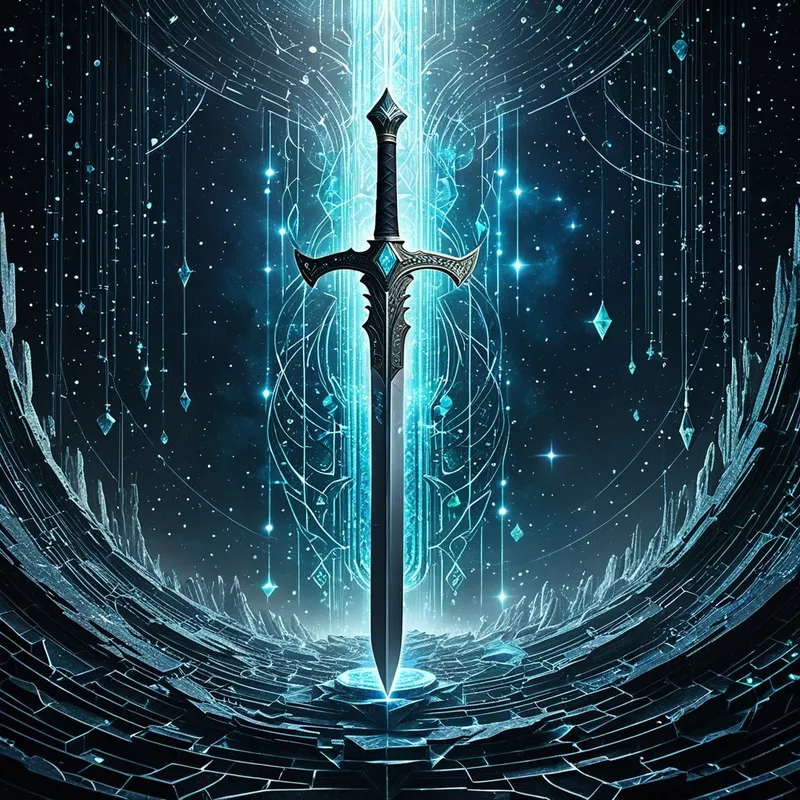
His name was a declaration: “Who is like God?” Not a question of doubt, but a shield of certainty. When the silence of eternity shattered under the clamor of treason, he was the first to move. No fanfare preceded him, only the terrible, clear sound of purpose. His sword was not forged in any earthly fire, but drawn from the uncreated light of divine will. It burned with a cold, blue-white flame that cast no shadow, for it was the light that defines all shadows.
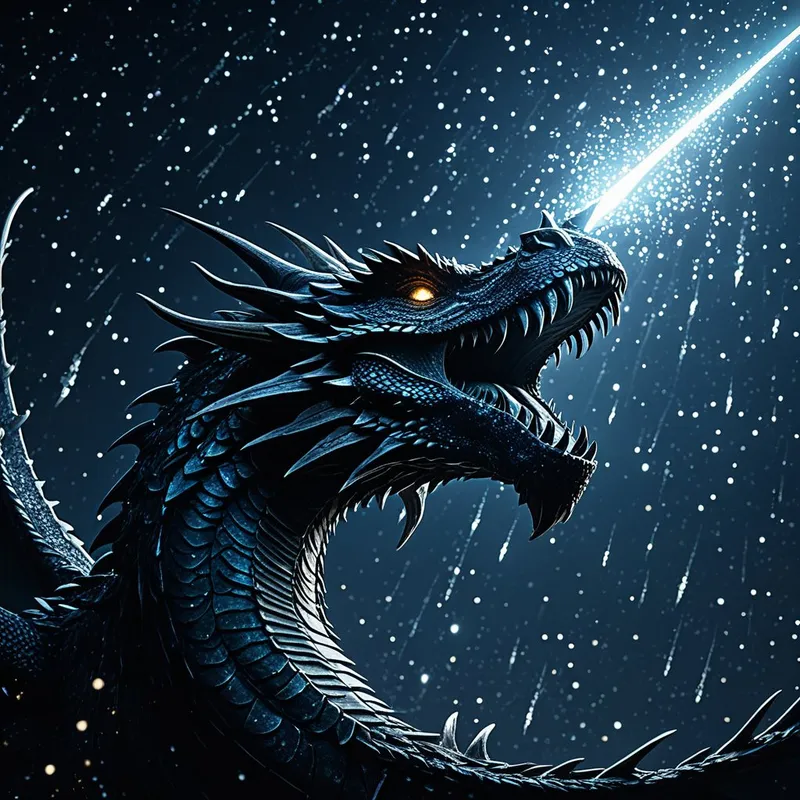
The battleground was the empyrean, the fields of stars themselves. The rebel angels fell upon the loyal like a storm of shattered comets, their forms now twisted—wings of light become leathern, eyes of wisdom now pits of envy. Michael did not rage. He stood as a fulcrum, the unwavering point upon which chaos broke. He sought out the Dragon, the great serpent whose tail swept stars from the sky in its fury. Their clash was the first thunder, a sound that would echo in every storm to come.
The serpent spewed a river of darkness, a void meant to drown creation in nothingness. Michael’s sword cleaved it, drinking the darkness into its flame and transmuting it into a shower of fading embers. He fought not to destroy the rebel, but to bind him; not to annihilate the chaos, but to limit it. With a final, resonant cry that shook the foundations of the cosmos—“Who is like God?”—he prevailed. He seized the ancient Dragon, that serpent of old, and cast him down. Not into oblivion, but into the abyss, into the realm of form and matter and time—a fallen star impacting the nascent world, its poison seeping into the clay.
And so Michael remained, a sentinel at the gate. His sword now rests, but is never sheathed. His gaze is upon the descent, watching the long shadow of that war play out upon the earth, in the hearts of men and women, waiting for the final trumpet call when the conflict will be concluded.
Cultural Origins & Context
The figure of Michael emerges from the rich tapestry of post-exilic Jewish thought, a period of profound theological crystallization. During the Babylonian exile and after, Jewish scribes and visionaries engaged deeply with the cosmologies of their captors and neighbors, refining their own understanding of the divine hierarchy and the problem of evil. Michael appears not in the earliest Torah, but in the prophetic and apocalyptic literature—books like Daniel, and later in extracanonical texts like 1 Enoch.
He is the protector of Israel, a "prince" who contends with the patron angels of other nations. This reflects a societal function: in a world where empires rose and fell, the story assured a persecuted people that their fate was overseen by a celestial champion greater than any earthly king or god. In the New Testament, the Book of Revelation solidifies his role as the commander of heaven’s armies in the ultimate eschatological battle. Passed down through liturgy, art, and homily, Michael became the archetypal defender of divine order, a figure invoked for protection, justice, and the courage to resist spiritual corruption.
Symbolic Architecture
Michael is not a god of war, but the psyche’s principle of discernment and righteous sovereignty. He represents the faculty that can distinguish the authentic Self from the inflations and usurpations of the ego.
The sword is not for vengeance, but for clarity. It cuts through confusion, severs the parasitic thought from the genuine impulse, and divides the shadow from the soul.
His adversary, the Dragon, symbolizes the primordial, undifferentiated chaos—the massa confusa of the unconscious that seeks to engulf conscious order. This is not "evil" as a foreign force, but the potential for psychic disintegration, the raw, untamed power of instinct and pride that refuses to serve the greater totality of the Self. Michael’s battle is the eternal, internal process of individuation: the conscious ego (the loyal host) aligning with the central, ordering principle of the Self (the Most High) to integrate and bound the chaotic, destructive potentials within (the rebel host).
The scales he is often depicted holding speak to this. His fight is one of justice, of restoring correct weight and measure to the inner world. He is the archetype of the integrator, who does not deny the shadow but forces it into its proper, limited relation to the whole.
The Dreamer's Resonance
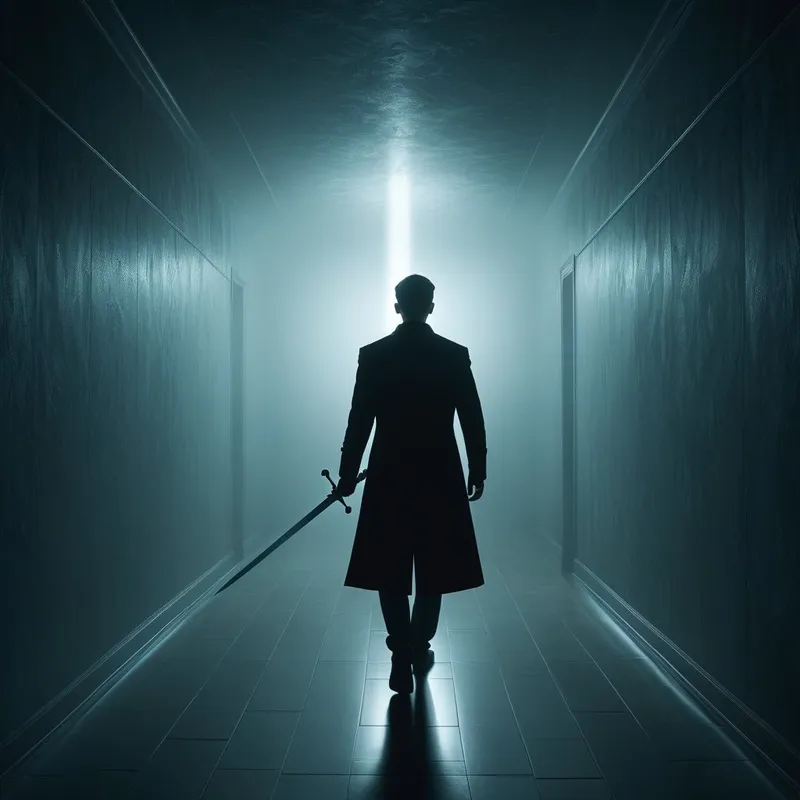
When Michael strides into modern dreams, he rarely appears in full Byzantine regalia. His presence is felt as a quality: a sudden, unwavering conviction in a moment of moral fog; a surge of protective energy when one feels spiritually violated; or as a literal figure of light intervening in a nightmare of pursuit or collapse.
Somnially, he manifests when the dreamer is undergoing a profound process of psychic defense. This could be against external enervating influences, but more often it is an internal coup attempt. The "Dragon" might appear as a domineering inner critic, a addictive pattern, or a grandiosity that threatens to consume the personality. Dreaming of Michael signals that the ego is mustering its resources of discernment and courage to confront a disintegrative force within. The somatic experience is often one of a clenched resolve in the solar plexus, a feeling of "standing your ground" upon waking. It is the psyche activating its own immune system.
Alchemical Translation
The alchemical work mirrored in Michael’s myth is the opus contra naturam—the work against nature, not in defiance of the natural world, but against the prima materia’s initial state of chaotic identification. The rebel angels are the projections and complexes that claim autonomy and pretend to be the ruling center. The loyal angels are the nascent, often silent, aspects of the true Self.
The fall of the Dragon is the necessary separatio, the violent but essential act of distinguishing what is "me" from what has merely been "lodged in me."
For the modern individual, the transmutation begins with the question, "Who is like God?"—or psychologically, "What serves the totality of my being, and what serves only a partial, prideful impulse?" This is the sword’s edge. To wield it is to engage in ruthless self-honesty, to cut away the attachments to old identities, victim narratives, and inflations. The binding of the Dragon is not its destruction, but its integration into service. The fierce energy of rebellion, once conscious, can become the fuel for righteous action. The pride becomes sovereignty. The chaos becomes creative force. One does not become Michael; one invokes the Michael principle within to do the precise, courageous surgery required to liberate the authentic self from the grip of its own inner tyranny, thus restoring the celestial order of the psyche.
Associated Symbols
Explore related symbols from the CaleaDream lexicon: