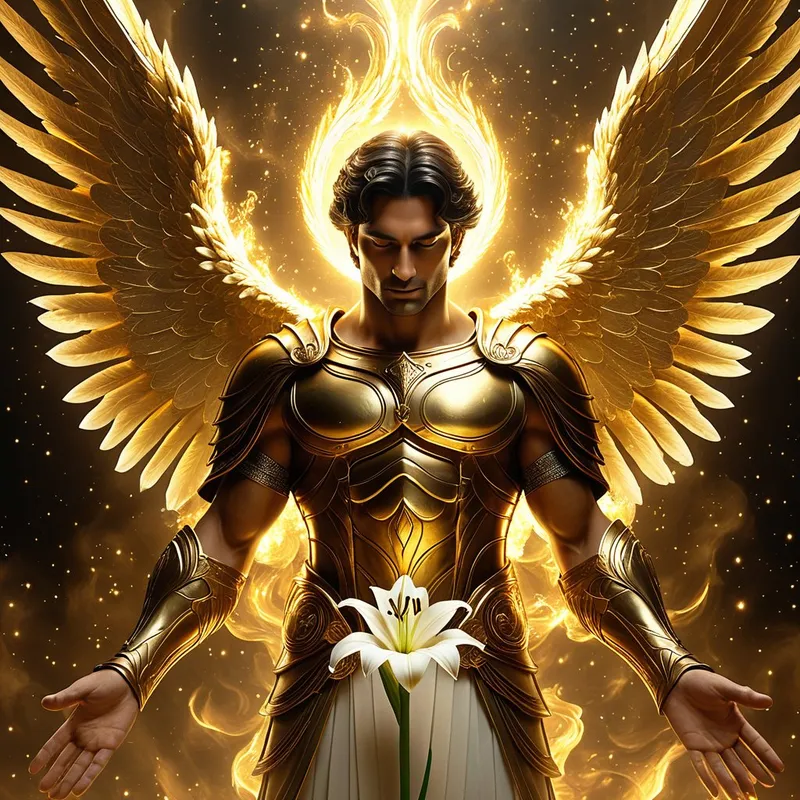
Archangel Gabriel Myth Meaning & Symbolism
The celestial herald who bridges heaven and earth, delivering messages that shatter old worlds and announce the birth of the impossible.
The Tale of Archangel Gabriel
In the silence that exists between heartbeats, in the stillness that hangs between the turning of worlds, he waits. He is a being of the unspoken word, a vibration held in perfect tension before it becomes sound. His name is Gabriel, and he stands in the courts of the Unseen, a pillar of listening attention.
His domain is the threshold. Not the grand gates, but the quiet doorways within the human soul where eternity whispers to time. He is clad not in armor, but in the luminous certainty of his purpose. His wings are not for flight alone, but are vast instruments that tune the atmosphere to the frequency of proclamation.
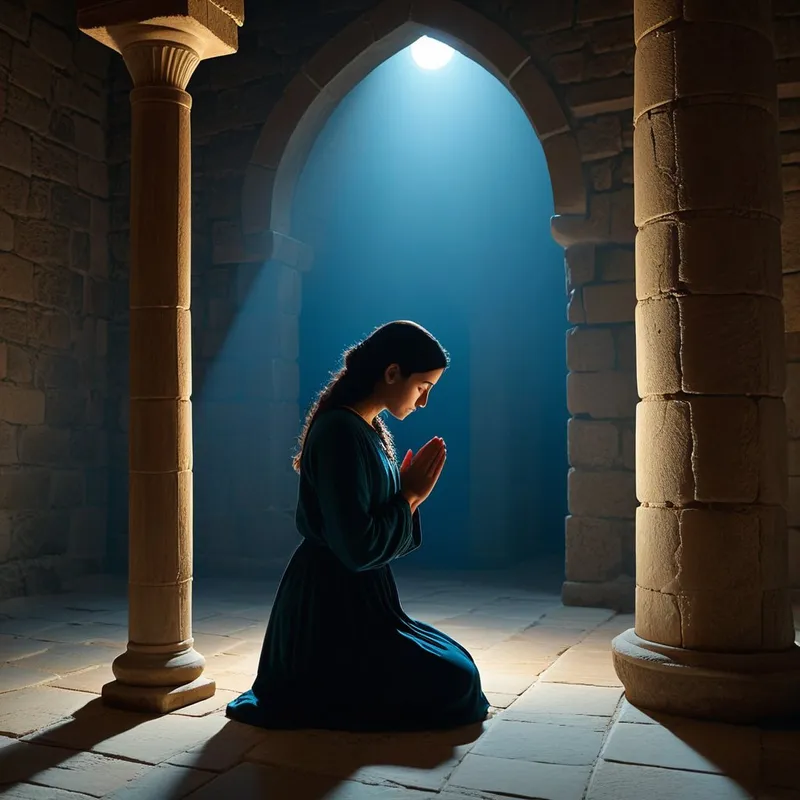
And a proclamation is coming. A word so potent it will need a vessel of flesh to hold it. The Most High has chosen. In a forgotten corner of the world, in a town called Nazareth, a young woman named Mary kneels in the fading light of her room. The air is thick with the scent of oil and dust, the quiet hum of an ordinary life.
Then, the air changes. It does not tear, but parts. It becomes a lens, focusing a light that has no source. And he is there. Not arriving, but being present. The light does not blaze; it clarifies, making every thread in Mary’s cloak, every line on her palm, stark and sacred. The presence is immense, a pressure of pure attention, yet it does not crush—it hallows.
“Hail, O favored one,” the voice says. It is not a sound that travels through air, but a meaning that unfolds directly in the chamber of her mind, resonant and gentle as deep water. “The Lord is with you.”
She is troubled. Not with fear of the messenger, but with the awe of the addressed. She is a vessel being readied, and she senses the weight of the emptiness she is about to lose.
The messenger continues, his form a symphony of restrained power. “Do not be afraid, Mary, for you have found favor with God. And behold, you will conceive in your womb and bear a son, and you shall call his name Jesus.”
The words hang in the sanctified air. A son. Not just a child, but the child. The promise woven through the ages, now to be knitted from her own flesh. The impossible is announced not as a future event, but as a present reality waiting for her consent.
“How can this be,” she asks, the question itself an act of profound courage, “since I have no husband?”
The explanation is a mystery wrapped in light. “The Holy Spirit will come upon you, and the power of the Most High will overshadow you; therefore the child to be born will be called holy—the Son of God.”
And then, the final key: a sign. Her aged kinswoman Elizabeth is also with child. “For with God,” the messenger states, his voice the very sound of inevitability, “nothing will be impossible.”
The moment crystallizes. The entire cosmos leans in, listening for her answer. The angel has delivered the divine will, but he does not command. He announces. The choice, the terrifying, glorious choice, rests in the heart of this young woman.
She breathes. The weight of eternity rests on her “yes.” And she speaks it. “Behold, I am the servant of the Lord; let it be to me according to your word.”
With her consent, the word becomes flesh. The message is incarnated. The angel, his purpose fulfilled in her acceptance, departs. The light fades, not vanishing, but dissolving back into the fabric of the world, which is now forever altered. The ordinary room in Nazareth is now the axis mundi, the point where heaven touched earth, because a messenger spoke and a human heart said yes.
Cultural Origins & Context
The figure of Gabriel emerges from the rich tapestry of Second Temple Judaism, where angelology became more elaborate and specific. His name, meaning “God is my strength,” appears in the Book of Daniel, where he serves as an interpreter of visions, a role that firmly establishes his function as a clarifier of divine mysteries. This Jewish understanding was inherited and profoundly expanded by the early Christian community.
Gabriel’s primary narratives are found in the Gospel of Luke. Here, he is not a vague celestial being but the specific, personal emissary for the two pivotal announcements that inaugurate the Christian story: the conception of John the Baptist to Zechariah, and the Annunciation to Mary. These stories were passed down orally within the early Christian communities before being codified, functioning as sacred history that explained the divine origin of Jesus. In the Protoevangelium of James and later in Islamic tradition, Gabriel’s role is further solidified as the principal messenger, linking the Abrahamic faiths. His societal function was to authenticate the divine intervention in history, transforming inexplicable events into part of a coherent, sacred narrative.
Symbolic Architecture
Gabriel is the archetype of the Divine Messenger. He does not originate the message; he is its perfect conduit. Symbolically, he represents the moment of interface—where the transcendent breaks into the immanent, where potential becomes actuality. His traditional attributes are deeply symbolic: the trumpet for the final awakening and declaration of truth, the lily for purity, annunciation, and the graceful acceptance of divine will, and the lantern or mirror for illuminating truth and reflecting God’s light to humanity.
The angel does not bring a thing, but the idea of a thing. His arrival is the fertilization of reality with a possibility so potent it demands to be made real.
Psychologically, Gabriel symbolizes the autonomous content of the unconscious that suddenly announces itself to the conscious mind. This is not a slow, intellectual understanding, but a sudden, luminous, and often disruptive knowing. He is the herald of the Self, the greater totality of the psyche, announcing that a new chapter of one’s life—a new potential identity or calling—is ready to be born. The conflict in the myth is not against a monster, but against disbelief, smallness of vision, and the terror of the new. The triumph is in the courageous “yes” that allows the psychic content to incarnate.

The Dreamer's Resonance
To dream of a Gabriel-like figure is to experience the psyche in a state of profound announcement. The dreamer is often in a liminal space—a bedroom, a threshold, a quiet place—when a figure of awe-inspiring yet calm authority appears. This figure may not speak, but may hand the dreamer an object (a scroll, a key, a child), or simply impart a feeling of immense significance.
Somatically, one might awaken with a sense of vibration, a ringing in the ears, or a feeling of being “pierced” by clarity. Psychologically, this dream pattern signifies that a deep, transformative content from the unconscious is seeking conscious recognition and integration. The “annunciation” is always disruptive; it shatters the dreamer’s current self-conception. The figure’s calm is crucial—it represents the non-threatening but utterly serious nature of this psychic imperative. The anxiety in the dream mirrors Mary’s initial trouble, the soul’s resistance to its own expansion. Such a dream asks: What new, seemingly impossible potential is your deeper self announcing to you? And are you able, in your waking life, to say “let it be”?

Alchemical Translation
The myth of Gabriel models the alchemical stage of Coniunctio—the sacred marriage—but in a uniquely psychic form. It is not the union of opposites, but the fertilization of the human ego (Mary) by the transcendent Self (the Holy Spirit), facilitated by the mediating function (Gabriel). The process of individuation requires these moments of divine interruption, where a call from the Self breaks into the comfortable, familiar order of the conscious personality.
Individuation begins with an annunciation. The ego must be visited by a truth larger than itself and agree to become its vessel.
For the modern individual, the “alchemical translation” works thus: First, the Call (The Arrival): A sudden insight, a recurring symbol, a deep longing, or a crisis that functions as the angelic herald. It feels destined and carries an aura of sacred authority. Second, the Fear & Questioning (How Can This Be?): The ego’s rational resistance. “This doesn’t fit my plans. I am not equipped. This is impossible.” This stage is necessary—it is the conscious mind engaging with the mystery. Third, the Explanation & Sign (The Holy Spirit Will Overshadow You): A deeper understanding dawns, often through synchronicity or a supportive external event (like Elizabeth’s pregnancy). The individual realizes the transformation will be powered by a grace beyond their own will. Finally, the Incarnation (Let It Be): The conscious, willing surrender. The ego agrees to serve the larger process. The announced potential is accepted and begins its gestation in the dark of the unconscious, soon to be born as a new attitude, a creative work, or a renewed life direction. The angel departs because his work is done; the message has been received and accepted. The rest of the work—the pregnancy, the birth, the rearing—belongs to the human soul in its journey toward wholeness.
Associated Symbols
Explore related symbols from the CaleaDream lexicon: