Aranda Creation Stories Myth Meaning & Symbolism
In the timeless Dreaming, Ancestral Beings emerge, shape the world, and become its sacred features, establishing the eternal Law for all life.
The Tale of Aranda Creation Stories
Listen.
Before time was time, there was Alcheringa. The world was a flat, featureless plain, cloaked in a soft, grey twilight. It was a world asleep, waiting for its first breath.
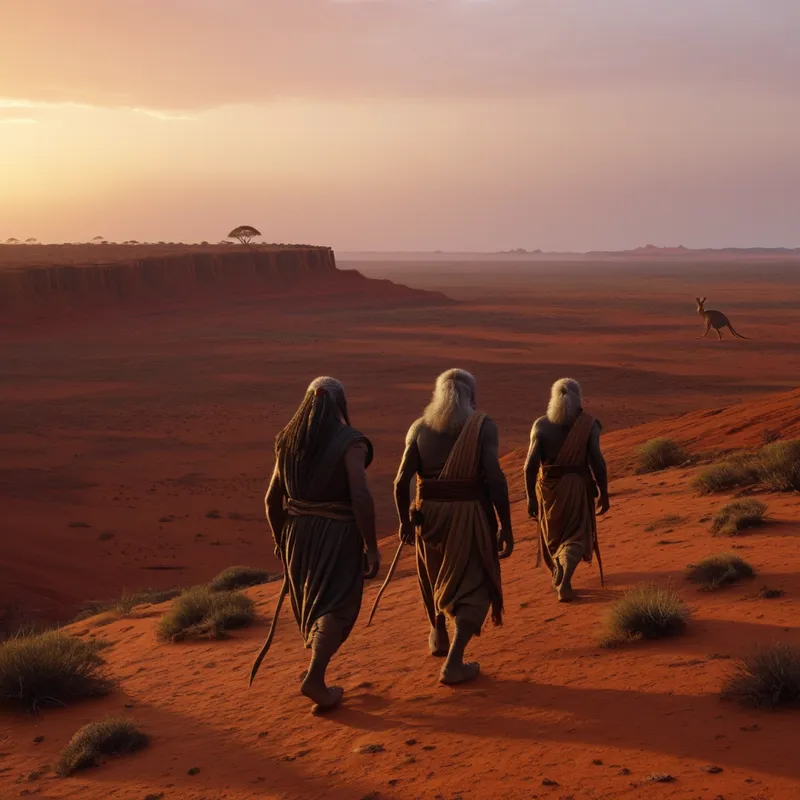
Then, they came. From beneath the surface of the earth, from within the sky itself, the Inapatua arose. They were not gods as you might imagine, but Ancestral Beings of immense power and ancient form. Some were like men and women, but not quite. Others bore the features of the kangaroo, the emu, the witchetty grub, the honey ant. They were the potential of all things, sleeping in the eternal twilight.
They stirred, and the world stirred with them. They began to wander. With every step, the earth, which had been soft as clay, received their imprint. Where a great Inapatua of the Kangaroo sat to rest, a mountain range heaved itself from the plain. Where one of the Lizard Men dragged his tail, a deep river channel was carved into the red earth. They sang as they travelled—deep, resonant songs that vibrated in the very substance of creation. These songs named the things they made, calling forth the color of the rock, the taste of the water, the scent of the gum leaves.
But their journey was not without conflict. They met other Inapatua on their paths. There were battles, great contests of power and cunning. A Honey Ant Ancestor might duel with a Wild Cat Ancestor over a territory. In their struggles, the landscape was further shaped—a cliff face sheared off here, a scattering of boulders thrown there. These were not battles of malice, but of necessity, the fierce negotiation of a world coming into being.
And then, the great transformation. Their journeys complete, their songs fully sung, the Ancestors did not die. They underwent a metamorphosis. Some sank back into the earth, their bodies becoming the very rock formations they had created. Others ascended into the sky, becoming stars, the sun, and the moon. A group of weary Inapatua, having travelled a vast circuit, simply lay down and became a chain of waterholes, their life-force remaining in the cool, deep water. At these sacred sites, their power was most concentrated. They left behind not just physical features, but the Tjukurpa—the Law. This Law dictated how every plant should grow, how every animal should behave, how humans should live in relationship with it all. The world was no longer a sleeping plain. It was a living, breathing testament, a map of sacred journeys, forever singing the songs of its own creation.
Cultural Origins & Context
These stories belong to the Aranda (or Arrernte) peoples of Central Australia, whose country stretches across the vast, red heartland around Mparntwe (Alice Springs). This is not mythology as a set of quaint, forgotten tales. This is Alcheringa made present, a living cosmology that structures all of existence. The stories were, and are, the ultimate authority—the constitution of the land and its people.
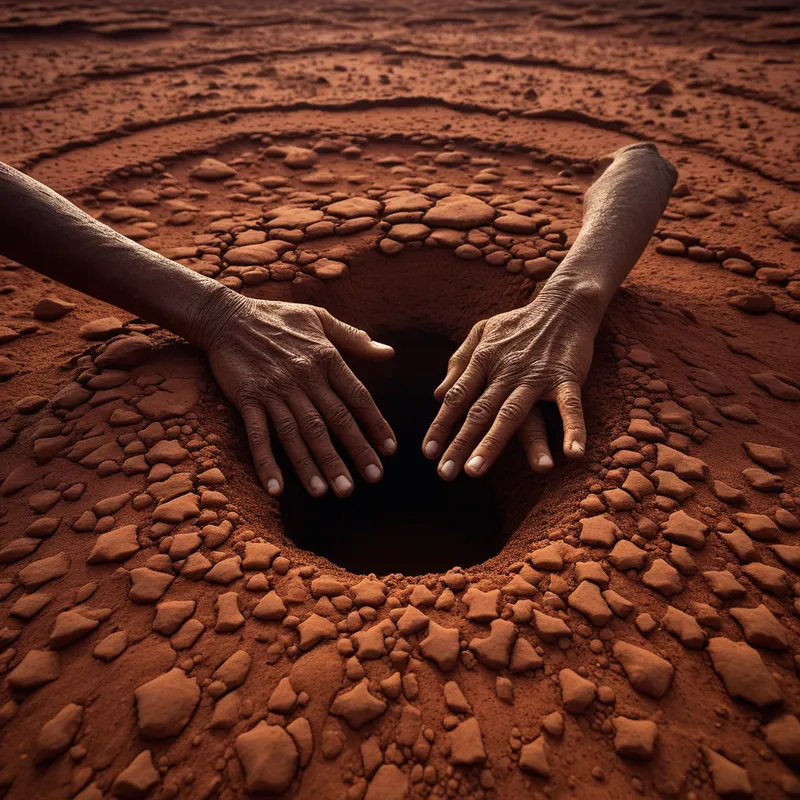
Transmission was, and remains, a sacred and precise duty. Elders, the custodians of specific tracts of country and the songlines that describe them, pass the knowledge to the initiated through ceremony, song, dance, and intricate sand drawings. Each person inherits a connection to particular Ancestors and their journeys. To know the story of the waterhole is to know its song, its ceremony, and your responsibility to care for it. The societal function is total: it provides identity, law, ecology, spirituality, and history. It answers the profound questions of "Who are we?" and "How must we live?" by pointing to the very ground beneath one's feet and the songs on one's breath.
Symbolic Architecture
The myth presents a profound symbolic architecture of emergence, imprint, and transmutation. The Alcheringa represents the primordial state of the psyche—the undifferentiated unconscious, full of potential but unmanifest. The Inapatua are the archetypal forces within that unconscious beginning to stir, to take distinct form.
The world is not found, but forged by the journey of consciousness itself. Every step of the Ancestor is a thought, a feeling, an impulse, leaving its permanent mark on the landscape of the soul.
Their wandering is the process of psychic differentiation. The conflicts are the necessary friction between competing inner forces—the instinctual (the wild cat) versus the communal (the honey ant)—whose resolution further defines the internal landscape. The final transformation, where the Ancestors become the features of the land, is the ultimate symbolic act: the internal archetypes structure the permanent, foundational architecture of the self. The Tjukurpa they establish is the innate, organic law of one's own being—the core values and patterns that, when followed, lead to a life in harmony with one's deepest nature.

The Dreamer's Resonance
When this mythic pattern stirs in the modern dreamer, it often signals a profound process of inner world-building. Dreams of wandering across vast, unknown terrains—especially stark, beautiful, or primordial landscapes—may echo the Inapatua's journeys. The somatic sense is one of purposeful movement, of feet meeting ground, of carving a path where none existed.
Dreams where the dreamer engages in an act of creation—shaping clay, painting a vast mural, or singing a powerful, unknown song—mirror the Ancestors' creative acts. More subtly, dreams where parts of the dreamer's body or the bodies of other figures transform into landscape features (a hand becoming a mountain, tears becoming a spring) are direct enactments of the Ancestral metamorphosis. This is the psyche working to solidify transient experiences, powerful emotions, or hard-won insights into permanent structures of personality. The dreamer is not just having an experience; they are becoming the ground of that experience.

Alchemical Translation
The alchemical process modeled here is the transmutation of chaotic, psychic potential into a lived, sacred order. For the modern individual, the "featureless plain" is a state of potential, confusion, or lack of identity. The call to adventure is the stirring of those inner Inapatua—a talent, a deep desire, a wound, or a calling that demands expression.
The "journey" is the often arduous process of bringing that inner content into the world: writing the book, starting the venture, pursuing the art, or simply living according to a newfound truth. The "conflicts" are the internal and external resistances—fear, doubt, criticism, old patterns—that must be engaged and shaped, as the Ancestors shaped the land in their battles.
Individuation is the process by which we travel our own songlines, and in the end, become the country we have sung into being.
The final "transformation" is the achievement of integrity. The energy that was once a restless, wandering impulse now becomes a foundational part of who you are. Your passion becomes your vocation, your wound becomes your source of empathy, your journey becomes your wisdom. You establish your own Tjukurpa—an internal law of authenticity. You no longer just visit your values; you inhabit them. The landscape of your life, with all its unique features and sacred sites, stands as a testament to the journey of your soul, forever singing the song of its own creation.
Associated Symbols
Explore related symbols from the CaleaDream lexicon:
- Earth — The primordial, malleable substance shaped by the Ancestors, representing the raw material of the self and the physical reality born from psychic action.
- Journey — The fundamental act of the Ancestral Beings, symbolizing the necessary process of moving through the unconscious to bring latent potentials into manifest form.
- Song — The creative power that names and calls forth reality, representing the vibrational essence of identity and the law that structures existence.
- Waterhole — A sacred site formed by an Ancestor's rest, symbolizing a place of concentrated life-force, deep nourishment, and connection to the primordial source within the psyche.
- Mountain — A feature created from an Ancestor's body, representing a permanent, elevated structure of the self, a hard-won insight or value that defines one's inner landscape.
- Dream — The state of Alcheringa itself, the timeless dimension where creation occurs and the blueprint for all reality is held.
- Root — The deep, unseen connection of the Ancestors to the land, symbolizing the archetypal foundations of identity that anchor an individual to their core being.
- Order — The Tjukurpa established by the Ancestors, representing the innate, organic law of the psyche that brings harmony when followed.
- Original Stories — The specific narratives of each Ancestor's journey, representing the unique, foundational myths that define an individual's personal identity and purpose.
- Spirit — The essential, immortal power of the Inapatua that persists within the landscape, symbolizing the enduring archetypal energy within every aspect of the created self.