Aquarius Myth Meaning & Symbolism
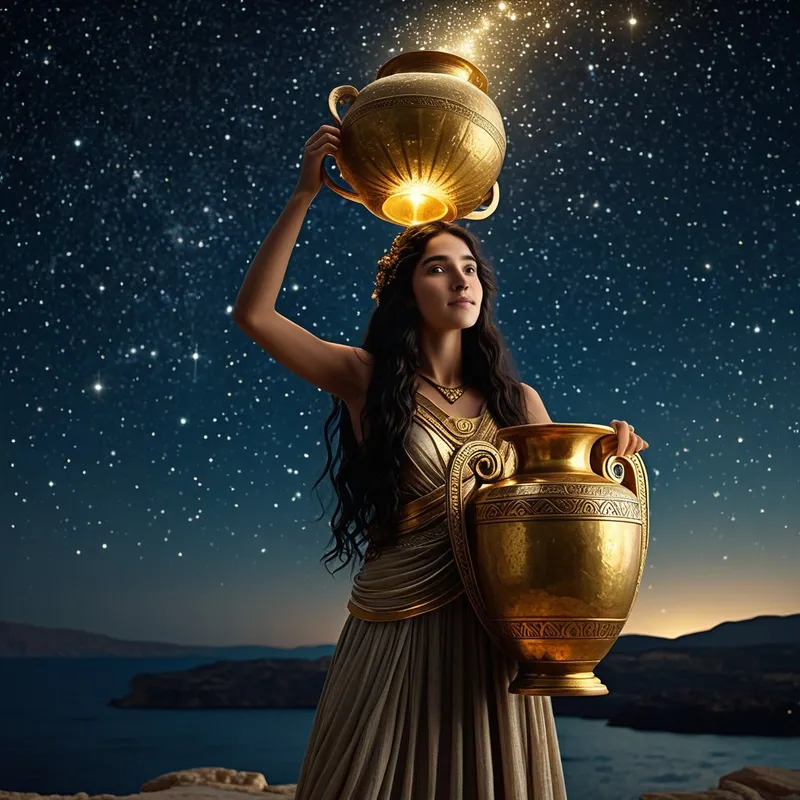
The story of Ganymede, the mortal youth chosen by Zeus to be the divine cupbearer, immortalized as the constellation Aquarius pouring the waters of life.
The Tale of Aquarius
Hear now the tale written in star-fire, a story not of a hero’s battle, but of a beauty so profound it halted the thunderbolt itself.
On the sun-drenched, thyme-scented slopes of Mount Ida, a youth named Ganymede tended his father’s flocks. He was not a king, nor a warrior of renown, but in his form and spirit, the raw, perfect beauty of the mortal world had found its purest vessel. His laughter was the sound of clear springs, and his gaze held the untroubled depth of a twilight sky.
From his throne of cloud and ether, Zeus</ab title> looked down. His eye, which measured the fates of empires and the fall of titans, rested upon the shepherd boy. In that mortal frame, Zeus saw something the Olympian court lacked: an innocence unburdened by divinity, a grace that was its own authority. The lord of the gods was seized not by lust, but by a sovereign desire—a need to possess and elevate this fragment of perfect mortality.
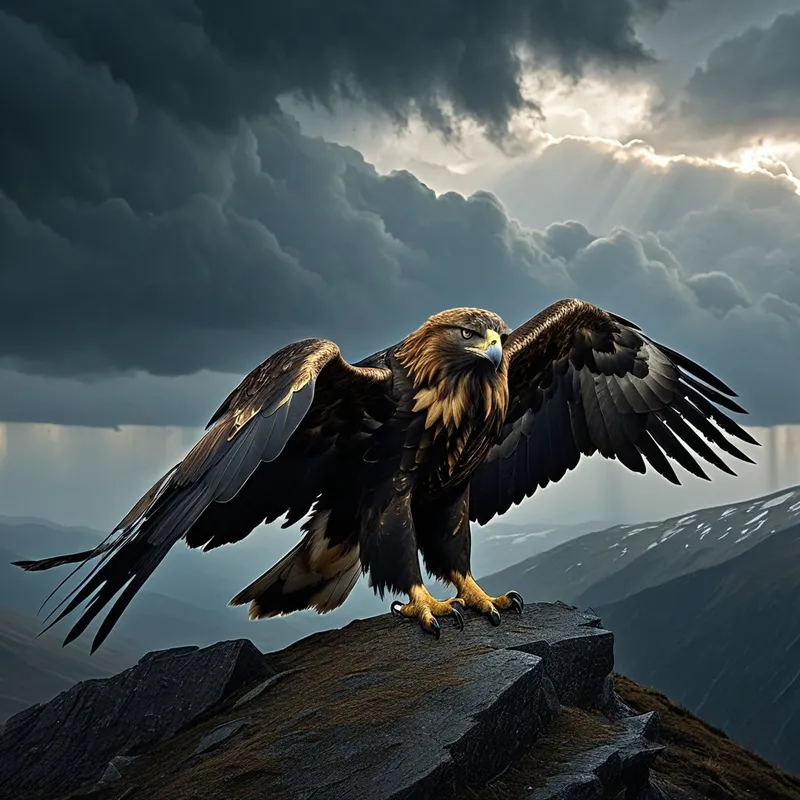
A decision was made. No embassy of gods, no offer of gifts. Zeus would take, as gods do, but he would take with a purpose. Shifting his form, he became the king of birds, a magnificent eagle whose feathers were the color of a gathering storm, its eyes holding the sharp intelligence of the heavens. With a beat of wings that stirred the winds of Ida, the eagle descended.
Ganymede looked up, his shepherd’s staff forgotten. There was no terror, only awe, as the great bird, gentle as a thought, closed its talons around him—not to pierce, but to lift. The earth fell away, the bleating of sheep fading into a whisper. He was borne aloft, through the veil of cloud, into the crystalline, rarefied air where the chariot of the sun blazed a path.
He was brought not to a prison, but to the heart of creation: the gleaming halls of Olympus. The assembled deities fell silent. Here was the cause of the Thunderer’s absence. Before them stood the mortal, radiant with confusion and an unearthly light reflected from the marble and gold.
Zeus resumed his form and spoke. The boy would not return to the fields of Troy. His service would be higher. He would be the cupbearer of the gods, replacing Hebe. His duty: to pour the divine nectar, the very essence of immortality and joy, for the eternal ones. To honor him and soothe the grief of his mortal father, Zeus sent Hermes with gifts of immortal horses and the promise of his son’s divinity.
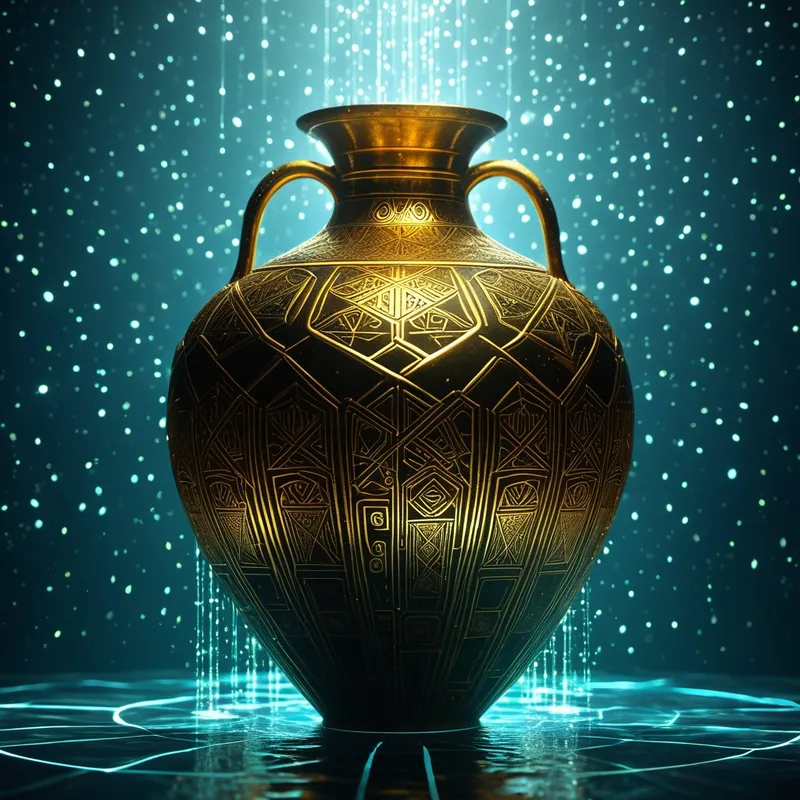
And so Ganymede took up the golden amphora. His hand did not tremble as he poured the star-bright liquid for Hera, whose jealousy was a cold, silent flame. He served Poseidon and Athena, Apollo and Artemis. In time, the mortal confusion in his eyes transformed into a serene, knowing light. He had become the conduit, the one who serves the source.
When his time in the halls ended, Zeus set him among the fixed stars, forever immortalized as the Water-Bearer. There he stands, eternally poised, his amphora tilting, pouring not nectar, but a river of life—the celestial waters that flow into the mouth of the Southern Fish, a never-ending gift from the elevated mortal to the cosmos below.
Cultural Origins & Context
The myth of Ganymede is a complex tapestry woven from threads far older than classical Athens. Its deepest roots likely lie in Anatolia, near Troy, reflecting a pre-Greek stratum of myth where beautiful youths were associated with divine service and the renewal of life. The Greeks, master synthesizers, adopted and adapted this figure, fitting him into their own Olympian framework.
The primary tellers of this tale were the epic poets, like Homer in the Iliad, who mentions Ganymede’s beauty as the reason for his rapture, and the lyric poets who explored its more sensual undertones. Later, tragedians and vase painters solidified the iconography: the eagle, the youth, the lifted krater. Its societal function was multifaceted. On one level, it explained the origin of a prominent constellation, Aquarius. On another, it explored the complex relationship between gods and mortals—divine caprice tempered by compensatory honor (the gifts to Ganymede’s father, Tros). It also served as an etiological myth for the practice of pederasty in certain Greek social strata, framing the relationship between an older, powerful erastes (lover) and a young eromenos (beloved) in divine terms.
Symbolic Architecture
At its core, the myth of Aquarius is not about abduction, but about election and transmutation. Ganymede represents the aspect of the human psyche that is inherently worthy of the divine—not through deed, but through being. His beauty is symbolic of a latent, perfect potential, an unconscious wholeness that exists prior to the labors of the hero.
The cupbearer does not own the wine; his sovereignty lies in the steadiness of his pour.
The eagle of Zeus is the archetypal force of sudden, penetrating consciousness. It is the lightning-strike of insight, the numinosum that descends and seizes a part of the psyche, lifting it out of its familiar, pastoral context (the personal unconscious) into the collective realm of the gods (the archetypal realm of the collective unconscious). The amphora and nectar symbolize the aqua permanens, the perennial waters of life, knowledge, and spiritual sustenance. Ganymede’s role is to mediate this substance, to become the vessel through which the divine is distributed.
His replacement of Hebe (Youth) is profoundly significant. He does not represent youth in its transient, flowering state, but the eternalization of a certain quality—the timeless beauty of pure potential now placed in service to a cosmic order. His final placement as the constellation speaks to the process of becoming a fixed, guiding pattern in the soul’s firmament, a permanent symbol of the psyche’s capacity to bear and distribute transformative energies.
The Dreamer's Resonance
When the pattern of Aquarius stirs in the modern dreamer, it often signals a crisis or calling of elevation. One might dream of being suddenly, unexpectedly chosen for a daunting task far beyond one’s self-perception—handed a sacred vessel and told to serve a council of imposing, unknown figures. There is a somatic sense of being lifted, of feet leaving the ground, coupled with both exhilaration and profound disorientation.
Psychologically, this marks the ego’s encounter with the Self (the central, ordering archetype of the whole psyche, symbolized here by Zeus). The dream-ego, like Ganymede, is passive in the action but central to the event. It is being claimed by a larger, non-personal force. The conflict in such dreams is often between the longing for the familiar "pastoral" identity and the awe-inspiring but terrifying responsibility of the new role. The dream may also feature the jealous Hera-figure, representing the part of the psyche that feels betrayed or supplanted by this new, "chosen" orientation—often tied to old values or a former sense of self.

Alchemical Translation
The alchemical journey mirrored in the Aquarius myth is the sublimation of the base material of personal identity into a vessel for transpersonal meaning. The "lead" of Ganymede’s mortal, particular life is transmuted into the "gold" of his eternal, symbolic function.
Individuation is not about becoming a god, but about becoming the faithful cupbearer to the gods within.
The process begins with the raptus, the eagle’s seizure. In psychological terms, this is the often-uncomfortable eruption of a vocation or a calling that dismantles the previous life structure. One is taken to Olympus—confronted with the inner pantheon of archetypal forces (the inner ruler, the inner critic, the inner sage). The crucial stage is the service. The ego, initially identified with its own beauty or specialness (Ganymede the beautiful youth), must learn to forget itself in the act of pouring. It must become the attentive servant of the psychic totality, distributing the nourishing insights (nectar) to all parts of the inner system, even to those that are jealous or hostile (the Hera complex).
The final, celestial immortalization represents the achievement of a new psychological attitude. The individual is no longer merely living a personal life, but has become a conduit for something larger. The personal identity has been re-contextualized within a cosmic pattern. The Aquarius within is the one who has stabilized this connection, who can consistently bear the waters of the unconscious and pour them forth into the world as creativity, insight, or healing, in a steady, eternal stream. The myth thus models the path from being the object of divine desire to becoming the subject of divine service—the ultimate integration of the mortal into the eternal pattern.
Associated Symbols
Explore related symbols from the CaleaDream lexicon: