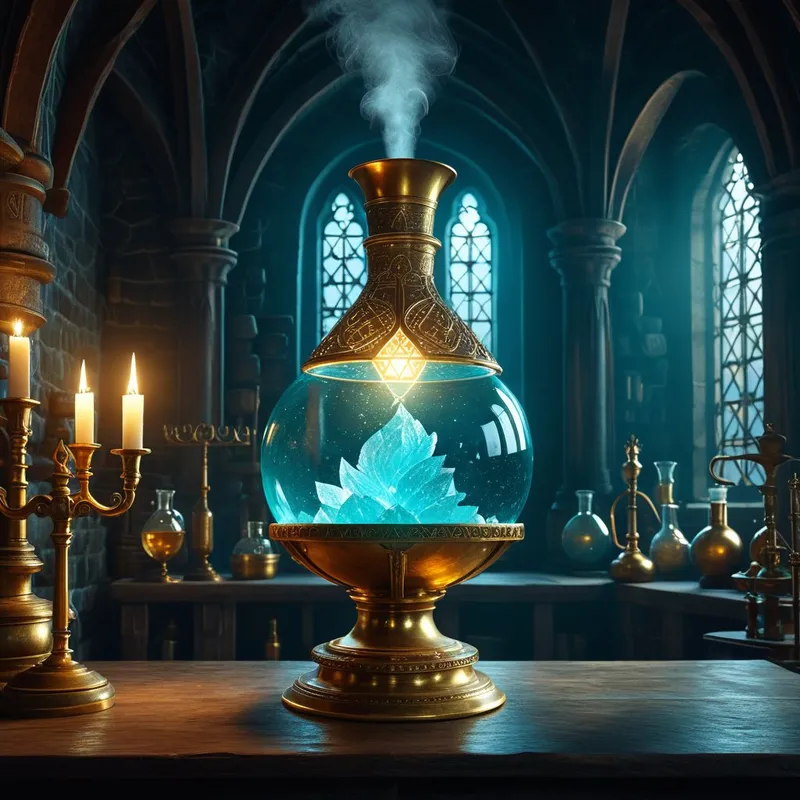
Aqua Vitae Myth Meaning & Symbolism
The quest for the divine Aqua Vitae, a transformative elixir born from the sacred marriage of opposites, promising both dissolution and eternal renewal.
The Tale of Aqua Vitae
Listen, and I will tell you of the water that is not water, the fire that does not burn, the stone that is no stone. In the beginning, before the world was fixed in its heavy ways, the great Prima Materia dreamed. And from its dream arose two sovereigns, eternal and opposed: the King of the Sun, a being of radiant, unyielding Sulphur, and the Queen of the Moon, a being of fluid, reflective Mercury.
The King dwelt in a palace of gold atop a mountain of crystal, and his law was Fixity. All things in his realm were permanent, brilliant, and separate. The Queen swam in the silver seas of a bottomless cavern, and her law was Flux. All things in her realm merged, reflected, and changed. Between their domains stretched the Salt Plain, a barren, crystalline desert where nothing grew, for the two principles could not meet without conflict. A flash of the King’s glance would boil the Queen’s seas; a touch of her tide would tarnish his golden towers. The world was locked in a sterile standstill.
But deep within the Prima Materia, a longing stirred—a memory of unity. This longing took form as a whisper, a secret known only to the Anima Mundi, the World Soul. It sang a recipe of impossible union. The whisper reached the ear of a solitary figure who walked the Salt Plain, the Adept. Not a king nor a queen, but one who bore the ache of both within their breast: the fire of will and the water of soul, forever at war.
Guided by the whisper, the Adept undertook the Magnum Opus. They did not seek to conquer either sovereign, but to court a catastrophe of love. In a sealed vessel—the Hermetic Vase—at the precise center of the barren plain, they performed the unthinkable. With hands that trembled not from fear but from awe, they invited a fragment of the King’s fiery essence (a grain of solar metal) and a tear of the Queen’s liquid essence (a drop of quicksilver) into the same sacred space.
The conflict was immediate and terrible. The fire raged, the mercury fled in steaming clouds. The vessel shook with their battle—the Nigredo, the blackening, a descent into utter chaos and despair. The Adept tended the vessel through this long night, holding the tension of the opposites within their own heart. Then, as the battle exhausted itself, a miracle. In the quiet ashes of their war, a new presence emerged. Not fire, not water, but a gentle, pervasive humidity—the Balneum Mariae. In this moist warmth, the corpses of the enemies began to soften, to sweat a luminous dew.
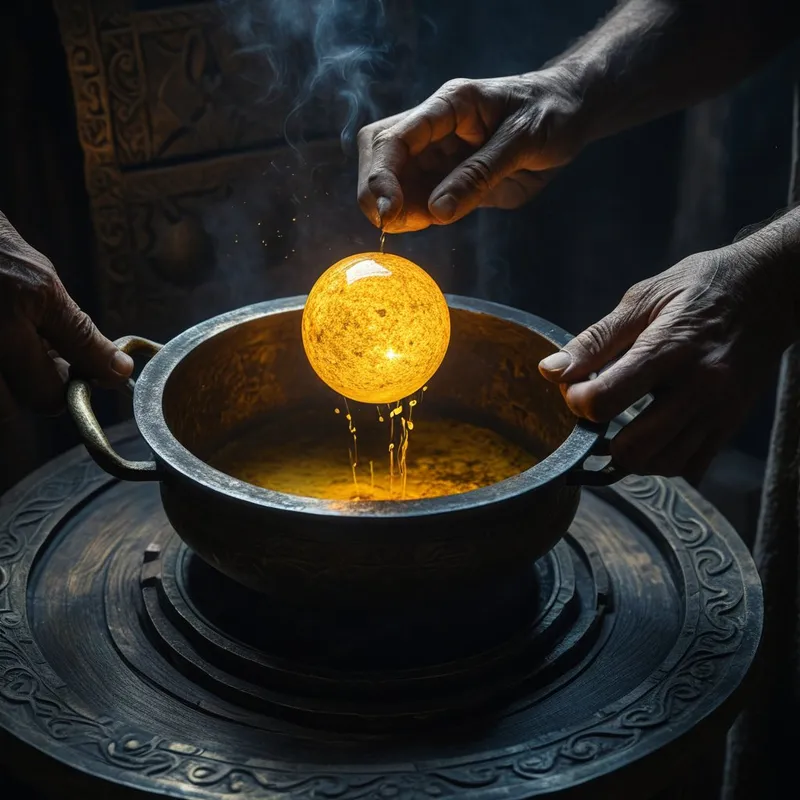
This dew, collecting drop by agonizing drop, was the first sign of the Aqua Vitae. It was a liquid light, a flowing solid. When the Adept finally unsealed the vessel and beheld it, they saw it contained the entire cosmos: the fire danced within it without being quenched; the water structured it without being rigid. They drank. And in that moment, the Adept did not gain a thing, but lost everything—the rigid boundary of self. They became the vessel. The barren Salt Plain at their feet burst forth with a garden of impossible, phosphorescent flowers, for the Aqua Vitae was not a possession, but a state of being: the reconciled world.
Cultural Origins & Context
The myth of the Aqua Vitae is not a folktale with a single origin, but the core narrative engine of Western alchemy, a tradition spanning from Hellenistic Egypt through the Islamic Golden Age to the Renaissance courts of Europe. It was passed down not by bards to crowds, but in encoded manuscripts, cryptic emblems, and whispered oral instructions from master to apprentice within laboratory-workshops. These adepts were often monks, physicians, or natural philosophers operating at the fraught boundary between sanctioned scholarship and heresy.
The myth served multiple societal functions. Exoterically, it provided a metaphysical framework for proto-chemistry, explaining the transformation of substances. Esoterically, and more importantly, it was a map of inner transformation. In an age where orthodox religion often presented a fixed path to salvation, alchemy offered a deeply personal, experiential journey of redemption through the material world and the self. The myth of the Aqua Vitae promised that divinity was not separate from creation, but hidden within its most base and conflicted elements, awaiting liberation by the disciplined human spirit. It was a science of the soul, using the language of matter.
Symbolic Architecture
At its heart, the myth is a profound drama of psychic integration. The warring King and Queen represent the fundamental opposites within the human psyche: conscious and unconscious, logic and intuition, spirit and nature, animus and anima. The barren Salt Plain is the ego-consciousness, sterile because it identifies with only one side of the pair, repressing the other.
The Aqua Vitae is not found; it is born from the sustained tension of holding what the ego insists must be kept apart.
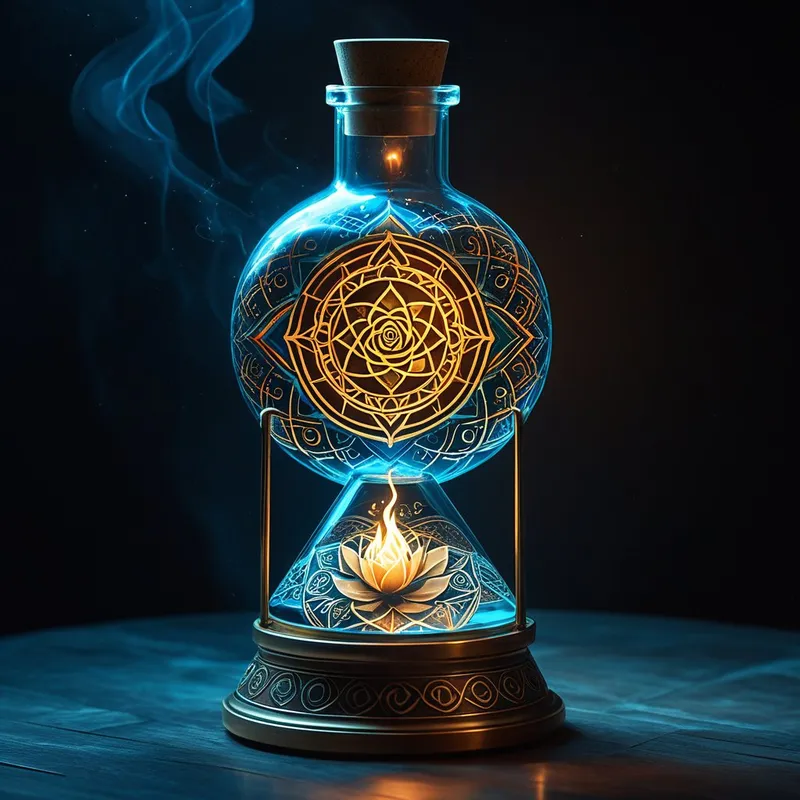
The Hermetic Vase is the total psyche, the temenos or sacred space where this inner conflict is consciously contained and endured. The terrifying Nigredo is the necessary descent into the shadow, the depression and confusion that arises when our cherished identities begin to dissolve. The Balneum Mariae—the gentle, moist heat—symbolizes the compassionate, nurturing attitude required to move through this stage, not with brute force, but with patient, womb-like containment.
The Aqua Vitae itself is the symbol of the transcendent function, the new, third thing that emerges from the unconscious when the conflict of opposites is held to its breaking point. It is not a compromise, but a novel creation that transcends and includes both sides. It represents the unus mundus, the unified reality behind apparent duality, experienced as a state of fluid wholeness, creative vitality, and spiritual illumination.
The Dreamer's Resonance
When this myth stirs in the modern dreamer, it often signals a profound process of psychic reorganization. One does not simply dream of a magical elixir. The symbolism is more visceral and process-oriented.
Dreams of being in a laboratory, struggling to combine two irreconcilable substances (e.g., mixing oil and water that suddenly fuse), point directly to the active opus. Dreams of a sacred, sealed container (a room, a locket, a womb) under great internal pressure reflect the Hermetic Vase of the psyche holding powerful opposing emotions. Nightmares of black, viscous fluids, rotting matter, or descent into a dark pit are the somatic experience of the Nigredo—the body-mind processing a necessary death of an old attitude.
To dream of a gentle, pervasive steam or a healing dew collecting in a barren place is a sign of the emergent Balneum Mariae, the self’s innate healing intelligence beginning its work. Finally, dreams of drinking a luminous liquid that causes not intoxication, but a serene, all-pervading clarity and connection, mark a direct encounter with the potential for the Aqua Vitae state—a taste of the transcendent function. The dreamer is undergoing the alchemical process itself, often during life periods of intense crisis, moral dilemma, or creative impasse.

Alchemical Translation
For the modern individual, the quest for the Aqua Vitae is the journey of individuation. It begins with the recognition of our inner "barren plain"—the feeling of sterility, meaninglessness, or being stuck between irreconcilable parts of ourselves (e.g., career vs. family, duty vs. desire, rationality vs. emotion).
The first practical step is the creation of the Hermetic Vase: a dedicated, conscious container for this conflict. This could be journaling, therapy, artistic practice, or contemplative meditation—any disciplined space where we can observe our inner opposites without immediately acting on one side. Here, we consciously "invite the King and Queen" by acknowledging both our burning ambitions (Sulphur) and our fluid, emotional needs (Mercury).
The transformation occurs not by choosing a side, but by suffering the truth of both until a new truth is born from their marriage.
The ensuing Nigredo is the dark night of the soul. It feels like depression, chaos, and the dissolution of everything we thought we were. The alchemical instruction is to "tend the vessel." Do not abandon the process. Stay with the heat of the conflict, trusting that this putrefaction is the precondition for new life.
The emergence of the Aqua Vitae is not a dramatic, final achievement, but often a quiet shift in perception. It is the moment a lifelong grudge suddenly seems petty from a new, broader perspective. It is the creative insight that solves a problem by reframing it entirely. It is the capacity to hold love and anger for the same person simultaneously, without contradiction. This "elixir" is the fluid intelligence of the integrated Self, which allows us to navigate life not from a fixed position, but with a responsive, adaptive wholeness. We do not possess the Aqua Vitae; for a time, we become its vessel, and our life, like the greening plain, becomes fertile with meaning that transcends our old, warring dichotomies.
Associated Symbols
Explore related symbols from the CaleaDream lexicon: