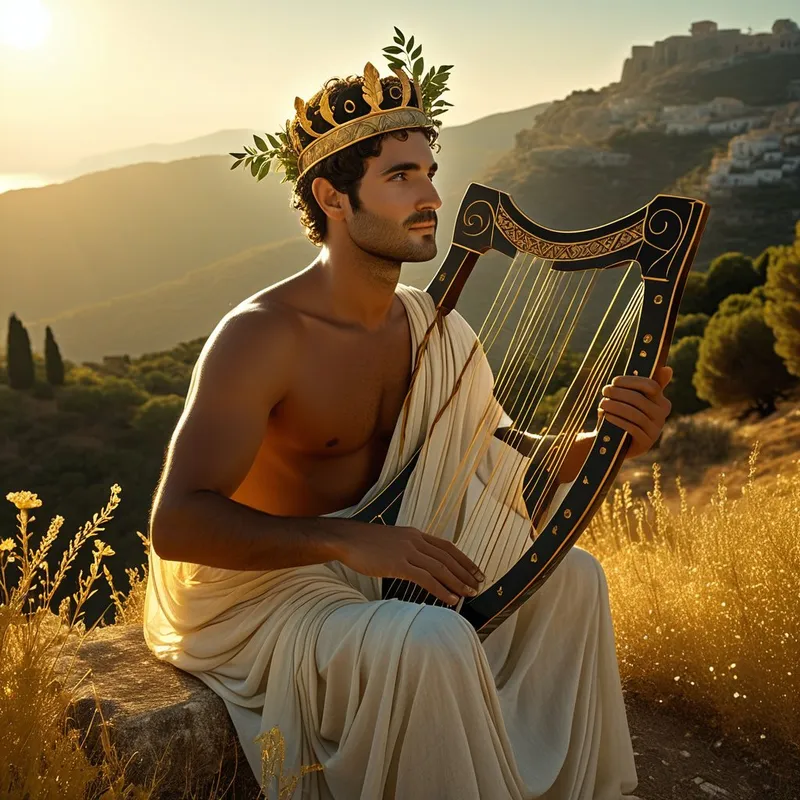
Apollo's Lyre Myth Meaning & Symbolism
The trickster god Hermes steals Apollo's cattle, invents the lyre, and trades it for peace, transforming discord into divine music and order.
The Tale of Apollo's Lyre
Hear now the tale of the first music, born not from harmony, but from theft. Before the dawn of the world’s first morning, when the mist still clung to the slopes of Mount Cyllene, a child was born. Not a mewling babe, but Hermes, son of Zeus and the nymph Maia. While his mother slept, the newborn slipped from his cradle. His eyes, old as the stars, saw the world not as it was, but as it could be.
He ventured into the twilight and found a tortoise, browsing on dewy grass. With a word and a touch, he emptied its shell, strung it with seven lengths of gut, and plucked a sound that had never been heard. The first note hung in the air, a question. He had his toy. But a greater mischief called.
His gaze turned to the sun-drenched pastures of Pieria, where the magnificent cattle of his elder brother, the glorious Apollo, grazed. Under the cover of night, the infant god drove fifty of the finest beasts backward, so their tracks pointed away, and hid them in a grove. He slaughtered two, offering a portion to the twelve Olympians—a gesture both pious and audacious. Then, as if it were all a dream, he returned to his cradle, the lyre cradled beside him.
When Apollo, the Far-Shooter, discovered the theft, his rage was a solar flare. The light of reason turned to a burning searchlight of wrath. He traced the cunning, reversed trail, confounded by the trick, until an old man, Battus, whispered of a child driving cattle. Apollo stormed into Maia’s cave, his presence filling the space with accusatory light. He demanded his property.
Hermes, playing the innocent, widened his eyes. “A newborn? Steal your cattle? I, who was born only yesterday?” But Apollo was not fooled. He seized his brother and dragged him before their father, Zeus, on high Olympus. There, before the throne of thunder, the infant god defended himself with such wit and charm that Zeus, rather than judging, laughed a sound like rolling clouds.
Yet proof was needed. Apollo brought Hermes back to the hidden cattle. There, to settle the divine dispute, Hermes took up his strange new instrument. He sat upon a rock, cradled the tortoiseshell, and let his fingers dance.
The music that flowed forth was not mere sound. It was the ordering of chaos. It was the rhythm of the stars finding their paths, the melody of rivers finding their beds, the harmony of a soul at peace with itself. It spoke of the joy of creation and the quiet mystery of the night. It was everything Apollo, god of perfect form and celestial order, revered but did not yet possess in this raw, enchanting form.
Apollo’s anger melted like frost in the dawn. The fire in his eyes softened to a glow of wonder. “Little brother,” he said, his voice now a murmur of awe, “this music… it is worth all the cattle in the world.” In that moment, a trade was struck, not of coercion, but of mutual recognition. The lyre, born of trickery and invention, passed from the hands of the thief into the hands of the musician. In return, Apollo gave Hermes the golden caduceus and blessed his cunning ways. Discord was transmuted. The thief became the patron of travelers and commerce. The god of light became the master of the divine chord. And from that day forth, the music of the lyre was the sound of the cosmos itself, in tune.

Cultural Origins & Context
This myth is primarily preserved in the Homeric Hymn to Hermes, a text likely composed in the 6th or 5th century BCE. These hymns were not liturgical documents in a modern sense, but poetic narratives performed by rhapsodes, the bards of ancient Greece, at festivals and symposia. Their function was multifaceted: to honor the gods, to explain the origins of cultural institutions (like music and cattle-herding), and to provide entertainment that reinforced the social and cosmic order.
The story operates within a deeply pragmatic yet spiritual framework. It explains the divine provenance of the lyre—the central instrument of Greek education, ceremony, and poetry—linking it directly to Apollo, the patron of civilized arts. It also delineates the domains of two crucial Olympian brothers: Apollo’s realm of law, prophecy, medicine, and artistic perfection, and Hermes’s realm of boundaries, communication, luck, and the fertile chaos that precedes order. The myth served to reconcile these two powerful, often opposing forces within the Greek worldview, showing how cunning and law, innovation and tradition, could be integrated for the benefit of the whole cosmos. It was a foundational story about the birth of culture itself from the raw materials of nature and instinct.
Symbolic Architecture
At its heart, the myth is an allegory for the integration of opposites, a necessary process for the creation of anything whole and beautiful.
The Lyre: The central symbol is the lyre itself. Crafted from a lowly, earth-bound creature (the tortoise) and the gut of stolen, instinctual energy (the cattle), it represents the transformation of base, chaotic, or "shadow" material into an instrument of sublime order and harmony. It is the archetypal symbol of techne—craft, art, the application of intelligence to raw matter.
The true magic lies not in the possession of power, but in the ability to transform raw, even stolen, experience into a form that creates harmony.
Hermes: He embodies the psychopomp and the trickster. He is the quickening spirit of the unconscious, the sudden insight, the disruptive idea that steals away our settled, "sacred cattle" (established beliefs, routines, or energies) and forces a crisis. His invention is an act of spontaneous, intuitive genius arising from confrontation with the material world.
Apollo: He represents the conscious mind, the ego, and the principle of order, light, and logos. His initial rage is the ego's response to a violation of its domain. His transformation, upon hearing the music, is the moment the conscious self recognizes the value of the unconscious creation. He does not destroy the trickster; he negotiates with him and is enriched by him.
The Theft and Trade: The conflict is not resolved through punishment, but through a creative exchange. This symbolizes a profound psychological truth: the energies we repress or disown (our "inner Hermes") will inevitably steal our vitality. Wholeness is achieved not by banishing these energies, but by listening to what they have created in the shadows and integrating it, paying the price of recognition.
The Dreamer's Resonance
When this mythic pattern stirs in the modern dreamer, it often signals a profound inner negotiation between established identity and emerging, disruptive potential.
Dreaming of being Apollo—discovering a theft, feeling a righteous fury over a loss of personal resources, time, or energy—suggests the conscious ego feels violated. The somatic sense may be one of burning frustration or depletion. Psychologically, the dreamer is being asked: what rigid structure or prized possession in your life is being challenged by a younger, more cunning part of yourself?
Dreaming of being Hermes—crafting something ingenious from unlikely materials, getting away with a clever trick—points to the activation of the inner innovator or shadow. This can feel exhilarating but also isolating. It indicates a nascent creativity or a necessary deception (of self or others) is at work, often related to bypassing an "Apollonian" rule or expectation that feels stifling.
Most powerfully, dreaming of hearing or playing the transformative music itself signifies the moment of synthesis is near or has occurred. This is the dream of resolution, where the conflict between duty and desire, order and chaos, gives way to a new, harmonious understanding. The body may feel a deep resonance, a release of tension, as discordant psychic elements find their place in a larger, more beautiful composition.
Alchemical Translation
The journey from theft to traded lyre is a perfect map for the Jungian process of individuation—the becoming of one’s whole, unique self.
The Nigredo (The Blackening): Apollo’s cattle, symbols of solar vitality and ordered life-force, are stolen. This is the necessary crisis, the dark night of the soul where what we relied upon (our conscious achievements, our persona) is taken. We feel robbed, angry, and in the dark. Hermes, the shadow, has acted.
The Albedo (The Whitening): In the cave (the unconscious), Hermes works on the tortoise. This is the reflective, interior work. The dreamer must take the raw, hardened aspects of their nature (the shell) and the sacrificed, instinctual energies (the gut) and begin to fashion something new. This is the stage of insight, of lonely invention.
The Rubedo (The Reddening): The confrontation before Zeus and the final performance. This is the bringing of the new creation into the light of consciousness. The ego (Apollo) must face the trickster and hear his music. The initial fiery anger must be transmuted into the fiery gold of appreciation. The trade is the critical act of psychic negotiation: the conscious mind accepts the gift of the unconscious, and in return, grants it legitimate status (the caduceus, a role in the psyche’s economy).
Individuation is the art of turning the theft of your certainty into the music of your becoming.
The final state is not Apollo or Hermes ruling, but a sacred partnership. The individual gains the lyre—the capacity to create harmony from their own inner contradictions. The once-chaotic, rebellious, or hidden energies (Hermes) become the messengers of the soul, while the organizing principle (Apollo) gains a deeper, more soulful melody to conduct. One becomes, in a sense, both the cunning inventor of one’s destiny and the divine musician who gives it beautiful, resonant form.
Associated Symbols
Explore related symbols from the CaleaDream lexicon: