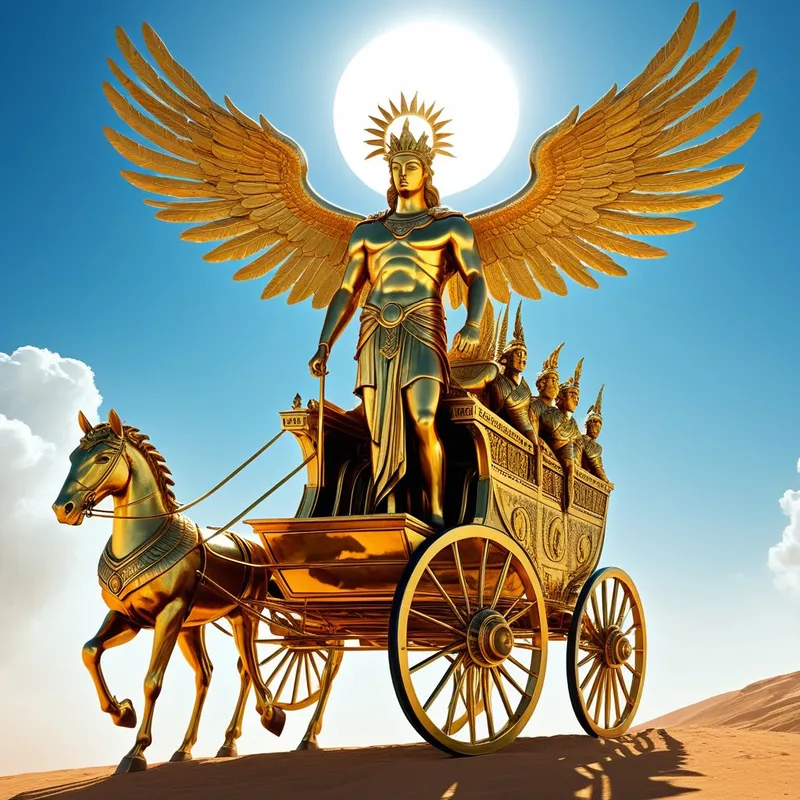
Apollo's chariot at its zenith Myth Meaning & Symbolism
The sun god's daily journey, a story of divine duty, cosmic order, and the terrifying, brilliant moment of noon where all shadows vanish.
The Tale of Apollo's chariot at its zenith
Hear now the tale of the Apollo's most perilous duty, a journey not of conquest, but of cosmic necessity. Each dawn, in the stables of the east forged from coral and rose quartz, he harnesses the four immortal steeds—Pyrois, Eous, Aethon, and Phlegon. Their breath is the morning mist set aflame, their hooves striking sparks that become the first stars to fade.
With a command that is both song and law, Apollo mounts the chariot of beaten gold, its wheels rimmed with amber. The gates of dawn part, and the ascent begins. This is no gentle climb. It is a furious, glorious haul against the gravity of night. The world below awakens to his light: shadows stretch long and lean, then shrink as he climbs. The sea becomes a sheet of hammered silver, the mountains reveal their stark bones.
But the climb is not the trial. The trial is the peak.
As the chariot approaches the zenith, the midpoint of the sky-vault, a profound silence descends. The wind of ascent dies. The joyous song of the rising becomes a focused, tense hum. Here, at the apex, the sun is a furious, unblinking eye. All shadows flee, cowering directly beneath the feet of men and leaves of trees. The light is absolute, merciless, and clarifying. It reveals every crack in the earth, every ripple on the ocean, with a detail that is almost cruel.
In this moment, Apollo is not a musician or a healer. He is the stern Cosmocrator, the driver of order. His muscles, though divine, strain. The reins, woven from the threads of fate, grow hot in his hands. The horses, feeling the strange stillness of the peak, grow restless; their fire seeks to expand, to run wild, to break from the ordained path and scorch the earth. A tremor runs through the chariot. This is the pivot of the world, the breath-held instant between ascent and descent. One slip, one moment of prideful inattention or awe at his own power, and the chariot would plunge, setting the world ablaze.
He must hold the line. Not with force alone, but with perfect, poised balance—a harmony of will, duty, and respect for the Logos he serves. For a heartbeat that lasts an eternity, solar fire and cosmic law are in perfect, precarious equilibrium. Then, with a sigh that is the first hint of the afternoon breeze, the descent begins. The chariot tilts toward the west, the shadows slowly stretch their limbs once more, and the god guides the sun home, his face now turned toward the gentle embrace of twilight.
Cultural Origins & Context
The image of the solar chariot is one of humanity's most universal archetypes. While the specific narrative of Apollo's perilous zenith is most vividly articulated in Greco-Roman mythology (most famously in Ovid's Metamorphoses in the tale of Phaethon), its essence is global. From the Vedic Surya to the Norse Sól, and the Egyptian Ra in his barque, cultures observed the sun's supreme, predictable journey and personified its terrifying power and necessary discipline.
This was not merely a "just-so" story for ancient peoples. It was a foundational cosmological model, a mythic explanation for the most reliable yet potent phenomenon in their lives: the diurnal cycle. It was told to illustrate the fragility of cosmic order, the immense responsibility of divine power, and the danger of that power left unchecked. The story, especially in the cautionary tale of Phaethon, functioned as a societal bulwark against hubris. It taught that even the most glorious forces are subject to a law greater than themselves. The moment at the zenith was the dramatic highlight of this lesson—the point of maximum risk and maximum revelation.
Symbolic Architecture
The myth is a masterful symbolic map of consciousness, power, and the structure of reality itself. Apollo represents the ruling principle of the conscious ego—the part of the psyche that seeks order, clarity, distinction, and light. His chariot is the vehicle of the individual will and life-force, harnessed to a transcendent purpose.
The Zenith is the core symbol. It is not just a spatial high point, but a temporal and psychological one.
The zenith is the moment of perfect, unsustainable focus. It is the peak of achievement, the height of power, the point of absolute clarity where all ambiguities are burned away, and one stands utterly exposed to the truth of one's own position.
The Four Horses symbolize the raw, instinctual, and creative energies (the four elements, the four psychic functions) that must be harnessed and directed by the conscious ruling principle. Their restlessness at the peak speaks to the instinctual psyche's discomfort with the sterility of pure, shadowless consciousness.
The Vanishing Shadows are critically important. In the blinding light of the zenith, shadows disappear. Symbolically, this represents the temporary—and dangerous—illusion that the shadow has been conquered or eliminated. It is a state of one-sidedness, where the illuminating but scorching light of conscious judgment denies the fertile, necessary darkness of the unconscious.

The Dreamer's Resonance
When this myth pattern appears in modern dreams, it rarely features a literal chariot. Instead, the dreamer may find themselves at the top of a towering, exposed structure—a skyscraper, a mountain peak, a lighthouse—under a glaring, silent sun. The somatic feeling is one of intense exposure, isolation, and a paradoxical emptiness at the moment of supposed triumph. There is often a fear of falling, not from a loss of footing, but from the sheer unsustainable tension of the position.
Psychologically, this dream signals that the conscious ego is at its "zenith." The dreamer may be experiencing a peak in their career, a moment of hard-won intellectual clarity, or a period where they feel in absolute control of their life. The dream is the psyche's warning. It says: This height is an illusion maintained by immense strain. You have illuminated so much that you can no longer see your own foundation. Your shadows—your vulnerabilities, your repressed needs, your ignored frailties—are not gone; they are compressed beneath you, waiting. The dream is an invitation to begin the necessary, graceful descent into integration before a catastrophic fall forces it.
Alchemical Translation
The individuation process, the alchemy of the soul, is mirrored perfectly in Apollo's daily journey. The conscious ego must make its ascent: developing competence, achieving goals, forging an identity in the light of day (the solificatio). But the zenith is not the goal of individuation; it is its crisis point.
The true alchemical work begins not in the blinding light of the zenith, but in the conscious, willing turn toward the descent. It is the sacrifice of solar supremacy for the sake of wholeness.
Holding the chariot at the peak represents the ego's temptation to identify with the Self, to believe it is the central, unchanging source of light. The alchemical translation is the realization that one is not the sun, but the charioteer serving the sun—a vessel for a transcendent energy. The "perilous equilibrium" is the ego's mature state: in command, but not in tyranny; illuminated, but aware of its limits.
The descent toward the west is the nigredo. It is the voluntary journey into the shadow, the twilight, and the unconscious waters where the sun must be regenerated. Apollo does not fight this descent; he guides it. This is the model for the modern individual: after a period of brilliant conscious achievement, one must consciously, deliberately, turn one's skills toward navigating the inner darkness, recovering the shadows that were lost at noon, and preparing for a renewal that is not merely a repetition of the ascent, but a deeper, more integrated cycle. The myth teaches that rulership is not about perpetual noon, but about shepherding the entire cycle—light and dark—with reverence and skill.
Associated Symbols
Explore related symbols from the CaleaDream lexicon: