
Apollo and Hyacinthus Myth Meaning & Symbolism
A god's love for a mortal prince ends in tragedy, transforming grief into an immortal flower, a symbol of beauty born from sorrow.
The Tale of Apollo and Hyacinthus
Hear now of a love that shook the heavens and stained [the earth](/myths/the-earth “Myth from Hindu culture.”/) with beauty.
In the sun-blessed land of Sparta, where [the river](/myths/the-river “Myth from Buddhist culture.”/) Eurotas whispered through the plains, there lived a prince. His name was [Hyacinthus](/myths/hyacinthus “Myth from Greek culture.”/), and his beauty was not of this world. It was said his laughter could make the asphodel bloom out of season, and his form was so graceful that the very winds would still to watch him pass. He was the darling of Amyclas, a mortal jewel in a mortal court.
But mortal beauty is a flame that draws immortal eyes. From his golden chariot high above, [Apollo](/myths/apollo “Myth from Global/Universal culture.”/), lord of the unclouded mind and the piercing light, looked down. And he was pierced. The god who sees all truths was blinded by a single, human truth: desire. He descended, laying aside his radiance like a cloak, to walk beside the prince. The god of music taught the youth to play the lyre, its notes weaving spells around them. The god of archery placed a bow in his hands, guiding his aim. In the [gymnasium](/myths/gymnasium “Myth from Greek culture.”/), they wrestled, god and mortal, sweat and sunlight mingling on their skin. For a season, the divine and the human met in perfect, joyous harmony, and [the world](/myths/the-world “Myth from Tarot culture.”/) seemed to hold its breath.
Their favorite pastime was the discus. Apollo, in his divine strength, could hurl the bronze plate with [the force](/myths/the-force “Myth from Science Fiction culture.”/) of a thunderbolt, carving arcs across the vault of [the sky](/myths/the-sky “Myth from Persian culture.”/). Hyacinthus watched, enthralled, always begging to try. One afternoon, under a sky of flawless cobalt, Apollo prepared for a mighty throw. He spun, a whirlwind of perfect form, and released. The discus sang as it flew, a humming note of impending fate.
But another watched. [Zephyrus](/myths/zephyrus “Myth from Greek culture.”/)</ab title=“The god of the west wind, known for his jealousy and tempestuous nature”>, the West Wind, who also loved the prince, burned with a jealous, possessive fury. As the discus reached its apex, [Zephyrus](/myths/zephyrus “Myth from Greek culture.”/) blew. Not a gentle breeze, but a sudden, vicious gust. It caught the heavy discus and twisted its path, sending it not into the soft earth, but in a murderous curve directly toward Hyacinthus.
There was a sound—a terrible, dull impact. The prince fell without a cry. Apollo was at his side in an instant, his divine hands pressing against the mortal wound, but his arts of healing, which could cure plagues and raise temples, were useless. [The Fates](/myths/the-fates “Myth from Greek culture.”/) had cut the thread. The god cradled the dying youth, his light unable to penetrate the gathering dark. As Hyacinthus’s life bled into the Spartan soil, Apollo wept. His tears fell upon the prince’s brow, mingling with the blood that seeped from the fatal blow.
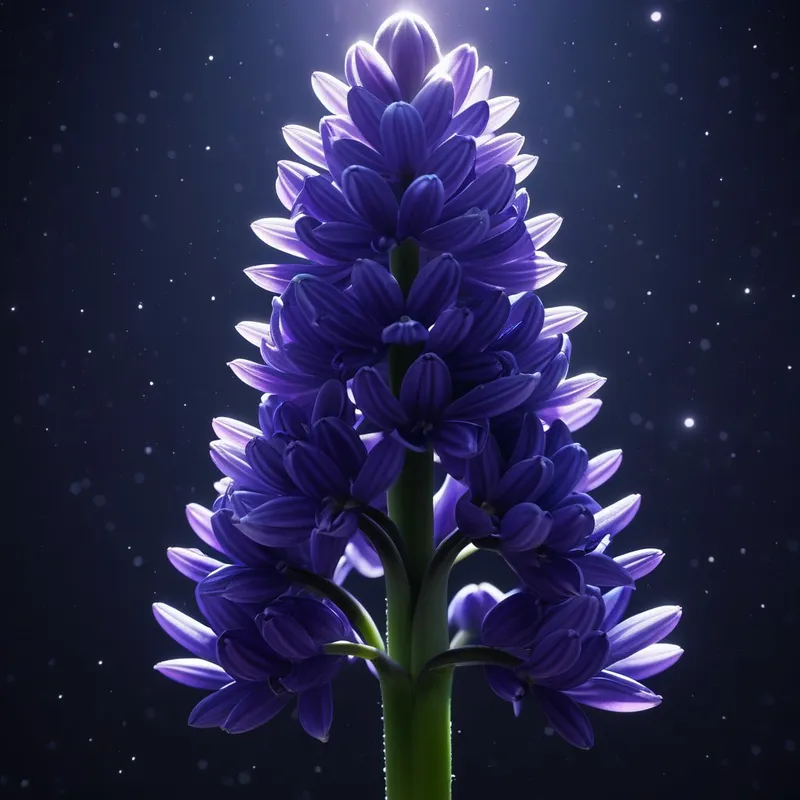
“You shall not fade,” the god whispered, his voice thick with a grief that echoed in the silent heavens. “You shall not go to [Hades](/myths/hades “Myth from Greek culture.”/) and be forgotten.” Where the blood and tears met the earth, something stirred. A slender green shoot pushed through, growing with supernatural speed. It budded, then burst into bloom—a flower of deep, mournful purple, its petals marked as if with stains of blood. And upon those petals, Apollo inscribed his eternal lament: the letters AIAI, a cry of woe. He named the flower [hyacinth](/myths/hyacinth “Myth from Greek culture.”/). Thus, the beautiful mortal was gone, but his essence was transfigured, returning each spring as a fragrant memorial to a love that defied the order of life and [death](/myths/death “Myth from Tarot culture.”/).

Cultural Origins & Context
This poignant myth comes to us primarily from the later classical and Hellenistic periods, most comprehensively in the [Metamorphoses](/myths/metamorphoses “Myth from Greek culture.”/) of the Roman poet Ovid, though its roots are undeniably Greek. It belonged to a cycle of Spartan local legends, or patria, which connected the landscape and its rituals to divine stories. The cult of Apollo was strong in Sparta, and the myth of Hyacinthus was central to the major Spartan festival of the Hyacinthia, a three-day rite that intriguingly mingled mourning and celebration.
The festival’s structure mirrored the myth’s duality: the first day was given to solemn lamentation for the dead prince, with sacrifices to [the underworld](/myths/the-underworld “Myth from Greek culture.”/) and abstention from festive adornments. The subsequent days dramatically shifted to a grand celebration of Apollo, featuring musical contests, chariot races, and feasts. This ritual sequence served a profound societal function. It acted as a cultural pressure valve, modeling a contained, formalized process for grief before a necessary return to life and communal vitality. It taught that beauty and joy can, and must, emerge from loss, a vital lesson for a warrior society intimately acquainted with death. The myth was not merely a story of tragic love; it was a sacred narrative underpinning a community’s relationship with mortality, renewal, and the capriciousness of the divine.
Symbolic Architecture
At its core, this is a myth of impossible [conjunction](/symbols/conjunction “Symbol: In arts and music, a conjunction represents the harmonious or dissonant merging of separate elements to create a new, unified whole.”/) and its catastrophic, yet creative, consequence. Apollo represents [the principle](/symbols/the-principle “Symbol: A fundamental truth, law, or doctrine that serves as a foundation for a system of belief, behavior, or reasoning, often representing moral or ethical standards.”/) of nous—the luminous, ordering, conscious intellect. Hyacinthus embodies the ephemeral, instinctual [beauty](/symbols/beauty “Symbol: This symbol embodies aesthetics, harmony, and the appreciation of life’s finer qualities.”/) of the somatic and natural world—the physis that blooms and dies. Their union is the eternal [human](/symbols/human “Symbol: The symbol of a human represents individuality, complexity of emotions, and social relationships.”/) yearning to wed [spirit](/symbols/spirit “Symbol: Spirit symbolizes the essence of life, vitality, and the spiritual journey of the individual.”/) to flesh, [eternity](/symbols/eternity “Symbol: The infinite, timeless state beyond human life and measurement, often representing the ultimate or divine.”/) to the [moment](/symbols/moment “Symbol: The symbol of a ‘moment’ embodies the significance of transient experiences that encapsulate emotional depth or pivotal transformations in life.”/).
The tragedy is not that they loved, but that the conscious light sought permanent residence in a vessel of clay.
The fatal agent, Zephyrus, is the necessary third element: the unconscious, affective [psyche](/myths/psyche “Myth from Greek culture.”/)—[jealousy](/symbols/jealousy “Symbol: A complex emotion signaling perceived threat to valued relationships or status, often revealing insecurities and unmet needs.”/), [passion](/symbols/passion “Symbol: Intense emotional or physical desire, often linked to love, creativity, or purpose. Represents life force and deep engagement.”/), the unpredictable wind of [fate](/symbols/fate “Symbol: Fate represents the belief in predetermined outcomes, suggesting that some aspects of life are beyond human control.”/) that disrupts all perfect plans. He symbolizes the [shadow](/symbols/shadow “Symbol: The ‘shadow’ embodies the unconscious, repressed aspects of the self and often represents fears or hidden emotions.”/) that inevitably appears when [consciousness](/symbols/consciousness “Symbol: Consciousness represents the state of awareness and perception, encompassing thoughts, feelings, and experiences.”/) becomes too identified with an ideal, reminding us of the autonomous, often disruptive, power of the unseen [depths](/symbols/depths “Symbol: Represents the subconscious, hidden emotions, or foundational aspects of the self, often linked to primal fears or profound truths.”/). The discus, Apollo’s tool, becomes the [instrument](/symbols/instrument “Symbol: An instrument symbolizes creativity, communication, and the means by which one expresses oneself or influences the world.”/) of [fate](/symbols/fate “Symbol: Fate represents the belief in predetermined outcomes, suggesting that some aspects of life are beyond human control.”/). It is the focused, directed [energy](/symbols/energy “Symbol: Energy symbolizes vitality, motivation, and the drive that fuels actions and ambitions.”/) of the conscious will, which, when seized by the unconscious (Zephyrus’s [gust](/symbols/gust “Symbol: Gusts symbolize sudden, unexpected changes or strong influences that can invigorate or disorient.”/)), turns back upon the very object of its desire with destructive force.
The [metamorphosis](/symbols/metamorphosis “Symbol: A profound, often irreversible transformation of form, identity, or state, representing a complete journey from one condition to another.”/) is the key. Hyacinthus does not become a [constellation](/symbols/constellation “Symbol: Represents guidance, destiny, and the navigation through life, symbolizing the connections between experiences and paths.”/), a remote star. He becomes a flower—a rooted, earthly, cyclical [life](/symbols/life “Symbol: The symbol of ‘Life’ represents a journey of growth, interconnectedness, and existential meaning, encompassing both the joys and challenges that define human experience.”/). The inscribed petals (AIAI) eternalize the sound of [grief](/symbols/grief “Symbol: A profound emotional response to loss, often manifesting as deep sorrow, yearning, and a sense of emptiness.”/) itself, while the flower’s perennial return transmutes personal tragedy into a law of [nature](/symbols/nature “Symbol: Nature symbolizes growth, connectivity, and the primal forces of existence.”/): beauty is born from wounds, and [memory](/symbols/memory “Symbol: Memory symbolizes the past, lessons learned, and the narratives we construct about our identities.”/) is encoded in the very processes of [life](/symbols/life “Symbol: The symbol of ‘Life’ represents a journey of growth, interconnectedness, and existential meaning, encompassing both the joys and challenges that define human experience.”/).
The Dreamer’s Resonance
When this myth stirs in the modern unconscious, it often manifests in dreams of poignant, doomed connections or creative endeavors shattered at their peak. One might dream of a mentor or beloved figure accidentally causing harm; of a beautiful project or idea being suddenly and senselessly destroyed by an external, chaotic event; or of finding a unique, marked flower growing from a place of personal injury or loss.
Somatically, this can feel like a piercing grief in the chest, a literal “heartbreak,” or a heavy, melancholic inertia. Psychologically, the dreamer is likely navigating the brutal end of an idealized state—a “[golden age](/myths/golden-age “Myth from Universal culture.”/)” in a relationship, the pure joy of a new talent, or a period of inspired creativity. The dream presents the Hyacinthus moment: the catastrophic rupture of identification with a perfect, sunlit state of being. It is the psyche’s way of initiating a necessary, albeit painful, dissolution. The process underway is the shattering of an inflation—where one has become too identified with the “Apollonian” ideal of perfection, control, or luminous consciousness, and the unconscious (Zephyrus) intervenes to bring it crashing down, wounding the innocent, beautiful attachment (Hyacinthus) in the process.

Alchemical Translation
The alchemical journey mirrored here is [solutio](/myths/solutio “Myth from Alchemical culture.”/) followed by [coagulatio](/myths/coagulatio “Myth from Alchemical culture.”/)—dissolution and coagulation. The bright, conscious union (the [coniunctio](/myths/coniunctio “Myth from Alchemical culture.”/) of god and mortal) is dissolved in blood and tears. This is not a failure, but the crucial [nigredo](/myths/nigredo “Myth from Alchemical culture.”/), the blackening, the descent into the grief-stricken void where all seems lost.
The work of the soul begins not in the light, but in the acknowledgment of the stain upon the earth.
Apollo’s response models [the alchemist](/myths/the-alchemist “Myth from Various culture.”/)’s next step: he does not deny the death or rage impotently against fate. He attends to it. He holds the dying form, weeps, and then performs the act of sacred imagination. He speaks the new form into being: “You shall not fade.” This is the moment of transmutation. The psychic energy that was locked in the idealized object (the living prince) is not lost; it is released into the substance of the soul itself, where it coagulates into a new, enduring form—the flower.
For the modern individual, the myth charts the path of individuation through tragic loss. It teaches that our deepest attachments and most brilliant potentials will, inevitably, be wounded by the winds of fate, our own shadows, or simple mortality. The individuation task is to do as Apollo did: to fully mourn the loss of the ideal, the perfect, the “sunlit” self or relationship, and then to consciously participate in the metamorphosis. We must inscribe our grief (AIAI) upon the experience, not to dwell in lament, but to cultivate the hyacinth—the new growth, the creative work, the deeper compassion, the cyclical wisdom that springs directly from the wounded place. The flower is the symbol of [the Self](/myths/the-self “Myth from Jungian culture.”/) that is more whole for having integrated the reality of death and grief, a beauty that is profound precisely because it is rooted in the stained earth.
Associated Symbols
Explore related symbols from the CaleaDream lexicon: