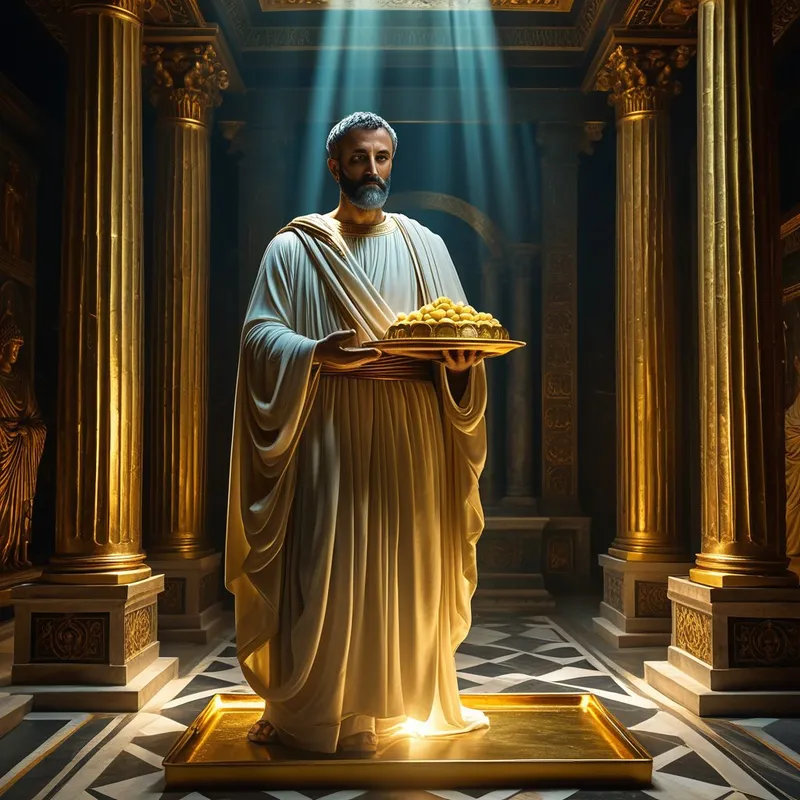
Apicius Myth Meaning & Symbolism
The tale of the mortal chef who became a god of culinary excess, whose insatiable hunger led to a feast with his own soul as the final course.
The Tale of Apicius
Listen, and hear the tale that is told not in the roar of the forum, but in the hush of the kitchen hearth, in the sizzle of oil and the sigh of rising dough. It is the story of Apicius, a man whose name became synonymous with the feast, yet whose soul knew only famine.
He was born with a silver spoon that tasted of ash. From his first breath, the world was a bland, textureless gruel to him. While other men sought glory in legion or law, Apicius sought it in the alchemy of the palate. He traveled the empire, from the fish-salt markets of Ostia to the spice-scented docks of Alexandria, not as a merchant, but as a pilgrim. He sought the secret that lay between salt and sweet, between the crunch of a fresh apple and the unctuous melt of fattened goose liver. He believed, with a fanatic’s heart, that the perfect flavor could fill the hollow place behind his ribs.
His home in Rome became a temple to this quest. Marble floors echoed with the chop of a hundred knives. The air, thick with saffron and roasting meat, was a visible haze. He spent fortunes on a single jar of garum from the first pressing, on dormice fattened on walnuts and honey, on peacocks whose feathers were re-set after roasting. Senators and poets clamored for an invitation to his table, where they would eat dishes that sang of distant seas and sun-drenched hills, all while Apicius watched them, his own eyes empty.
The crisis came on a night of unparalleled extravagance. The centerpiece was a sow, roasted whole, but from whose belly live thrushes flew when carved, a spectacle of such grotesque wonder the guests wept. Yet when the last wine was poured, Apicius retired to his chamber, gripped by a cold, vast despair. He tallied his remaining wealth and found it still immense. And he whispered to the darkness, “If I cannot live as Apicius, I shall not live at all.”
But this was not a cry for the mortal end. It was an invocation. He called his remaining servants and commanded one final, supreme banquet. Every last sestertius was to be spent. The market was stripped bare. For days, the fires burned, and the smells that wafted from his villa were so potent they were said to make birds fall from the sky in rapture.
The feast was laid in his great hall. It was a landscape of food, a topography of desire. And there, at the head of the table, sat Apicius, alone. He ate. Not with gluttony, but with a terrifying, focused reverence. Course after mythical course passed his lips. He consumed the physical manifestation of his entire life’s pursuit, his fortune, his identity. As he swallowed the final, transcendent morsel—a concoction involving pearls dissolved in vinegar and the brains of a hundred nightingales—a profound silence fell.
The hollow behind his ribs did not fill. Instead, it expanded, becoming a vortex. And in that moment of ultimate satiation and ultimate starvation, the household gods in the corner, the Lares, turned their faces away. The man dissolved. Where Apicius sat, there remained only the essence of the hunger itself, now divine and eternal. The last servant, entering with more wine, found not a corpse, but an empty chair radiating a terrible, tempting aroma, and a new, faint constellation glowing above the hearth—the Celestial Casserole, forever out of reach.
Cultural Origins & Context
The figure of Apicius is a peculiar chimera of history and moral fable. He is loosely based on several historical Roman gourmands named Apicius, most notably Marcus Gavius Apicius from the 1st century AD, during the reign of Tiberius. The legendary, mythological Apicius we discuss is a cultural composite, a story that coalesced in the late Republic and early Empire, a period of unprecedented wealth, expansion, and anxiety about luxury (luxuria).
This myth was not preserved in epic poetry but in the moralizing anecdotes of satirists like Juvenal and the gossipy pages of chroniclers. It was a story told at dinner parties about dinner parties, a cautionary tale shared between cups of wine. Its societal function was multifaceted: it was a warning against the emasculating and corrupting influence of excessive pleasure, a commentary on the soul-destroying potential of boundless wealth, and a paradoxical celebration of Roman culinary ingenuity. It gave a name and a face to the culture’s deep ambivalence about its own material success.
Symbolic Architecture
At its core, the myth of Apicius is not about food, but about the nature of desire. Apicius is the archetype of the ego that mistakes the object of desire for the source of fulfillment. His kitchen is his conscious world, ordered, controlled, and dedicated to the procurement of sensory experience. The hollow within him is the unrecognized anima or soul, starving for meaning, connection, and the numinous.
The banquet is the ego's masterpiece, but the empty chair is the soul's verdict.
The final, solitary feast is the ultimate act of psychic inflation—the ego attempting to incorporate the entire outer world (symbolized by the empire’s bounty) to feed its inner poverty. His transformation into a god is not a reward, but a fate. He becomes the eternal principle of insatiability, a daemon of craving. He is cursed to forever be the hunger, not to satisfy it. The constellation left behind symbolizes how such all-consuming passions, when divorced from soul, become fixed, distant, and untouchable patterns—beautiful but lifeless ideals.
The Dreamer's Resonance
When this myth stirs in the modern dreamer, it often manifests as dreams of endless, unsatisfying consumption. You may dream of shopping in infinite malls for an item you can never find, of preparing a colossal meal for guests who never arrive, or of eating plate after plate yet feeling emptier with each bite. Somaticly, this can feel like a tightness in the solar plexus, a gnawing anxiety in the gut.
Psychologically, this is the process of the psyche signaling that a core desire is being misdirected. The dream is highlighting a "spiritual anorexia" where the individual is gorging on substitutes—be it career success, romantic conquests, material acquisition, or even spiritual knowledge—while the authentic hunger of the soul goes unfed. The dream Apicius is the personification of an addictive complex, a pattern of behavior that promises wholeness but only deepens the void.

Alchemical Translation
The alchemical journey modeled by Apicius is a stark warning of the Nigredo—the blackening—that occurs when the process of individuation is avoided. His initial quest represents the prima materia, the raw stuff of life (sensory experience, passion). But instead of submitting this material to the inner fire of reflection and relationship, he attempts to possess and control it outwardly. This is the ego refusing the dissolution necessary for transformation.
The transmutation of lead into gold fails when the alchemist tries to eat the furnace.
The path out of this fate is implied in the myth’s negative example. The modern individual must learn to differentiate between hunger and appetite. The first step is to stop the frantic consumption and sit, like Apicius at his final table, in the terrifying silence of one’s own company. One must ask, “What does this craving truly seek?” The answer is never another object, but a state of being: connection, peace, meaning, love.
The alchemical “feast” then becomes an internal one. The ingredients are memories, emotions, shadows, and potentials. The “cooking” is the slow, patient work of introspection, therapy, art, or prayer—the heat that transforms raw experience into wisdom. The goal is not to become a god of hunger, but to become fully human, capable of savoring a simple meal because one is finally present to it, the inner hollow having been acknowledged and filled with the light of consciousness, not the ash of consumption. The true banquet is the integrated self.
Associated Symbols
Explore related symbols from the CaleaDream lexicon: