
Aphrodite's cosmetics Myth Meaning & Symbolism
Aphrodite's secret cosmetics, born of divine essence, reveal the perilous alchemy where beauty, artifice, and true self converge.
The Tale of Aphrodite's cosmetics
Listen, and let the scent of salt and myrtle carry you to the dawn of the world. The foam-born one, Aphrodite, had stepped from the sea, and beauty itself had found a face. Yet, even for her, the work of enchantment was not passive. In the secret hours, when only the Horai were her witnesses, she would retire to her sun-drenched chambers on Olympus.
There, from a casket of polished ivory and gold, she would draw forth her phials. These were not the pastes of mortals, ground from berries and ochre. These were the distilled essences of the cosmos itself. One held the last blush of a sunset before Hesperus claimed the sky. Another contained the shimmer left on a wave’s crest by a diving tern. A third was the dew gathered from the first rose, touched only by Eos’s pale fingers. With a swan’s-down brush, she would anoint her skin, and the very air would grow heavy with a longing so sweet it ached.
But the heart, even a divine one, is a curious organ. From her high throne, Aphrodite watched the daughters of men. She saw their clumsy attempts at adornment, their soot-lined eyes and berry-stained lips. A strange emotion stirred within her—not jealousy, but a deep, resonant loneliness. Her beauty was absolute, a law of nature. Theirs was a striving, a hopeful prayer. In a moment of inscrutable whim, or perhaps profound empathy, she decided to share a fragment of her mystery.
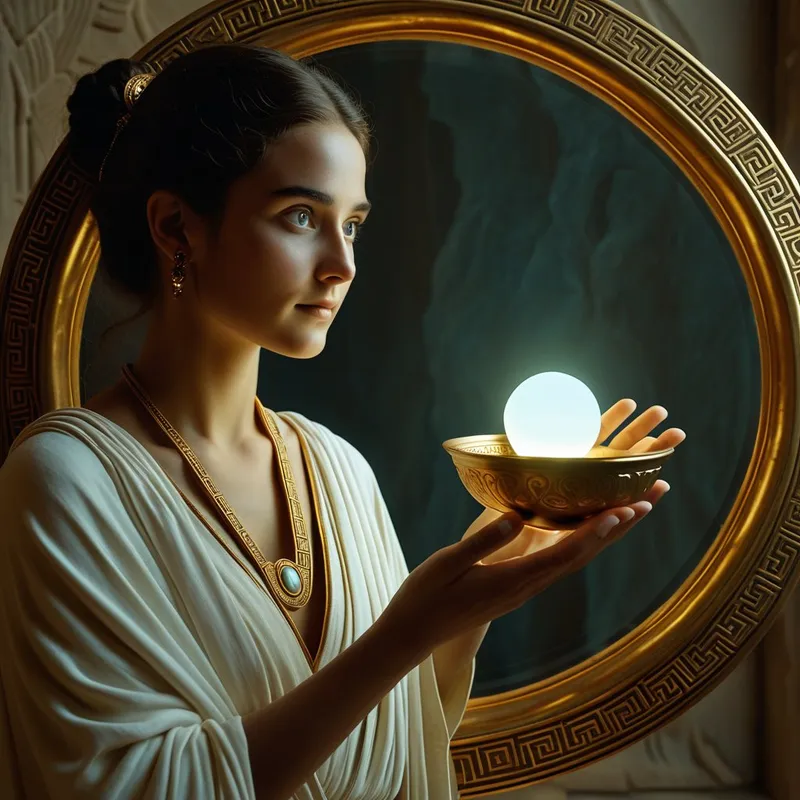
She summoned a trusted mortal, a priestess whose soul was as clear as a mountain spring. Into a humble kylix, Aphrodite poured a single drop from her most potent phial—the one that held the light of stars reflected in a lover’s eyes. “Take this,” she whispered, her voice the sound of distant waves. “Let it be a bridge between my world and yours. But know this: it is a seed of the divine. It will show you not what you lack, but the beauty that sleeps within your own mortal clay.”
The priestess descended to the world of men, the kylix hidden in the folds of her peplos. The secret did not stay secret for long. Whispers became legends, and the legend became a desperate hunger. Women of power and passion sought the divine unguent. Yet, in mortal hands, the alchemy changed. They did not see the star-light within the drop; they saw only the promise of the goddess’s own face. They applied it not as a revelation of self, but as a mask to obliterate the self. Where the priestess had glowed with an inner grace, others shone with a hard, borrowed radiance that did not reach their eyes. The cosmetics, a gift of connection, became a tool of comparison, a measure of infinite lack. The myth ends not with a thunderclap, but with a sigh—the sigh of a goddess who offered a mirror and watched the world become obsessed with the glass.
Cultural Origins & Context
This tale, woven from threads of older Ishtar and Astarte cults, finds its home in the poetic fragments and cultic practices of ancient Greece. It is not a single, codified story from Homer or Hesiod, but a pervasive motif that lived in the rituals of women’s mysteries and the komoi of lyric poets like Sappho. It was passed down not in state-sanctioned epics, but in the intimate spaces of the gynaikonitis (women’s quarters), during preparations for festivals of Adonis, or in the rites of
Its societal function was dual. On one hand, it sacralized the daily act of adornment, elevating cosmetics from mere vanity to a potential hieros gamos (sacred marriage) with the divine principle of beauty. On the other, it served as a cautionary narrative about hubris—the peril of mortals overreaching their station by trying to appropriate divine attributes wholesale, rather than integrating their essence. The myth policed the boundary between the human and the divine, while simultaneously offering a tantalizing glimpse across that very border.
Symbolic Architecture
At its core, the myth of Aphrodite’s cosmetics is an allegory of the psyche’s relationship with the archetype of the Anima (or, in a woman’s psyche, the Self). The cosmetics are the numinous, transformative power of the archetype itself—raw, potent, and ambivalent.
The divine cosmetic is not a mask to wear, but a solvent to dissolve the illusion of separateness from one’s own inherent beauty.
Aphrodite represents the autonomous, compelling force of Eros and beauty in the universe. Her secret chamber is the sanctum of the unconscious, where primal patterns are formed. The mortal desire for her cosmetics symbolizes our longing to possess the archetype’s power, to have love, allure, and creative life-force on tap. Yet, the tragedy unfolds when this numinous content is applied literally as an external fix, rather than symbolically as an internal catalyst. The cosmetic becomes a symbol of the idealized self-image, leading to inflation (identifying with the goddess) or despair (seeing only the gap between oneself and the ideal).
The Dreamer's Resonance
When this myth stirs in the modern dreamer, it often manifests around themes of radical self-presentation and identity alchemy. To dream of discovering a strange, radiant makeup or an unguent of impossible beauty signals a confrontation with the Anima/Animus or the call of the Self. The somatic experience is crucial: does the dream-application feel like a joyous unveiling, or a sticky, suffocating mask?
Such dreams frequently arise at life thresholds—before a new relationship, a career change, or in the midst of an identity crisis. The psychological process is one of projection retrieval. The dream is asking: “Where have you placed your inherent power to attract, to create, to connect? Have you bottled it up and handed it to an internalized ‘goddess’ or ‘god’ out there, believing you must borrow your own light?” The anxiety in the dream—the fear the cosmetic will wash off, or that it creates a frightening, unfamiliar face—mirrors the ego’s terror at integrating these potent, archetypal forces into a stable, mortal identity.
Alchemical Translation
The myth provides a precise map for the alchemical individuation process, specifically the stage of albedo (whitening) and its perilous turn towards false rubedo (reddening). The initial divine gift is the prima materia—the raw, unconscious content offered to the conscious mind (the priestess). The mortal’s task is not to wear this content, but to work with it.
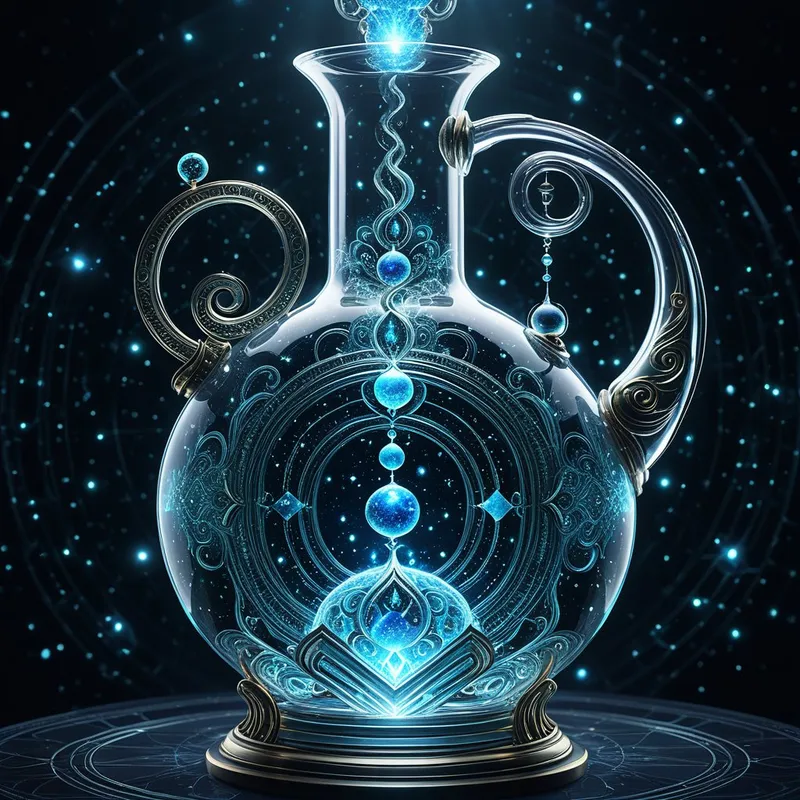
The true alchemy occurs not in applying the goddess’s star-light to the skin, but in allowing it to illuminate the shadows within the vessel of the soul.
The failed application by the other women represents a failed coniunctio (sacred marriage). They attempt to skip the necessary mortificatio—the humbling, dark night of the soul where one confronts one’s plain, mortal clay—and jump straight to the glorified body. The individuation process modeled here demands that we take the “cosmetic”—the inspiring, beautiful, archetypal image—and not project it outward, but ingest it. We must allow it to work on our inner composition, transforming our leaden self-doubt into the gold of self-acceptance. The triumph is not becoming Aphrodite, but becoming fully, radiantly mortal, having internalized the truth that the capacity for divine beauty was always our native inheritance. The cosmetic was merely the mirror that showed us where to look.
Associated Symbols
Explore related symbols from the CaleaDream lexicon: