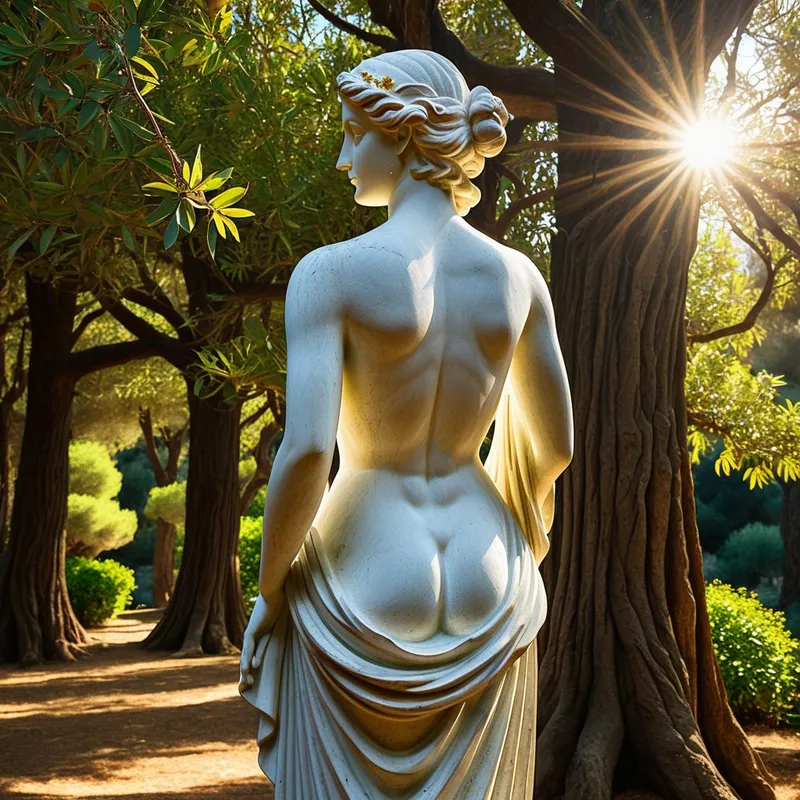
Aphrodite Kallipygos Myth Meaning & Symbolism
A myth where two sisters' rivalry leads to a temple for Aphrodite, celebrating divine beauty found in the human form's natural grace.
The Tale of Aphrodite Kallipygos
Hear now a tale not of thunderous gods on high Olympus, but of the divine made intimate, found in the sun-warmed dust of a Sicilian road. In the countryside near the great city of Syracuse, where the air hummed with cicadas and smelled of thyme and olive groves, there lived two sisters. They were not princesses of legend, but daughters of the earth, blessed with such surpassing grace of form that the very goats would pause in their browsing to watch them pass.
On a day when the sun hung heavy and golden, the sisters walked the long road home. Their simple chitons, damp with the honest sweat of their journey, clung to their forms. As they walked, a playful argument arose between them—a debate as old as humanity, yet as fresh as the well-water they carried. Which of them possessed the more beautifully shaped pygē? The laughter that sparked it was bright, but beneath it glowed the fierce, unspoken fire of sibling rivalry, the desire to be the one in whom nature’s favor shone most clearly.
Seeing no judge among the silent cypress trees, they resolved upon a whimsical test. They would walk ahead of the first stranger they met, and he, unknowing, would be their arbiter. Soon, a young farmer approached from the opposite direction, his mind on his fields. As he drew near, the sisters, with a mix of boldness and sudden shyness, quickened their pace to pass before him. And then, in a gesture that was neither lewd nor vain but simply decisive, they each lifted the hem of their garments just enough to reveal the subject of their dispute.
The young man stopped as if struck. The sight that met his eyes—the harmonious, healthy, and divine curve of human beauty—robbed him of breath and thought. But his judgment was swift and certain. He pointed to the elder sister. Her form, he declared in a voice thick with awe, was the more perfect. Yet, so potent was the vision that his verdict held no bitterness for the younger. Instead, a profound reverence filled him. He was a man who had glimpsed the goddess in the mortal.
The victorious sister, flushed with a joy that was both personal and strangely impersonal, felt the moment swell beyond a mere contest. This was an epiphany. To celebrate it—to give thanks for the divine favor shown in her own flesh—she vowed to build a temple. Not with her own hands, but with the dowry meant to secure her a husband. She offered it all. Her chosen one, the young farmer who had seen the truth, agreed, and with her wealth, a sanctuary was raised.
And the goddess who received this temple? Not Hera of the marriage bed, nor Artemis of the wilds, but Aphrodite herself. For in that moment of recognition, in that celebration of natural, embodied grace, it was the Cyprian’s essence that had been revealed. The temple was dedicated to Aphrodite Kallipygos. It became a place where the goddess was worshipped not as a distant power of cosmic love, but as the immanent divinity of human beauty, acknowledged and adored in the very form of the devotee.

Cultural Origins & Context
The story of Aphrodite Kallipygos comes to us not from the grand epic cycles of Homer, but from the later, more playful and human-centered world of Hellenistic literature. It is preserved in the Dialogue of the Courtesans by the Syrian-Greek satirist Lucian, though he presents it as a much older tale. This origin is telling. It is a folk story, a local aition from Syracuse explaining the existence of a peculiar and famous temple.
Its societal function was multifaceted. On one level, it is a charming, slightly risqué etiological myth. On another, it reflects a shift in religious and aesthetic sensibility. The Classical Greek ideal often sought to transcend the physical, to see the body as a temple for the soul. The Hellenistic period, however, saw a growing appreciation for individuality, realism, and the celebration of specific, sensual beauty. The cult of Aphrodite Kallipygos embodies this. It sanctifies a moment of very human pride and rivalry, elevating it to a divine encounter. It suggests that the gods can be found not only in abstract virtue but in the joyful, unashamed appreciation of the physical form—a concept that would have been both popular and slightly subversive, existing comfortably within the realm of folk piety and personal devotion.
Symbolic Architecture
At its core, this myth is an allegory for the moment of self-recognition and the courage to have that recognition witnessed and validated. The sisters’ argument symbolizes the internal dialogue of comparison and self-assessment that exists within every individual. The road represents the journey of life, and the stranger is the objective, external world—the "other" whose gaze we both fear and seek.
The most profound temple is often built not to an external deity, but to the divinity one has dared to recognize within one's own embodied existence.
The act of lifting the garment is profoundly symbolic. It is a revelation, a deliberate unveiling (apokalypsis) of what is typically hidden, not out of shame, but for judgment. It represents moving a part of the self—often a source of secret pride or insecurity—from the shadow of the private into the light of the public sphere. The farmer’s awe-struck judgment is crucial; it represents the world’s capacity to reflect back our own beauty when we have the courage to present it authentically. His reaction transforms a personal attribute into a universal object of reverence, mirroring the psychological process where owning a part of ourselves integrates it into our wholeness.
Aphrodite here is not the goddess of romantic love, but of philautia—self-love in its healthy, necessary form. She is the archetype of Anima in its most grounded, sensual, and self-delighting aspect. The temple built with the dowry is the ultimate symbol: the sister trades the currency of societal alliance (marriage) for a permanent shrine to her own embodied truth. She chooses self-consecration over conventional exchange.

The Dreamer's Resonance
When this myth stirs in the modern unconscious, it often manifests in dreams centered on exposure, judgment, and unexpected pride. A dreamer may find themselves in a situation where a part of their body—or a metaphorical aspect of their personality they consider their "back side," a hidden strength or vulnerability—is suddenly on display. There is initial anxiety, a fear of ridicule or rejection.
The somatic sensation accompanying such dreams is key: a flush of heat, a mix of tension and exhilaration in the chest and gut. This is the body registering the risk of vulnerability. The resolution in the dream, if it follows the myth’s pattern, is not the removal of the gaze, but its transformation. The dream-other—be it a stranger, a group, or even a symbolic animal—reacts not with scorn or lechery, but with a silent, profound appreciation. This signals a deep psychological process: the ego’s fear is being soothed by the Self. The dream is facilitating the integration of a disowned or undervalued aspect of the dreamer’s identity. It is the psyche’s way of staging its own "beauty contest" and arriving at a verdict of wholeness.

Alchemical Translation
The alchemical process mirrored here is not the dramatic mortificatio (death) of the hero, but the gentle, celebratory sublimatio (elevation) of the base into the sacred. The "base material" is the physical, instinctual body with all its mortal particularities—its curves, its imperfections, its animal reality. The sisters’ rivalry is the initial separatio, distinguishing one quality from the general mass of the self for examination.
The act of revelation before the stranger is the crucial coniunctio (conjunction). It is the marriage of the subjective self-image with the objective outer world. This encounter generates the lapis—the philosopher’s stone—which in this myth is the moment of awed recognition. That moment is the transformative agent.
Individuation requires not only confronting the shadow, but also unveiling the gold we have foolishly kept hidden in the dark.
The building of the temple represents coagulatio—the solidification of this fleeting, luminous experience into a permanent structure of the psyche. The dowry, the energy once reserved for an outward alliance (the persona’s adaptation to society), is wholly reinvested in this inner sanctum. For the modern individual, this translates to the process of moving from shame or ambivalence about a core aspect of one’s nature—be it a talent, a sensitivity, a physical trait, or a deep desire—towards its conscious celebration and integration. It is the psychic work of stopping on the road of life, turning to look at oneself without flinching, and with the funds of one’s attention and intention, building an inner altar to that truth. One becomes both the devotee and the deity, inhabiting a wholeness that is both human and divine.
Associated Symbols
Explore related symbols from the CaleaDream lexicon: