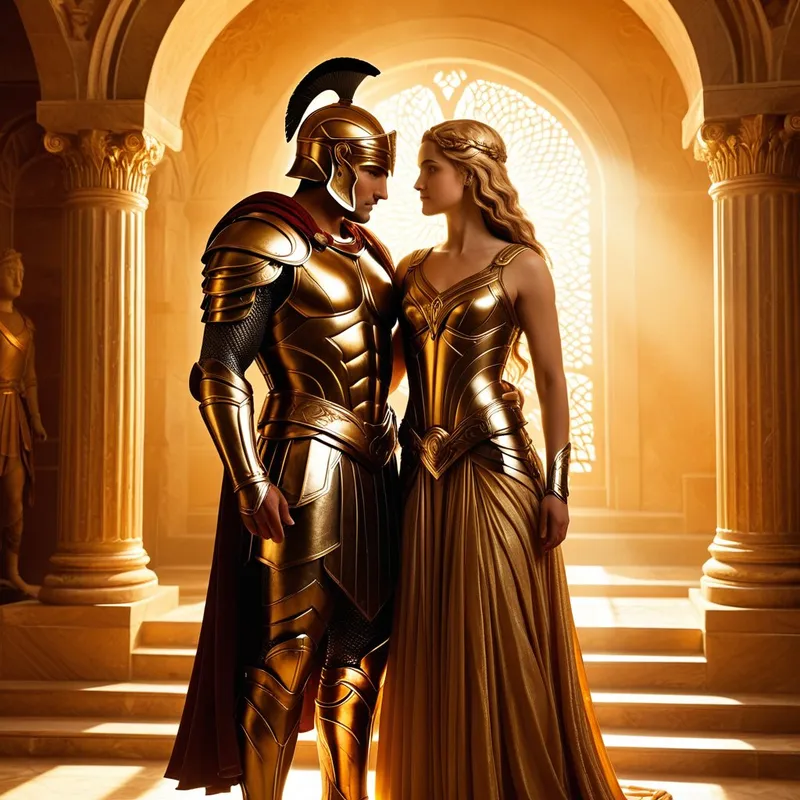
Aphrodite and Ares Myth Meaning & Symbolism
The secret, scandalous union of the goddess of love and the god of war, a myth of irresistible attraction and the alchemy of opposing forces.
The Tale of Aphrodite and Ares
Hear now of a secret that shook the very foundations of Olympus. In the halls of the gods, where [ambrosia](/myths/ambrosia “Myth from Greek culture.”/) flows and laughter rings eternal, a fire was kindled that no divine decree could quench. It was the fire between [Aphrodite](/myths/aphrodite “Myth from Global/Universal culture.”/), born of sea-foam and starlight, and Ares, forged in the furnace of strife.
Aphrodite, bound by the will of her father Zeus to the sooty, limping smith [Hephaestus](/myths/hephaestus “Myth from Global/Universal culture.”/), dwelled in a gilded cage. Her marriage was one of political convenience, a reward for the artisan god, but her heart was a wild, untamed [thing](/myths/thing “Myth from Norse culture.”/). Ares, the brash and tempestuous son of Zeus and Hera, was scorned by many for his brutal delight in conflict, a necessary but unloved force.
Yet, when their eyes met across the feasting hall, a different kind of war was declared—a silent, electric campaign of stolen glances and charged silences. Where others saw only opposition—beauty and ugliness, creation and destruction, harmony and [chaos](/myths/chaos “Myth from Greek culture.”/)—they felt a pull as fundamental as the tide. Their meetings were clandestine, held in the shadowed hours when even the sun god [Helios](/myths/helios “Myth from Greek culture.”/) turned his chariot away. The air in Ares’ chambers would grow thick with the scent of myrrh and the metallic tang of sweat-polished armor. Here, the goddess of softness and the god of hardness found a shocking, perfect fit. Their union was a tempest of passion, a rebellion woven in whispers and sighs, a secret held sacred between them and the walls that witnessed it.
But secrets on Olympus are fleeting. The all-seeing sun god, Helios, beheld their trysts and carried the tale to the one most wounded by it: Hephaestus. The cuckolded smith’s heart, already hardened by labor, turned cold with a cunning rage. He did not roar or threaten; he retreated to his forge. There, with a genius born of bitterness, he hammered a net of threads finer than a [spider](/myths/spider “Myth from Native American culture.”/)’s web, yet stronger than adamantine chains. He fashioned it with invisible joins, a trap of breathtaking artistry.
He announced a journey to his beloved isle of Lemnos. The moment he was gone, the lovers stole to Aphrodite’s own marriage bed, believing themselves safe. As they lay entwined in post-coital slumber, the invisible net descended from the rafters. It settled over them, a sudden, weightless prison. At that moment, Hephaestus threw open the doors of bronze and called all the gods to witness. They came—[Poseidon](/myths/poseidon “Myth from Greek culture.”/), [Hermes](/myths/hermes “Myth from Global/Universal culture.”/), [Apollo](/myths/apollo “Myth from Global/Universal culture.”/)—and they laughed. They laughed at the perfect, humiliating capture, at the mighty god of war trapped like a fish, at the goddess of desire exposed in her infidelity.
The laughter was the true punishment. In that moment of exposure, the private ecstasy was made a public spectacle, the sacred profaned into a joke. It was Poseidon who, after his mirth subsided, negotiated their release, promising Ares would pay a fine. Freed, the lovers fled to separate corners of [the world](/myths/the-world “Myth from Tarot culture.”/), Aphrodite to Cyprus and Ares to Thrace, their secret laid bare, their passion momentarily cooled by the scorching light of ridicule. Yet, the myth whispers, the attraction never truly died.

Cultural Origins & Context
This scandalous tale comes to us primarily from the epic poetry of [Homer](/myths/homer “Myth from Greek culture.”/), in the eighth song of the Odyssey, where the blind bard Demodocus sings it for the pleasure of the Phaeacian court. Its transmission is oral, performed, and deeply embedded in a culture that used myth not merely as entertainment but as a complex social and psychological mirror.
In the highly structured, honor-based society of ancient Greece, where marriage was a [cornerstone](/myths/cornerstone “Myth from Biblical culture.”/) of social order and feminine fidelity was paramount, the myth served multiple functions. It was a cautionary tale about the chaos of unchecked desire and the perils of transgressing social contracts, particularly that of marriage ([xenia](/myths/xenia “Myth from Greek culture.”/)). It validated the cunning of the craftsman over brute strength. Yet, it also provided a safe, narrative outlet for exploring the powerful, disruptive, and universally human forces of erotic attraction and jealousy. The gods’ laughter reflects a very human response: the mingling of schadenfreude, moral judgment, and a tacit acknowledgment of desires that everyone understands but society must officially condemn.
Symbolic Architecture
At its core, the myth of Aphrodite and Ares is a supreme [allegory](/symbols/allegory “Symbol: A narrative device where characters, events, or settings represent abstract ideas or moral qualities, conveying deeper meanings through symbolic storytelling.”/) for the union of opposites. They are not merely a cheating [wife](/symbols/wife “Symbol: The symbol of a ‘wife’ in a dream often represents commitment, partnership, and personal relationships, reflecting one’s desires for intimacy or connection.”/) and a reckless [lover](/symbols/lover “Symbol: A lover in dreams often represents intimacy, connection, and the emotional aspects of relationships.”/); they are primordial principles drawn into inevitable [collision](/symbols/collision “Symbol: A sudden, forceful impact between objects or forces, often representing conflict, unexpected change, or the meeting of opposing elements in life.”/).
Aphrodite represents Eros—the force of attraction, connection, beauty, and life-giving desire. Ares represents Polemos—the force of separation, conflict, differentiation, and the destructive fervor that defines boundaries.
Their union symbolizes the terrifying and fertile [truth](/symbols/truth “Symbol: Truth represents authenticity, honesty, and the quest for knowledge beyond mere appearances.”/) that creation and destruction are not enemies, but lovers in a perpetual dance. Love requires the aggression to pursue, to protect, to differentiate the beloved from all others. War, in its brutal way, creates new orders, clears the ground, and can be driven by a passionate love for one’s own. The myth suggests that the fullest, most potent [life](/symbols/life “Symbol: The symbol of ‘Life’ represents a journey of growth, interconnectedness, and existential meaning, encompassing both the joys and challenges that define human experience.”/) force exists at the volatile [intersection](/symbols/intersection “Symbol: An intersection symbolizes the crossroads of decision-making, presenting choices and the potential for change.”/) of these energies.
[The net of Hephaestus](/myths/the-net-of-hephaestus “Myth from Greek culture.”/) is the third, crucial [symbol](/symbols/symbol “Symbol: A symbol can represent an idea, concept, or belief, serving as a powerful tool for communication and understanding.”/). It is not merely a trap, but [the principle](/symbols/the-principle “Symbol: A fundamental truth, law, or doctrine that serves as a foundation for a system of belief, behavior, or reasoning, often representing moral or ethical standards.”/) of containment and [revelation](/symbols/revelation “Symbol: A sudden, profound disclosure of truth or insight, often through artistic or musical means, that transforms understanding.”/). Hephaestus, the conscious craftsman, represents [the ego](/myths/the-ego “Myth from Jungian culture.”/) or the societal [structure](/symbols/structure “Symbol: Structure in dreams often symbolizes stability, organization, and the framework of one’s life, reflecting how one perceives their environment and personal life.”/) that attempts to bind and control these wild, instinctual forces. The net makes the hidden visible. It forces the unconscious, shadowy [affair](/symbols/affair “Symbol: An affair represents secretive relationships that often imply deception, desire, and tension between personal ethics and impulses.”/) into the light of [consciousness](/symbols/consciousness “Symbol: Consciousness represents the state of awareness and perception, encompassing thoughts, feelings, and experiences.”/), where it can be witnessed, judged, and—crucially—integrated. The humiliation is the price of [revelation](/symbols/revelation “Symbol: A sudden, profound disclosure of truth or insight, often through artistic or musical means, that transforms understanding.”/).

The Dreamer’s Resonance
When this myth stirs in the modern [psyche](/myths/psyche “Myth from Greek culture.”/), it often manifests in dreams of powerful, forbidden attraction or shocking exposure. To dream of being irresistibly drawn to a figure who embodies a quality opposite to your conscious identity—the pacifist drawn to the soldier, the artist to the engineer, the nurturer to the rebel—may signal the psyche’s attempt to integrate its own inner Ares or Aphrodite.
Dreams of being caught in a net, a web, or trapped in a room while being watched speak to the somatic fear and necessity of exposure. The dreamer may be on the cusp of acknowledging a passionate drive or a “shadow” aspect of themselves that feels socially unacceptable or at war with their self-image. The anxiety in the dream is the ego’s resistance to this integration, the fear of the laughter of the inner “gods”—our internalized values, judgments, and parental complexes. The dream is an initiatory net, forcing what is secret within us into the open for our own psychic evolution.

Alchemical Translation
The alchemical journey modeled here is the transmutation of a secret, compartmentalized life into one of greater wholeness. Initially, the Aphrodite and Ares within us meet in secret. We relegate our “unacceptable” passions and aggressions to [the shadow](/myths/the-shadow “Myth from Jungian culture.”/), letting them play out in hidden fantasies, private resentments, or compulsive behaviors that are split off from our conscious self (the Hephaestus ego).
The alchemical fire is not just their passion, but the scorching light of awareness that Hephaestus’s net brings. Individuation requires that we craft our own “net”—the tool of self-reflection and conscious observation—to catch our inner opposites in the act.
The “laughter of the gods” is the necessary, if painful, phase of mortificatio—the humiliation of the ego that clings to a perfect, conflict-free self-image. We must witness our own contradictions with brutal honesty. The release negotiated by Poseidon, god of the fluid unconscious, suggests that after this confrontation, a new deal must be struck. The fine Ares pays is the commitment to bring that aggressive energy under conscious dominion. The flight to Cyprus and Thrace is not an end, but a retreat for re-composition.
The ultimate goal is not to expel either force, but to achieve the state of the Mysterium Coniunctionis—[the sacred marriage](/myths/the-sacred-marriage “Myth from Various culture.”/). This is the integrated self where love can be fierce and protective, where righteous anger can be deployed with precision, where creativity has the aggressive drive to manifest in the world, and where the capacity for conflict serves the deeper purpose of connection and integrity. The lovers, once a source of secret shame, become the united, dynamic core of a more complete and potent being.
Associated Symbols
Explore related symbols from the CaleaDream lexicon: