
Aphrodite and Adonis Myth Meaning & Symbolism
The goddess of love falls for a mortal youth, whose tragic death and cyclical return embody the fragile, eternal dance of desire and decay.
The Tale of Aphrodite and Adonis
Hear now a story woven from the golden threads of desire and the dark soil of grief. It begins not with a meeting, but with a transgression. In the halls of Cinyras, a queen, blinded by hubris, boasted her daughter’s beauty surpassed that of [Aphrodite](/myths/aphrodite “Myth from Global/Universal culture.”/) herself. The goddess, whose power flows in the blush of a cheek and the quickening of a heart, does not suffer such slights lightly. She cursed the princess, Myrrha, with a forbidden, burning passion for her own father. Through trickery and darkness, the union was consummated, and from this act of profound shame, a child was conceived. When the king discovered the deception, he pursued his daughter with a sword. In her terror, Myrrha prayed to the gods, who transformed her into a myrrh tree. Her tears became the precious, fragrant resin, and from the splitting bark of her wooden prison, a baby boy emerged. He was [Adonis](/myths/adonis “Myth from Greek culture.”/), whose beauty was so piercing it seemed a wound upon [the world](/myths/the-world “Myth from Tarot culture.”/).
Aphrodite, moved by the infant’s perfection, hid him in a chest and gave him to [Persephone](/myths/persephone “Myth from Greek culture.”/) for safekeeping in the shadowed realm below. But when [Persephone](/myths/persephone “Myth from Greek culture.”/) opened the chest, she too was captivated. She refused to give him back. The dispute between the goddess of blooming life and the queen of withered souls rose to the throne of Zeus. He decreed a balance: Adonis would spend one-third of the year with [Persephone](/myths/persephone “Myth from Greek culture.”/) in [the underworld](/myths/the-underworld “Myth from Greek culture.”/), one-third with Aphrodite, and one-third wherever he chose. The youth, now grown into breathtaking manhood, chose to spend his free time with Aphrodite as well.
Thus began their idyll. The goddess, who had laughed at the follies of mortals and gods alike, was herself ensnared. She forsook her shimmering home on Olympus and her golden chariot drawn by swans. She walked with Adonis through forests and over mountains, dressed as a huntress, reveling in the mortal world. She warned him of the dangers of the hunt, pleading with him to pursue only gentle creatures and to flee the proud, the fierce—the lion, the wolf, the boar. But the blood of hunters ran in Adonis, and the call of the wild was a siren song he could not deny.
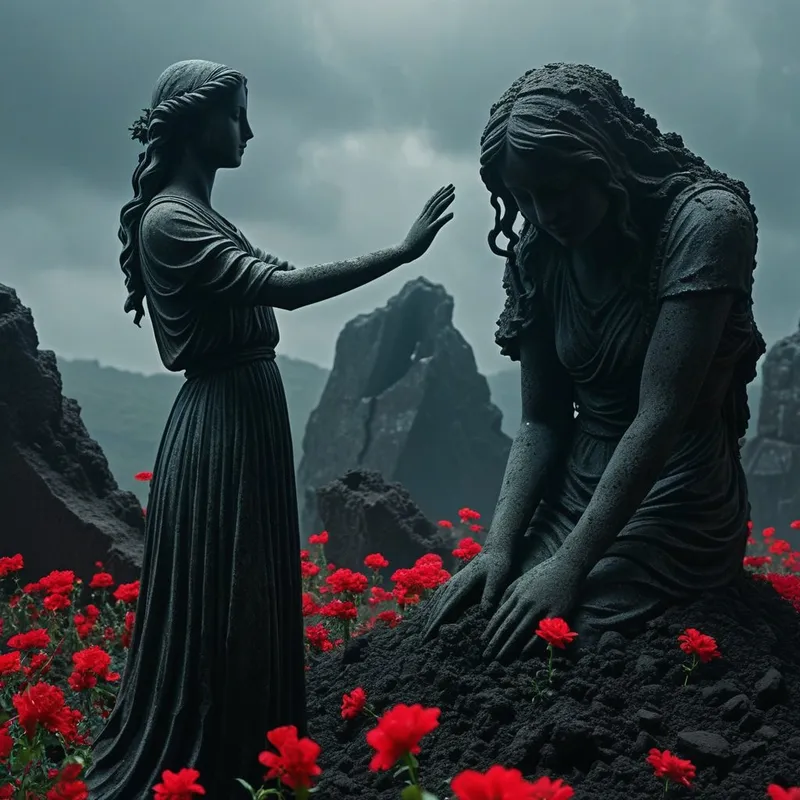
One day, his hounds roused a monstrous boar—some say the beast was Ares in disguise, or [Artemis](/myths/artemis “Myth from Global/Universal culture.”/)’s wrathful weapon. Adonis, brave and brash, charged. His spear struck, but only enraged the creature. The boar turned, its tusks like polished ivory scythes, and gored the youth deep in the thigh. A mortal wound. Aphrodite, hearing his cry from across the heavens, flew to him on wings of desperation. She found him lying in a meadow, his lifeblood seeping into [the earth](/myths/the-earth “Myth from Hindu culture.”/), his beauty paling like a sunset. As she cradled him, his last breath mingled with her immortal tears. Where each drop of his blood fell, a crimson flower sprang forth—the anemone, delicate and short-lived, its petals trembling in [the wind](/myths/the-wind “Myth from Various culture.”/). Her love could not keep him in the world of the living, but the earth itself received him and gave back a fragile, recurring memory in bloom.

Cultural Origins & Context
The myth of Aphrodite and Adonis is a powerful example of a dying-and-rising god narrative deeply embedded in the ancient Mediterranean world, with clear antecedents in the Near Eastern cults of [Ishtar](/myths/ishtar “Myth from Babylonian culture.”/) and [Tammuz](/myths/tammuz “Myth from Mesopotamian culture.”/). In Greece, the story was most famously told in the Hellenistic period by the poet Bion in his Lament for Adonis, and it forms a poignant part of Ovid’s [Metamorphoses](/myths/metamorphoses “Myth from Greek culture.”/). It was not merely entertainment; it was the sacred narrative underpinning the Adonia, a women’s festival. In cities like Athens, women would climb to rooftops and plant “Gardens of Adonis”—seeds sown in shallow pots that would sprout quickly and wither just as fast. They would then mourn the beautiful youth with laments and ritual cries. This practice connected the rapid growth and [death](/myths/death “Myth from Tarot culture.”/) of the plants to Adonis’s brief, glorious life, symbolizing the fragility of vegetative and erotic life, and the poignant, personal grief experienced outside the official, state-sanctioned cults.
Symbolic Architecture
At its [heart](/symbols/heart “Symbol: The heart symbolizes love, emotion, and the core of one’s existence, representing deep connections with others and self.”/), this is a myth about the [collision](/symbols/collision “Symbol: A sudden, forceful impact between objects or forces, often representing conflict, unexpected change, or the meeting of opposing elements in life.”/) of two eternal principles: [the immortal](/myths/the-immortal “Myth from Taoist culture.”/), generative force of Eros (Aphrodite) and the finite, beautiful [vulnerability](/symbols/vulnerability “Symbol: A state of emotional or physical exposure, often involving risk of harm, that reveals authentic self beneath protective layers.”/) of mortal [life](/symbols/life “Symbol: The symbol of ‘Life’ represents a journey of growth, interconnectedness, and existential meaning, encompassing both the joys and challenges that define human experience.”/) (Adonis). Adonis is not a [hero](/symbols/hero “Symbol: A hero embodies strength, courage, and the ability to overcome significant challenges.”/) of [strength](/symbols/strength “Symbol: ‘Strength’ symbolizes resilience, courage, and the ability to overcome challenges.”/) or intellect; his power is his [beauty](/symbols/beauty “Symbol: This symbol embodies aesthetics, harmony, and the appreciation of life’s finer qualities.”/), which acts as a mirror, reflecting the deepest longing of the divine itself for the poignant, fleeting experience of the earthly.
The immortal does not yearn for more eternity; it yearns for the bittersweet taste of an ending.
Aphrodite’s descent from [Olympus](/symbols/olympus “Symbol: In Greek mythology, Mount Olympus is the divine home of the gods, representing ultimate power, perfection, and spiritual transcendence.”/) represents the incarnation of love itself into the vulnerable, messy [realm](/symbols/realm “Symbol: The symbol of ‘Realm’ often signifies the boundaries of one’s consciousness, experiences, or emotional states, suggesting aspects of reality that are either explored or ignored.”/) of [relationship](/symbols/relationship “Symbol: A representation of connections we have with others in our lives, often reflecting our emotional state.”/) and attachment. Her warning to Adonis is the [psyche](/myths/psyche “Myth from Greek culture.”/)’s intuitive [knowledge](/symbols/knowledge “Symbol: Knowledge symbolizes learning, understanding, and wisdom, embodying the acquisition of information and enlightenment.”/): to fully engage with the raw, instinctual world (the hunt) is to risk a fatal encounter with one’s own untamed, shadowy [nature](/symbols/nature “Symbol: Nature symbolizes growth, connectivity, and the primal forces of existence.”/) (the boar). The boar is the brutal, unconscious force that shatters the idyll. It is the sudden tragedy, the unexpected [betrayal](/symbols/betrayal “Symbol: A profound violation of trust in artistic or musical contexts, often representing broken creative partnerships or artistic integrity compromised.”/), the [eruption](/symbols/eruption “Symbol: A sudden, violent release of pent-up energy or emotion from beneath the surface, often representing transformation or crisis.”/) of raw aggression that destroys what is most cherished. The [resolution](/symbols/resolution “Symbol: In arts and music, resolution refers to the movement from dissonance to consonance, creating a sense of completion, release, or finality in a composition.”/)—the shared custody and the anemones—speaks to a profound psychic [truth](/symbols/truth “Symbol: Truth represents authenticity, honesty, and the quest for knowledge beyond mere appearances.”/): what we love mortally does not vanish; it is translated. It moves into a cyclical [rhythm](/symbols/rhythm “Symbol: A fundamental pattern of movement or sound in time, representing life’s cycles, emotional flow, and universal order.”/) of [presence](/symbols/presence “Symbol: Presence in dreams often signifies awareness or acknowledgment of something significant in one’s life.”/) and [absence](/symbols/absence “Symbol: The state of something missing, void, or not present. Often signifies loss, potential, or existential questioning.”/), [memory](/symbols/memory “Symbol: Memory symbolizes the past, lessons learned, and the narratives we construct about our identities.”/) and renewal, [underworld](/symbols/underworld “Symbol: A symbolic journey into the unconscious, representing exploration of hidden aspects of self, transformation, or confronting repressed material.”/) (the unconscious) and upper world (conscious life).

The Dreamer’s Resonance
When this mythic pattern stirs in the modern dreamer, it often signals a profound encounter with the anima or animus. To dream of a beautiful, captivating, yet fragile figure may point to the awakening of one’s own capacity for deep feeling, vulnerability, and relatedness—a potential that feels exhilarating yet terrifyingly perishable. The dream may be lush with sensual beauty (the idyllic grove) followed by a violent, shocking intrusion (the charging beast).
Somatically, this can manifest as a tension between expansive, open-hearted desire and a sudden, gut-wrenching contraction—a feeling of being “gored” emotionally. The dreamer is processing the inevitable grief that accompanies deep attachment, the recognition that to love anything in time is to consent to future loss. The psyche is rehearsing the alchemy of turning blood into flowers, of finding a form for mourning that allows life, in a different shape, to continue.
Alchemical Translation
The individuation process modeled here is the sacrifice of the eternal for the sake of the real. Aphrodite’s journey is the descent of a transcendent value (idealized love, perfect beauty) into the flawed, temporal world where it must suffer. The devouring of Adonis by the boar is the [nigredo](/myths/nigredo “Myth from Alchemical culture.”/), the blackening, the essential wounding that seems to destroy the prized conscious attitude.
The goal is not to avoid the boar, but to survive its tusk and learn the geography of the underworld it sends us to.
The shared custody brokered by Zeus represents the achieved [coniunctio oppositorum](/myths/coniunctio-oppositorum “Myth from Alchemical culture.”/)—a conscious psyche that can hold the tension between life and death, attachment and release, summer’s passion and winter’s introspection. The part of us that is Adonis—our beautiful, youthful, engaged self—must “die” periodically. It descends to Persephone’s realm (the unconscious) to be stripped of its literal form. It is not annihilated, but composted. What returns is not the literal beloved, but the anemone: a symbolic, flowering insight, a poignant memory that fertilizes the soul’s soil. The modern individual undergoing this alchemy moves from clinging to a static, perfect love or a permanent state of youthful bloom, toward embracing a loving that is deep enough to include grief, and a vitality that is renewed precisely through its cyclical encounters with loss.
Associated Symbols
Explore related symbols from the CaleaDream lexicon: