Anzu and the Tablet of Destinies
A Babylonian myth about the thunderbird Anzu who steals the divine Tablet of Destinies, threatening cosmic order until heroes intervene.
The Tale of Anzu and the Tablet of Destinies
In the primordial age, when the cosmos was newly ordered, the great god Enlil held the sacred Tablet of Destinies. This was no mere clay ledger, but the luminous, living core of cosmic law. Upon its surface, the fates of gods and mortals, the rhythms of seasons and stars, the very boundaries of reality were inscribed. Its possession conferred the authority to decree the function of the universe. Enlil, as steward, performed the daily rites of ablution, and in these moments of sacred washing, he would set the Tablet aside, its power momentarily at rest.
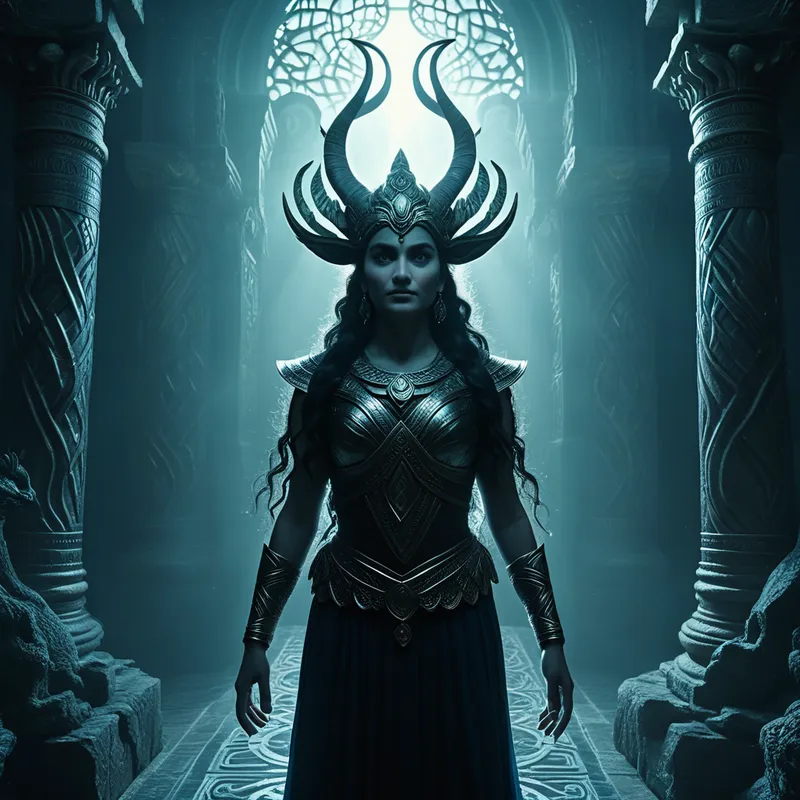
Witnessing this ritual was Anzu, a being of terrifying majesty. He was not a god of the assembly, but a creature born of the abyssal waters of the Apsu and the wide heavens. His form was a cosmic amalgam: the body of a lion, the wings of an eagle, and the head of a god, his voice the roar of thunder and the howl of the storm. He served as the guardian of Enlil’s sanctuary, a trusted servant who beheld the source of all power each day. A profound hunger awoke within him—not for flesh, but for sovereignty. He saw the ritual, the vulnerability, and the prize. “I will take the Tablet of Destinies,” he resolved, “and I will decree the fates myself. The divine assembly will bow to me, and I will establish my throne upon the mountain of the world.”
One day, as the waters cascaded and Enlil was divested of his divine regalia, Anzu struck. With a beat of his storm-cloud wings, he snatched the gleaming Tablet and fled to his mountain refuge. The universe shuddered. The Tablet’s light was veiled, and with it, the fundamental order of things began to unravel. The rivers forgot their courses. The stars trembled in their paths. The sacred rites lost their potency. A terrible silence, the silence of suspended law, fell upon the council of the gods. They gathered in despair, their radiance dimmed. Who could confront the thief? Anzu, with the Tablet in his possession, had usurped the very power of decree. Any god who approached him risked having their own essence unmade by a word from the stolen Tablet.
Fear paralyzed the assembly, until the clever god Ea spoke. He proposed creating a champion not from the existing pantheon, but anew, one whose nature was specifically forged for this battle. The task fell to the warrior goddess Inanna and the mother goddess Nintu, but it was the fierce god Ninurta, Enlil’s own son, who ultimately stepped forward. He was armed with the seven great winds and an arsenal of divine weapons, but his true strength required cunning.
The battle was cataclysmic. Ninurta loosed his arrows, but Anzu, holding the Tablet, simply decreed, “Let the arrow return to its reed!” and it fell harmlessly. He commanded the winds to still, and they died. The rebel bird-god wielded the grammar of creation as a shield. Seeing his son falter, Enlil despaired. But Ea, the deep thinker, whispered strategy to Ninurta. “Do not fight his power. Slip into the spaces between his words. Attack the wings that give him dominion over the realms.”
Ninurta understood. He rallied the South Wind, not as a blunt force, but as a subtle, infiltrating agent. As Anzu roared another decree, the South Wind slipped into the pinions of his vast wings, plucking feathers, disrupting the harmony of his flight. Thrown into imbalance, Anzu’s concentration broke. In that fleeting moment, when the thief’s claim over fate wavered, Ninurta let fly his arrow. It found its mark. The great lion-bird fell from the sky, the Tablet of Destinies tumbling from his grasp. Ninurta recovered the luminous Tablet, and the universe exhaled. The rivers resumed their flow, the stars steadied in their courses, and authority was restored to Enlil’s hands. Order was not merely reimposed; it was reaffirmed through a trial of cosmic consequence. Anzu was slain, his rebellion absorbed into the mythic fabric, a permanent testament to the peril and necessity of the established cosmic law.
Cultural Origins & Context
The myth of Anzu, known from Old Babylonian versions (c. 1800-1600 BCE) and most completely from the Standard Babylonian Anzu Epic (c. 1100-700 BCE), is not a simple monster-slaying tale. It emerges from the heart of Mesopotamian cosmological anxiety. The cosmos was seen as a fragile, divinely administered state, perpetually threatened by forces of chaos (Tiamat, the saltwater ocean, being the primordial example). Kingship, both divine and human, was the essential institution that held this chaos at bay.
Anzu’s theft is the ultimate bureaucratic coup. The Tablet of Destinies functioned as the divine ledger, the “me” (Sumerian) or “parsu” (Akkadian)—the foundational decrees and blueprints for all aspects of civilization and nature. Its theft represents the catastrophic dissolution of this divine administration. The gods’ initial paralysis reflects a profound theological point: even the gods are subject to the cosmic ordinances they uphold. They are not absolute sovereigns but executives of a higher, impersonal order embodied by the Tablet.
Ninurta’s victory, engineered by Ea’s wisdom, reinforces a key cultural ideal: legitimate power is restored not by brute force alone, but by intelligence (uznu, “ear,” meaning understanding) and rightful lineage. The myth served to legitimize the institution of kingship, casting the earthly king as a Ninurta-like figure who defeats chaos and upholds the divine order for the land.
Symbolic Architecture
The myth’s power lies in its stark, monumental symbols. Anzu himself is a liminal being, a composite creature of lion (earthly power), eagle (celestial dominion), and divine head (intelligence). He is the guardian who becomes the usurper, embodying the peril of the one who knows the secrets of power too intimately. His mountain retreat is not just a hiding place; it is the archetypal axis mundi, the center of the world, which he seeks to occupy illegitimately.
The Tablet is the ultimate symbol of the Logos—the word that structures reality. Its theft is not merely a crime but a metaphysical catastrophe, a severing of signifier from signified, where decrees become unmoored from truth.
The battle’s turning point is profoundly psychological. Anzu is not defeated by a greater counter-decree, but by a subversion of his wholeness. The South Wind attacking his wings symbolizes an attack on his integration, his ability to traverse and connect the cosmic realms (earth and sky). His power, derived from a stolen object, proves brittle when his own embodied nature is disrupted.
The Dreamer's Resonance
To the dreaming culture.") psyche, the myth of Anzu speaks to the terror and allure of seizing ultimate authority. The “Tablet of Destinies” can manifest as the dreamer’s rigid, internalized law—the superego’s absolute decree—or as the tantalizing possibility of overthrowing that law to claim total self-determination. Anzu is the shadow of the rebel archetype: the part of us that, feeling servile or oppressed by internal or external structures, fantasizes about stealing the very source of power to rewrite the rules of our existence.
The dream may present this as a thrilling liberation or a world-ending anxiety. The ensuing “paralysis of the gods” reflects a state of psychic collapse when the central organizing principles (the ego’s ruling council) are nullified. The victory comes not from repressing this rebellious energy, but from engaging it with cunning (Ea) and directed, rightful force (Ninurta). It is the integration of the rebel’s ambition into a more conscious, responsible structure of the self.

Alchemical Translation
In the alchemical vessel of the soul, the myth maps the perilous stage of inflation and the necessity of solve et coagula—dissolution and reconstitution. The ego, in a state of identification with the divine (Anzu serving Enlil), glimpses the lapis philosophorum, the Stone of ultimate knowledge and power (the Tablet). Seizing it prematurely leads to a monstrous inflation—the ego believes it is the Self.
The subsequent chaos is the necessary nigredo, the blackening, where all known structures fail. The gods’ despair is the ego’s realization that it cannot, by its own known resources, rectify the situation.
Ea, the god of wisdom and the deep unconscious, represents the guiding insight from the Self. His strategy—to attack the “wings”—is alchemical guidance to humble the aspirant’s spiritual pride (the wings of premature transcendence). Ninurta’s successful reintegration of the Tablet symbolizes the coagula: the re-establishment of order at a higher level, where the power is no longer possessed by the ego but is again in service to the transcendent center (Enlil as symbol of the Self). The rebel is sacrificed so that the principle of individuated order may live, more resilient for having faced its shadow.
Associated Symbols
Explore related symbols from the CaleaDream lexicon:
- Tablet — The inscribed foundation of cosmic law and personal destiny, representing the fixed code that structures reality and identity.
- Rebel — The archetypal force that challenges established order, driven by a hunger for sovereignty and the power to self-decree.
- Cosmic Order — The harmonious, divinely-willed arrangement of the universe, a fragile state perpetually requiring defense from entropic forces.
- Thunder — The terrifying voice of the storm-bird, symbolizing disruptive, awe-inspiring power that shakes the foundations of the known world.
- Hero — The designated champion who ventures into the domain of usurped power to restore balance, often armed with cleverness as much as strength.
- Fate — The pre-ordained course of events, which becomes malleable and contested when the instrument of its decree is stolen or misused.
- Mountain — The remote, lofty refuge of the rebel and the traditional seat of divine authority, representing the axis where earthly and cosmic powers meet.
- Shadow — The untamed, ambitious, and potentially destructive aspect of the psyche that covets ultimate power for its own ends.
- Ritual — The prescribed, vulnerable action (Enlil’s ablution) that creates the opening for chaos, yet also reaffirms order through its daily performance.
- Key — The means to access or control ultimate authority; here, the stolen Tablet itself functions as the key to the functioning of the cosmos.
- Chaos — The state of unraveling law and suspended function that ensues when the foundational principles of order are removed or corrupted.
- Destiny — Not a fixed path, but a dynamic script vulnerable to erasure and rewrite, embodying the profound anxiety and possibility of cosmic free will.