Antlered Shaman/Deity Myth Meaning & Symbolism
A mythic figure of the wild forest, whose crown of antlers bridges the human and spirit worlds, embodying sacrifice and the power of cyclical renewal.
The Tale of Antlered Shaman/Deity
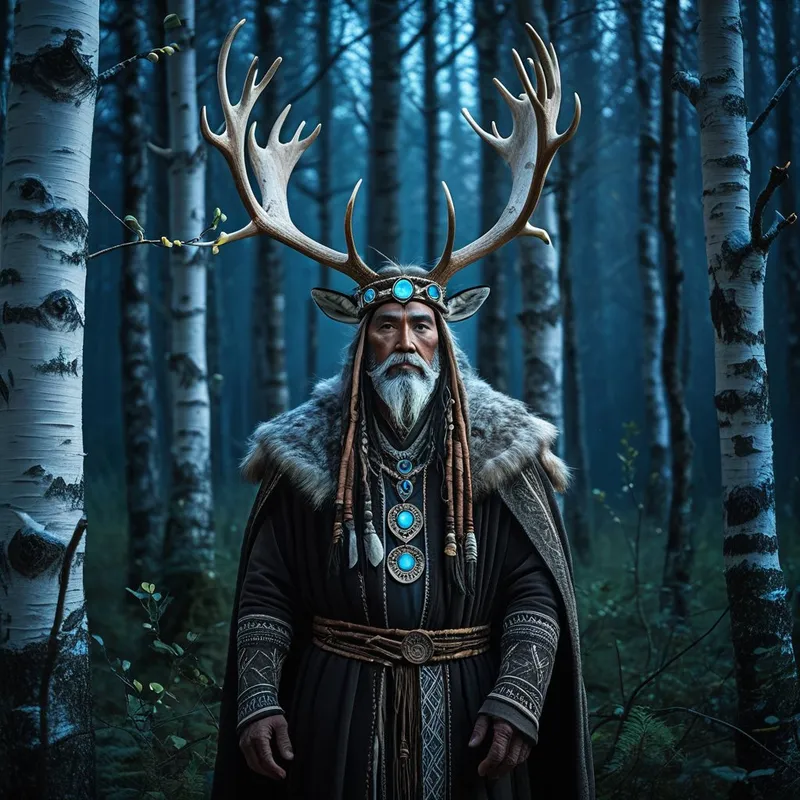
Listen. The wind does not just blow through the pines; it carries whispers from the time before memory, when the veil between the breathing world and the spirit world was thin as birch bark. In that time, when the great forests were the only cathedrals, there walked a figure who was neither wholly man nor wholly beast. He was the Shaman, but the people knew him by another name: the Antlered One.
His home was the trackless deepwood, where sunlight fell in shattered coins upon the moss. He wore the hides of the forest, and from his brow grew not hair, but a mighty crown of antlers—a living lattice of bone that shed and regrew with the turning year. He was the lord of the herd and the solitary stag, the keeper of the wild places where the soul goes to lose and find itself.
One year, the Wheel turned cold. A silence fell upon the woods. The game grew scarce, the rivers thin, and a creeping malaise settled on the people. Their songs had no heart; their dreams were empty. They knew the pact was broken. The spirit of the land, the Genius Loci, had withdrawn her favor. Life was leaching from the world.
The Antlered One felt this withering in his very bones. His majestic crown, usually a symbol of virile power, began to feel heavy, a weight of failed responsibility. He journeyed to the sacred grove, a circle of ancient oaks where the roots delved into the underworld and the branches scraped the sky-road. There, he fasted. He drummed until his hands bled, the rhythm a frantic heartbeat calling to the unseen. He danced until his feet wore grooves into the stone, a spiral path leading inward and downward.
In the trance-state, the boundary dissolved. The forest around him became the forest within. He saw the delicate web that connected the rabbit to the fox, the stream to the cloud, the people’s gratitude to the land’s abundance. The web was fraying. A sacrifice was required—not of blood, but of form; not of life, but of identity.
With a cry that was both human anguish and stag’s bellow, he grasped his great antlers. In the world of spirit, this was an act of immense will. He did not break them, but offered them up. He surrendered his crown, his sovereignty, his visible connection to the wild power he embodied. As he did, a profound stillness descended. The wind died. The grove held its breath.
From the earth at the base of the great oak, a figure emerged—the Spirit of the Land, now visible. She was the forest and the field, decay and blossom in one. She approached the prostrate, crownless Shaman. She did not speak with words, but with a touch that was like spring rain on parched soil. Where her fingers brushed his brow, a new sensation sparked. Not the weight of bone, but the tender, aching itch of new growth.
He rose, changed. His head was bare, vulnerable. But in his eyes was a deeper knowledge. He returned to the people not as a distant lord of beasts, but as a bridge. He taught them the songs to sing to the soil, the prayers to whisper to the hunted, the respect that turns taking into a sacred exchange. And as the first green shoots broke the frost, a new, smaller set of antlers began to bud from his brow—not a crown of domination, but a living testament to the cycle: that all power must be surrendered to be truly renewed.
Cultural Origins & Context
This mythic pattern is not a single story from a single scroll, but a deep, resonant motif woven into the spiritual fabric of both Celtic and Siberian shamanic traditions. In the Celtic world, we see it most vividly in the figure often called Cernunnos, the "Horned One," depicted on the Gundestrup Cauldron and other artifacts, seated in a meditative pose, torc in one hand, serpent in the other, master of beasts. In Siberia, among the Tungusic and other peoples, the shaman’s headdress, often crowned with iron antlers, was a crucial ritual implement, a conduit to the upper world and a symbol of the shaman’s ability to traverse the Axis Mundi.
The tale was never a fixed narrative for children. It was the living, breathing core of an oral tradition, performed and re-experienced by the shaman himself during ecstatic rituals. It was a map of his own initiatory crisis—the symbolic death and rebirth required to hold the office. Its societal function was paramount: it explained the sacred contract between the human community and the animate, intelligent world around them. The shaman, through his mythic identity as the Antlered One, became the guarantor of that contract, the one who could negotiate with the spirits of the hunt and the forest to ensure balance and survival.
Symbolic Architecture
The antlers are the central, multivalent symbol. They are a crown of authority, yet grown from the living body and shed annually. They represent the dynamic, cyclical nature of true power—it is not static possession, but a force that must be released to flow.
The antler is the tree of life growing from the mind, a bridge between thought and instinct, the individual and the cosmic pattern.
The act of shedding or offering the antlers is the ultimate sacrifice of ego. It is the surrender of one’s most prized attribute—one’s social role, one’s specialness, one’s perceived strength—to a higher order. The vulnerability of the crownless state is not weakness, but the necessary fertile void from which a new, more integrated consciousness can grow. The figure embodies the Deus Absconditus, the hidden god of the interior wilderness, the untamed psychic ground that must be encountered for wholeness.
The Dreamer's Resonance
When this myth stirs in the modern dreamscape, it often signals a profound crossroads in the dreamer’s psychological development. To dream of antlers growing from one’s own head speaks of an emerging, perhaps uncomfortable, sense of personal power or a burgeoning connection to instinctual, non-rational wisdom. It can feel awe-inspiring but also alienating, a "crown" that sets one apart.
Conversely, dreaming of shedding antlers, or of them being heavy and burdensome, points to a necessary crisis. The psyche is preparing to relinquish an outworn identity—the successful professional, the perpetual caregiver, the fierce intellectual—a role that has become a cage of bone. The somatic feeling is often one of profound relief mixed with terror, the ache of release. The dream is a depiction of the ego’s negotiation with the Self, the central archetype of totality, which demands the death of the old king for the new to be born.
Alchemical Translation
The myth of the Antlered Shaman is a perfect allegory for the Jungian process of individuation. It models the alchemical solve et coagula—dissolve and coagulate—applied to the psyche.
The first stage is the recognition of the "heavy crown." This is the inflated identity, the persona we have over-identified with, which has cut us off from the nourishing spirit of the land (the unconscious, the anima mundi). The ensuing drought is a state of psychic sterility, depression, or meaninglessness.
The journey to the sacred grove is the conscious descent into the unconscious, the engagement with deep introspection, therapy, or creative exploration. The offering of the antlers is the critical, voluntary act of ego-surrender. It is giving up the need to be special, to know, to control. This is the solve, the dissolution.
The power that is clung to becomes a prison. The power that is surrendered becomes a river.
The encounter with the Spirit of the Land is the confrontation with the Anima/Animus or the Self, the profound otherness within that holds the key to renewal. The new growth is the coagula—the emergence of a new attitude. The antlers grow back, but now they are in service to the whole, not just the individual. The modern seeker who undergoes this internal process does not become a literal shaman, but achieves a kind of inner sovereignty. They become a bridge within themselves, capable of moving between rational consciousness and intuitive wisdom, between personal identity and the transpersonal flow of life, wearing their power lightly, in a cycle of perpetual becoming.
Associated Symbols
Explore related symbols from the CaleaDream lexicon: