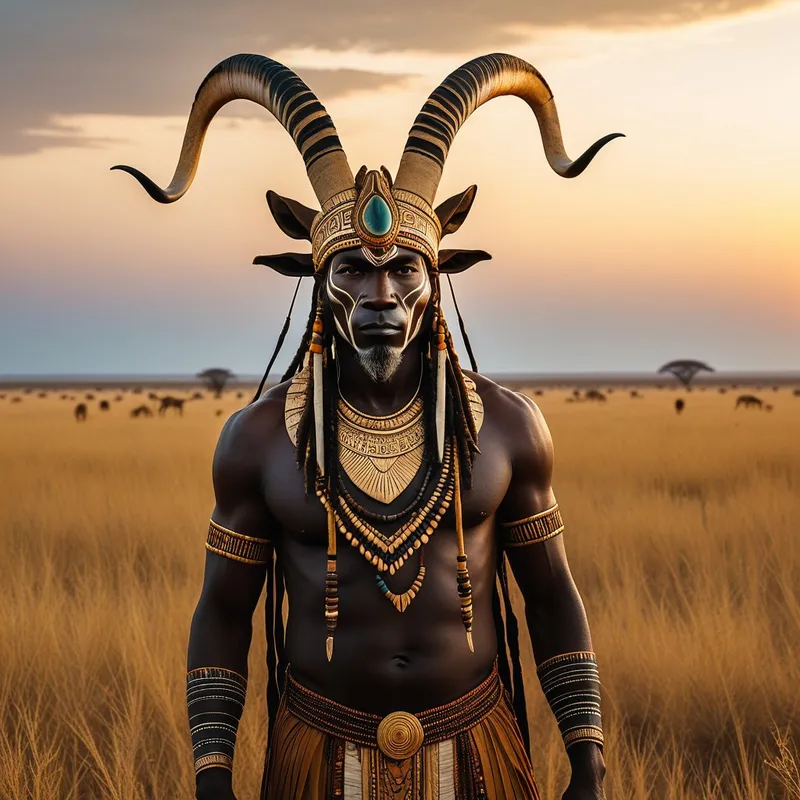
Antelope Horn Headdresses Myth Meaning & Symbolism
A myth where a hunter's sacrifice to the spirit of the plains transforms him, granting a headdress of power that binds humanity to the wild.
The Tale of Antelope Horn Headdresses
Listen. The story begins not in a time of plenty, but in a time of thirst. The sun was a hammer on the anvil of the earth, and the great plains, once a sea of whispering gold, had become a cracked and bleeding hide. The people of the grass were hollow-eyed, their songs silent. Among them was a hunter named Kele. His skill was unmatched, his arm strong, but his spirit was heavy. For days he walked, his shadow his only companion, and found nothing but dust and bone.
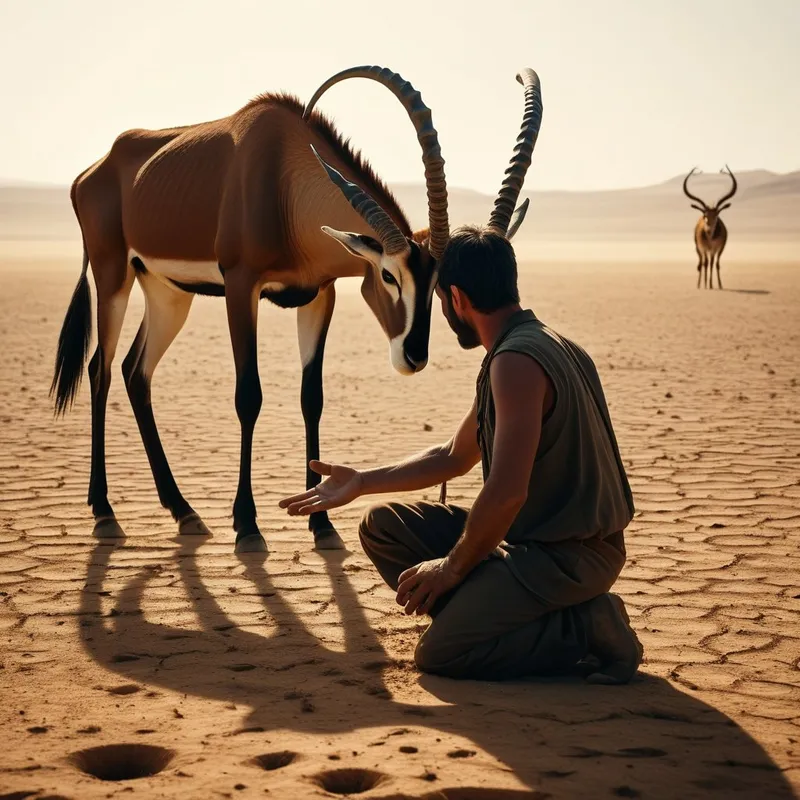
On the third day, when the world seemed made of brass and despair, he saw it. A great Sassab, a male antelope of impossible majesty. Its coat was the color of burnt honey, and its horns rose in a perfect, spiraled lyre that seemed to hold the very sky between them. But the beast was dying. It stood by a long-dry waterhole, its flanks heaving, its noble head bowed. Kele raised his spear, his muscles coiling with the memory of the hunt. But as he looked into the antelope’s dark, liquid eye, he saw not an animal, but a king brought low. He saw the spirit of the plains itself, wasting away.
The conflict was a storm within him. His people’s hunger screamed in his belly. The beast’s dignity whispered in his soul. With a cry that was part grief, part surrender, Kele cast his spear aside. It clattered on the stones, a sound of finality. He knelt. From his own parched gourd, he poured the last sips of muddy water into his palm and offered it to the great Sassab. The act was absurd, a drop against an ocean of need. Yet, as the cool liquid touched the antelope’s muzzle, the air changed.
The beast exhaled, a long, shuddering breath that was not a death rattle, but a release. It did not fall. Instead, it stepped forward, and its spiraled horn touched Kele’s forehead. A jolt, like lightning from a clear sky, coursed through him. Visions flooded his mind: the thunder of a thousand hooves, the sweet smell of rain on dry earth, the intricate web of life and death that wove the plain together. When the vision cleared, the great antelope was gone. Where it had stood lay only its pair of magnificent horns. And upon Kele’s own head, he felt a new weight, a sacred gravity. He was now crowned. He was the bridge. He wore the Horned Diadem, and his first task was not to hunt, but to lead his people to where the grass was still green, guided by a knowledge that flowed into him like a river.
Cultural Origins & Context
This narrative pattern, found in various forms across the Sahel and savanna regions of West Africa, is not merely a folktale but a foundational cosmogonic instruction. It belongs traditionally to hunter-gatherer and pastoralist societies, such as the Fulani, Dogon, and others, for whom the antelope is not just game, but a crucial psychopomp of the wilderness. The myth was transmitted by griots, elders, and during initiation rites for young hunters. Its societal function was multifaceted: it served as an ecological ethic, teaching sustainable hunting and reverence for the prey; as a psychological template for leadership, where power is granted through empathy, not conquest; and as a ritual justification for the regalia worn by spiritual mediators, diviners, and clan leaders. The headdress became a tangible symbol of this covenant between the human community and the untamable wild.
Symbolic Architecture
At its core, the myth is an alchemical drama of consciousness. The Sassab represents the untamed Self, the instinctual and spiritual wholeness of nature that exists beyond human need. Kele, the skilled hunter, embodies the directed, purposeful ego. The drought is a state of psychic sterility, where the ego’s methods—force, skill, taking—have failed.
The sacrifice that transforms is never of what you have, but of what you are. Kele did not give water; he gave up being only a hunter.
The casting aside of the spear is the critical moment of ego-relinquishment. By offering his last sustenance, he performs an act of irrational compassion that breaks the logic of scarcity. The horn’s touch is the infusion of the Self’s knowledge into the ego. The resulting Horned Diadem is not a tool for domination, but an antenna for attunement. It symbolizes the integrated psyche where human consciousness (the wearer) is crowned by, and made responsible for, the wisdom of the instinctual world (the horns).
The Dreamer's Resonance
When this myth surfaces in modern dreams, it often manifests during life’s "droughts"—periods of creative barrenness, emotional exhaustion, or a feeling of being out of sync with one’s deeper nature. To dream of the dying antelope is to encounter one’s own neglected vitality, the instinctual Self sacrificed on the altar of productivity or persona. To dream of wearing the headdress can feel simultaneously empowering and burdensome; it signals the dreamer’s psyche initiating a process of integration, granting them a new, unfamiliar authority that comes with great responsibility.
Somatically, this dream process may be felt as pressure or heat at the crown of the head, or a sense of being "pulled" by a deep, magnetic longing towards nature, art, or solitude. Psychologically, it is the process of the conscious mind being forced to kneel—to surrender its outdated identity (the hunter) to receive guidance from a more profound, non-rational source. The conflict in the dream mirrors the internal struggle between the will to control and the need to submit to a larger wisdom.
Alchemical Translation
For the modern individual navigating a fragmented world, the myth models the complete arc of individuation. Our initial state is often that of Kele the Hunter: proficient, resourceful, but ultimately facing a barren landscape with tools that no longer work. The "drought" is a necessary crisis, forcing a confrontation with the limits of the ego’s paradigm.
The alchemy occurs not in the taking of power, but in the sacred reception of it. The crown is placed upon you only after you have emptied your hands.
The act of offering water to the beast is the nigredo—the blackening. It is the humbling, the admission of failure, the compassionate gesture that seems to defy self-preservation. This is the dissolution of the old attitude. The touch of the horn is the albedo—the illuminating insight, the direct infusion of transpersonal knowledge. It is a moment of grace following surrender.
Finally, wearing the Horned Diadem represents the rubedo—the embodied result. The individual no longer acts upon the world (hunting) but from a place of connection with the world (guiding). The headdress is the enduring symbol of this transmutation: the ego, once separate, is now the conscious vessel and steward of the wild, intuitive Self. One becomes a sage not through accumulated knowledge, but through enacted reverence, carrying the weight and beauty of that covenant into every step upon the earth.
Associated Symbols
Explore related symbols from the CaleaDream lexicon: