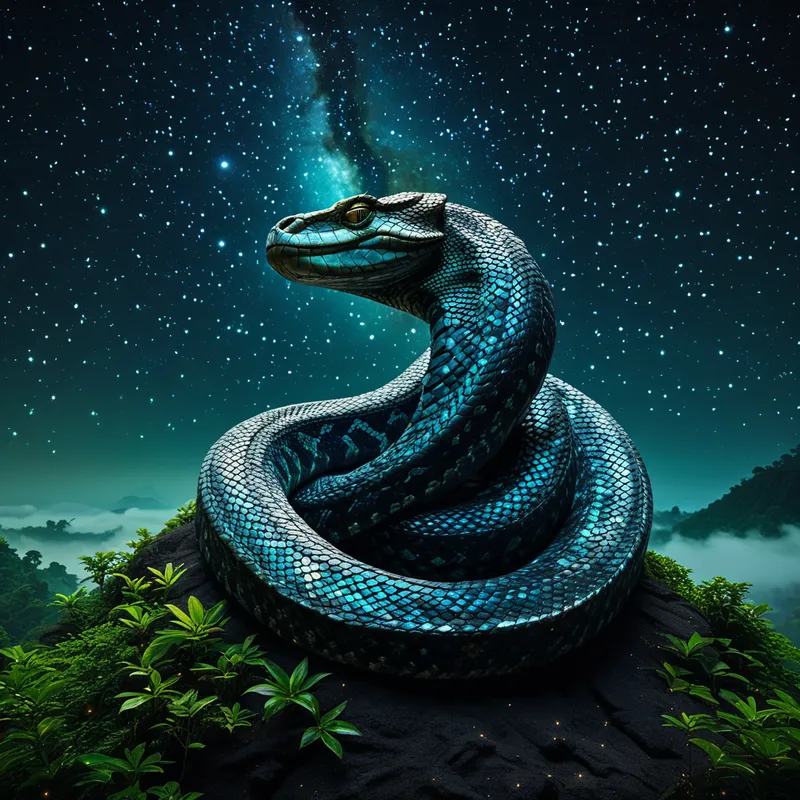
Antaboga the World Serpent Myth Meaning & Symbolism
The myth of Antaboga, the world serpent whose self-sacrifice births the earth, embodying primordial chaos, creation, and the foundation of reality.
The Tale of Antaboga the World Serpent
In the beginning, before time had a name, there was only the great, yawning Void. It was a silence so profound it was a sound, a darkness so complete it was a color—the color of potential. From this endless nothingness, a consciousness stirred. It was not a thought, but a presence. It was Antaboga.
Antaboga was the World Serpent, a being of such immense scale that its coils defined the edges of the possible. Its body was the first movement in the stillness, a slow, eternal undulation through the formless dark. Its scales were not of matter, but of condensed shadow and nascent light, shimmering with the memory of stars yet unborn. For eons, Antaboga swam through the Void, alone with its own vast being. Yet, within that solitude, a longing grew—a desire not for company, but for contrast. For something other than itself.
This longing crystallized into a profound, creative sorrow. From the depths of its cosmic psyche, Antaboga wept. But these were not tears of water; they were tears of concentrated essence, of will given form. One such tear, heavier than a thousand suns, brighter than the first dawn, fell from its eye. It fell through the infinite dark, a single point of luminous intention.
Where it landed, the Void recoiled and then embraced it. The tear did not dissolve; it fermented. It became a disturbance, a focal point. From it, something began to precipitate. Not land, not yet, but the idea of solidity. The concept of foundation. This was Bedawang, the World Turtle. Bedawang formed from the substance of the tear, a great, stoic shell rising from the chaos, offering the first promise of stability upon which things could be.
Yet, a shell alone is a vessel without content. The creative anguish of Antaboga was not yet spent. From its own divine substance, from the very fabric of its serpentine being, Antaboga performed the ultimate act of love. It sacrificed a part of itself. It is said this sacrifice took the form of its own shed skin, or perhaps a fragment of its spirit-body, offered unto the nascent reality anchored by Bedawang.
This offering did not land as a dead thing. It landed as a seed. It burrowed into the potential held by the Turtle and erupted. It became the rich, fertile earth. It became the rolling hills and the soaring mountains of Java. It became the very ground of being. Antaboga, the serpent of the Void, by turning its loneliness and creative desire into a tear and a piece of its own body, had given birth to the world. The serpent did not rule the earth from below; it was the earth’s hidden, foundational layer, the living bedrock from which all life would eventually spring. The cosmos was no longer empty. It was pregnant.

Cultural Origins & Context
The myth of Antaboga is a cornerstone of the Kejawen cosmological tradition, primarily from the island of Java, Indonesia. It is part of a rich oral and later written tapestry that sought to explain the origins of the world, not through a single ex nihilo command, but through a process of emanation, sacrifice, and transformation. The tale was preserved in ancient manuscripts and transmitted through the generations by gurus, dalangs, and elders.
Its societal function was multifaceted. On one level, it was a cosmogony, answering the fundamental human question, "Where did we come from?" On another, it was a metaphysical map. The layered cosmology—Antaboga (serpent/underworld), Bedawang (turtle/foundation), and later deities—mirrored the Javanese understanding of a layered universe and a layered self. The myth grounded people in their landscape; the island itself was seen as a sacred, living entity born from divine substance. Furthermore, it encoded a core ethical and spiritual principle: creation is not a casual act, but one that requires profound personal cost and transformation. The world exists because something greater gave of itself.
Symbolic Architecture
Antaboga is not a monster to be slain, but a primordial parent to be acknowledged. Its symbolism is deep and multifaceted, speaking to the foundational layers of psyche and reality.
The serpent does not threaten the world; it is the hidden, living geometry upon which the world is built. To fear it is to fear your own foundation.
Psychologically, Antaboga represents the vast, unstructured potential of the collective unconscious. It is the swirling chaos of pre-conscious thought, emotion, and instinct that exists before the ego—the "I"—crystallizes. Its initial state of lonely movement through the Void is the psyche in a state of pure potential, aware of itself but without an object for its awareness.
The Bedawang, born from Antaboga's tear, symbolizes the emergent ego or the structuring principle. It is the first container, the "shell" of identity that begins to form from the waters of the unconscious. The tear itself is the first moment of conscious emotion or desire arising from the deep unconscious—a creative longing that initiates the process of becoming.
The ultimate sacrifice, where Antaboga gives a part of itself to become the earth, is the critical act of individuation. The unconscious does not remain "other"; it must be sacrificed—transformed and integrated—to create the solid "ground" of the conscious personality. The fertile earth is the realized Self, a stable, living reality born from the negotiated settlement between infinite potential (the serpent) and necessary structure (the turtle).

The Dreamer's Resonance
When the pattern of Antaboga stirs in the modern dreamer, it often signals a profound encounter with the foundational layers of the Self. This is not the stuff of daily anxiety, but of existential re-formation.
Dreams may feature vast, dark spaces—abyssal oceans, starless skies, or infinite voids. Within these, the dreamer may sense a colossal, benevolent, yet utterly alien presence, often felt more than seen: a slow coiling in the depths, a vibration in the earth, or the feeling of being supported by something ancient and immense. One might dream of shedding a skin that feels like a part of one's very soul, or of weeping tears that transform into landscapes. There is a somatic quality to these dreams—a feeling of deep, tectonic shifts within the body-psyche, a literal grounding process.
Psychologically, this dream pattern emerges during periods of profound life transition, spiritual awakening, or when the very foundations of one's identity are being questioned and rebuilt. The psyche is engaged in its own act of creation, drawing upon the raw, primordial material of the unconscious (Antaboga) to sacrifice old, outworn structures of the self and give birth to new, more authentic ground upon which to stand. It is the process of finding one's own "inner Java"—a stable, fertile identity born from the depths of one own being.

Alchemical Translation
The myth of Antaboga is a perfect allegory for the alchemical and Jungian process of psychic transmutation. The goal is not to escape or defeat the primal serpent, but to engage with it, suffer its creative longing, and allow it to transform through sacrifice into the substance of one's being.
The prima materia is not base metal, but the lonely, swirling chaos of the un-lived self. The philosopher's stone is the world born from its sacrifice.
The Void (Nigredo) is the initial state of confusion, depression, or dissolution where old certainties fail. The dreamer feels adrift in potential with no form. Antaboga's movement is the first stirring of the libido—not sexual, but life-energy—in this darkness, a vague sense of something wanting to be born. The Tear (Albedo) is the moment of conscious realization, the "white" purification of emotion into a clear intention or insight (Bedawang, the container).
The core operation is the Sacrifice (Rubedo). This is the red stage, the crucible. The dreamer must consciously offer up a part of their old identity, a cherished self-image, a deep-seated complex, or a foundational belief to the transformative fire. This is painful; it feels like a loss of self. But this sacrificed material does not vanish. Like Antaboga's offered substance, it ferments and becomes the Earth—the Lapis, the Philosopher's Stone. In psychological terms, this is the achieved Self: no longer at war with the unconscious, but a living, fertile reality built upon its integrated substance. The serpent is not gone; it is the bedrock. The conscious personality now rests upon, and is nourished by, the vast, intelligent depth of its own primal nature.
Associated Symbols
Explore related symbols from the CaleaDream lexicon:
- Serpent — The primordial, creative force of the unconscious; the foundational energy that precedes and gives birth to form, representing both chaos and potential.
- Water — The formless, fluid medium of the Void and the unconscious mind from which the first structures of consciousness (the tear, the turtle) precipitate.
- Earth — The final, stable creation born from sacrifice; the realized Self, the grounded personality, and the tangible world of manifest reality.
- Sacrifice — The essential, voluntary act of giving up a part of the primal self to create something new and solid, the core mechanism of creation and individuation.
- Egg — The Bedawang as the cosmic egg, representing the first container, the potential for life, and the nascent structure of the ego.
- Ocean — The vast, undifferentiated expanse of the collective unconscious in which Antaboga swims, symbolizing the depth and mystery of the psyche's origins.
- Void — The primordial state of non-being and pure potential that precedes creation, analogous to the unconscious before the emergence of conscious thought.
- Mountain — The earth born from Antaboga's substance, representing the enduring, solid achievements of the psyche and the lofty aspirations grounded in sacrifice.
- Dream — The realm where the modern individual encounters the Antaboga pattern, a liminal space where psychic creation and foundational transformation occur.
- Chaos — The original state embodied by Antaboga, not as destructive disorder, but as the fertile, swirling potential necessary for all new creation.
- Transformation — The entire arc of the myth, depicting the alchemical process of changing primal, unconscious material into the substance of the conscious world.