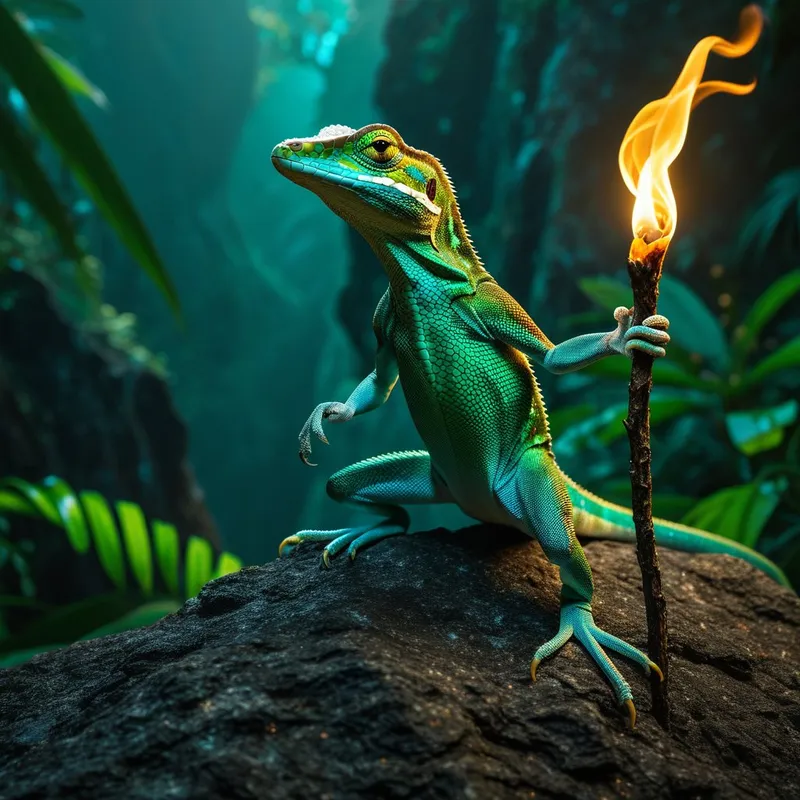
Anolis Myth Meaning & Symbolism
A myth of a humble lizard who endures a great sacrifice to bring the stolen gift of fire to a cold and dark humanity.
The Tale of Anolis
Listen. In the time before time, when the world was young and the great Yúcahu had shaped the islands from the bones of the sea, humanity lived in a gentle twilight. They had the sweet cassava, the cool waters, and the shade of the ceiba tree. But they did not have fire. Their nights were long and cold, filled with the whispers of unseen things. Their food was raw, their bodies chilled by the mountain mists. They huddled together, a people of shadow, yearning for a warmth they could not name.
This warmth belonged to the terrible ones, the Cemí of the deep earth, who hoarded the secret of flame in the bellies of the tallest mountains. It was a forbidden knowledge, a power too great for soft, surface-dwelling creatures. The people sent their bravest warriors, but the mountain paths defeated them. They sent their wisest elders, but the rumbling voices of the earth spirits turned them back with fear. Hope was a dying ember in their hearts.
Then, from the edge of the gathering, where the ferns were thickest, a small voice spoke. It was Anolis, the green lizard, whose skin was the color of the deepest forest. "I am small," he said, his voice a dry rustle. "The paths that are closed to you are open to me. The cracks you cannot see are my highways. I will go into the mountain. I will bring you the fire."
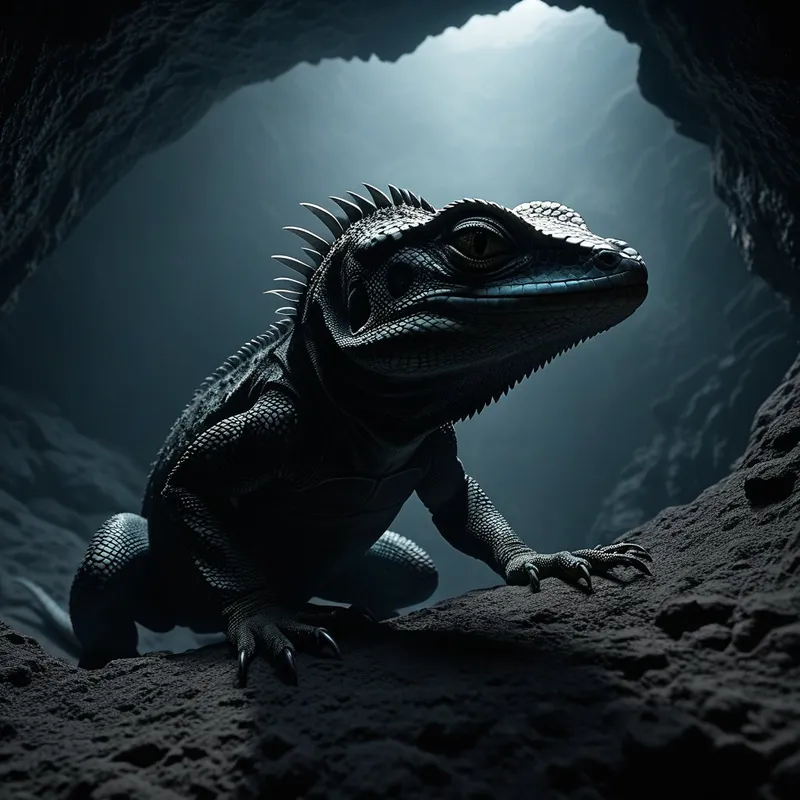
The people were silent, some in pity, some in doubt. But Anolis had already turned, his agile body disappearing into a crevice at the mountain's base. Down he went, into the profound dark, where the air grew hot and thick with the scent of stone and sulfur. He navigated not by sight, but by the growing tremor in the rock, a deep, rhythmic pounding like the heart of the world. For days he journeyed, until the darkness was replaced by a hellish, pulsing glow.
He emerged onto a ledge overlooking a cavern of impossible scale. In its center roared the Fire-Beast, a living cataract of molten stone and incandescent gas. The heat was a physical wall. This was the source. To steal from it was madness. But Anolis remembered the cold, shivering children. He focused his will into a single, desperate act. He waited for the beast's roar to subside into a momentary sigh. Then, with a speed born of absolute purpose, he darted across the searing stone floor, leapt, and snatched a single, tiny, white-hot spark from the very edge of the inferno.
The pain was instant and absolute. The spark burned his mouth, a agony so pure it erased all thought. But he did not drop it. He turned and fled, the spark searing his flesh, its light pouring from his jaws. The Fire-Beast awoke with a world-shaking bellow. The mountain itself began to convulse, sealing the great tunnels behind him. Anolis ran the only way left—up. He scrambled through narrower and narrower cracks, the spark burning away his tongue, charring his throat. He could feel his own life being consumed as fuel for the stolen gift.
He burst from a high fissure onto the mountainside, a tiny, living torch plummeting through the night air. The people below saw a falling star, green and glowing, streak toward the earth. Anolis landed in a soft bed of moss, the spark tumbling from his ruined mouth onto a prepared pile of dry tinder. It caught. The first true fire of humanity bloomed, orange and welcoming, pushing back the endless night.
But when they looked for Anolis, he was transformed. His once-vibrant green skin was now a dull, ashen brown, scorched by the inner heat he had carried. His throat was swollen, and when he tried to speak, only a faint push of air escaped—anoli, anoli. He had given his voice, his beauty, and nearly his life, for the warmth that now danced before the weeping, grateful people. He had become the fire-bearer, forever marked by his sacrifice.
Cultural Origins & Context
This myth originates from the oral traditions of the Taíno, the Indigenous people of the Greater Antilles at the time of European contact. For a culture deeply animistic and intimately tied to the ecology of their island world, every creature held potential as a cemí, a vessel of spiritual power and narrative. Stories were not mere entertainment; they were the living maps of cosmology, ethics, and survival, told by behiques and elders during communal gatherings.
The tale of Anolis functioned on multiple levels. Practically, it explained the origin of fire and the distinctive appearance and behavior of the anole lizard—its color-changing ability (from vibrant to dull), its bobbing dewlap (a remnant of the swollen, communicative throat), and its silent, watchful presence. Spiritually, it reinforced a core Taíno value: that great gifts require great sacrifice, and that power (zemi) often flows through the most humble and unexpected vessels. The hero is not the strongest warrior, but the smallest, most adaptable creature, teaching a lesson in humility and respect for all beings in the web of life.
Symbolic Architecture
At its heart, the myth of Anolis is an archetypal narrative of the stolen boon, where a vital element of consciousness (fire) must be retrieved from the clutches of the unconscious or the divine (the subterranean Cemí). Anolis represents the mediating psyche—the part of the self small enough, nimble enough, and brave enough to navigate the treacherous passage between worlds.
The gift of consciousness is always stolen from the gods, and the thief is forever marked by the fire they carry.
The Fire is the supreme symbol. It is light in darkness, warmth in cold, the catalyst of culture (cooking, ceremony, protection). Psychologically, it is libido—not merely sexual, but the fundamental psychic energy of transformation, illumination, and conscious life. The Mountain Cave is the underworld, the unconscious realm where primal, untamed power resides. The Transformation of Anolis—the loss of his voice and vibrant color—is not a punishment, but the indelible signature of the initiate. He becomes a living testament to the cost of enlightenment; his very body tells the story of the journey from naive wholeness to a scarred, earned wisdom.
The Dreamer's Resonance
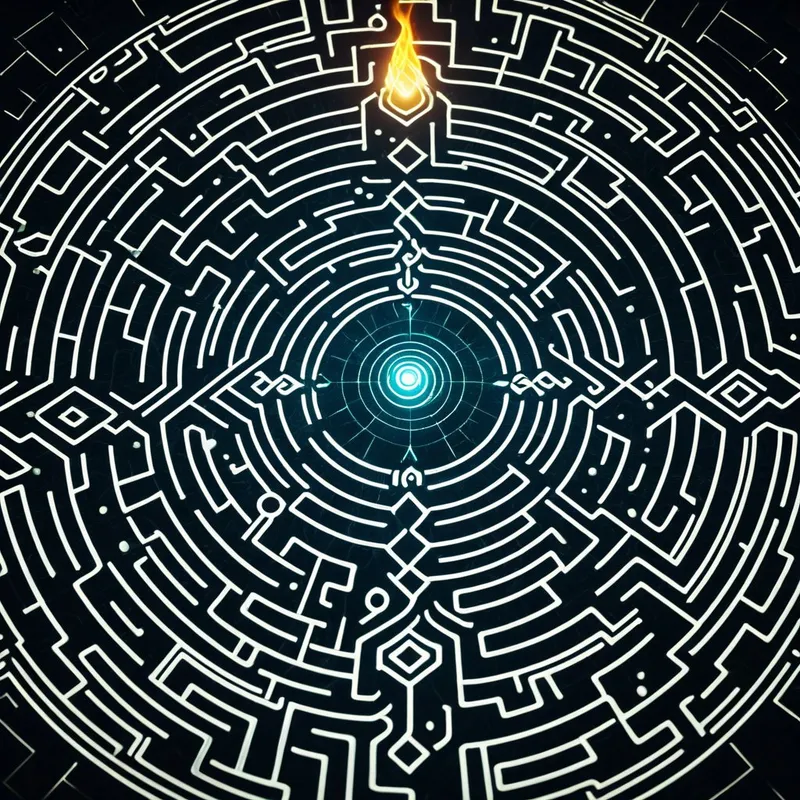
When this myth stirs in the modern dreamer, it often signals a profound initiation into a new level of psychological responsibility. To dream of a small, determined creature carrying a dangerous light may reflect a nascent talent, a painful truth, or a creative spark that the dreamer feels compelled to "bring to the surface," even at great personal cost.
Somatically, this can manifest as sensations of burning in the throat or chest—a literal feeling of being unable to speak one's truth or of carrying an inflammatory secret. The dreamer may feel "scorched" by their own insights or passions. The psychological process is one of bearing the tension. The myth models the necessity of holding the searing, transformative energy long enough to deliver it to the communal hearth of the conscious personality, without being utterly destroyed by it. The dream asks: What fire have you stolen? What price is your current transformation demanding?
Alchemical Translation
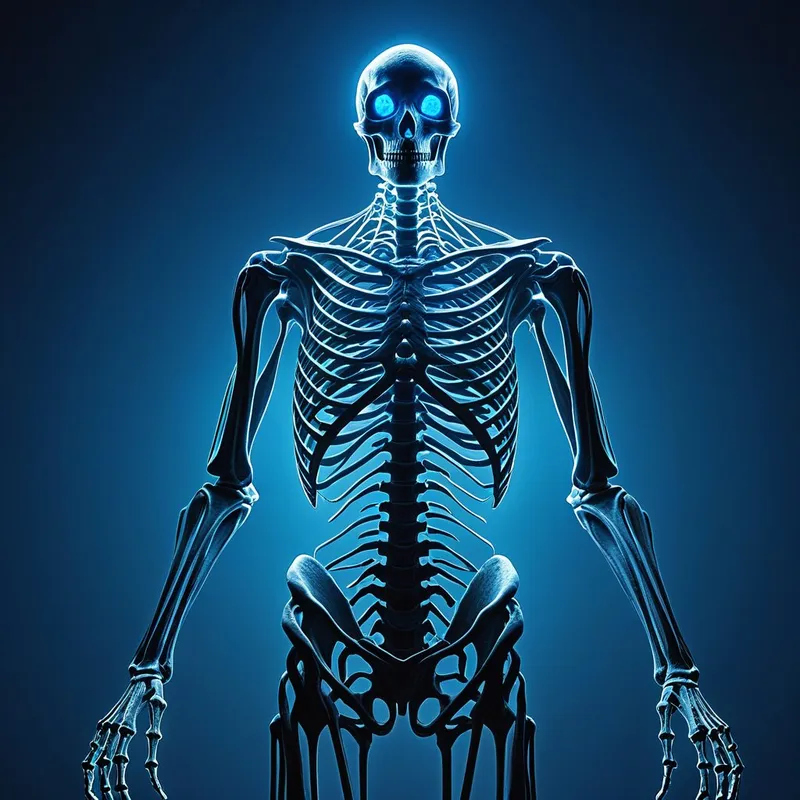
The journey of Anolis is a perfect allegory for the alchemical calcinatio and the Jungian process of individuation. The ego (the human tribe) is cold and in shadow, lacking the transformative fire of the Self. The lizard represents the mediating function of the psyche—the anima/animus or the transcendent function—that can descend into the prima materia of the unconscious (the chaotic fire-beast) and extract the lapis, the philosopher's stone, in the form of a single spark.
Individuation is not about becoming perfect, but about becoming authentic, carrying the sacred scar of your own hard-won consciousness.
The hero's transformation is the alchemical stage. His beautiful green viriditas (symbolic of unconscious, vegetative life) is burned away, leaving the sober, enduring brown of the nigredo. The loss of his voice signifies the end of naive expression and the beginning of a deeper, non-verbal wisdom communicated through presence and being. For the modern individual, this translates to the sacrifice required for authentic life: the death of an old, perhaps more "colorful" but unconscious identity, to make way for a self forged in the fires of difficult truth, responsibility, and hard-won insight. We are all Anolis, forever carrying the burn marks of the light we dared to bring into our world.
Associated Symbols
Explore related symbols from the CaleaDream lexicon: