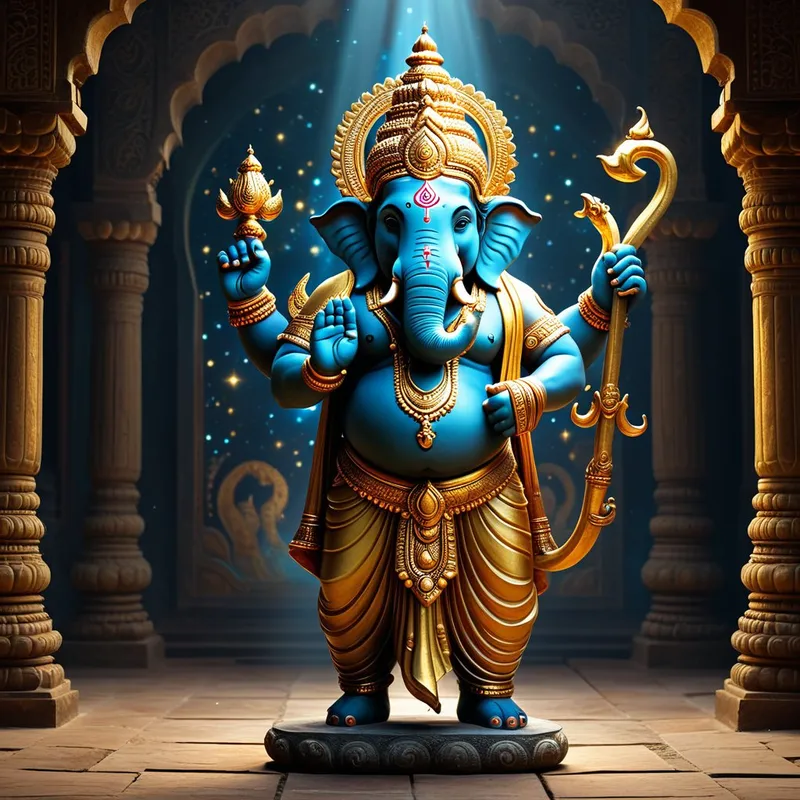
Ankusha Myth Meaning & Symbolism
The myth of the divine elephant goad, a symbol of the focused will required to guide the immense, unruly power of the psyche toward enlightened sovereignty.
The Tale of Ankusha
Listen. Before the world learned balance, it knew only raw, surging force. In the high halls of Svarga, where the air hums with the music of spheres, a problem stirred. Not a problem of demons or drought, but of dominion. The gods, in their wisdom, had crafted the perfect vehicle for a king: Airavata, the great white elephant who emerged from the churning ocean of milk. His form was a mountain of pearl, his tusks like crescent moons, his strength enough to bear the weight of the cosmos. But strength untamed is chaos wearing a crown. Airavata’s power was sublime, yet his will was the untamed monsoon, his movements the unpredictable tremor of tectonic plates. He could carry Indra, but he could also, in a moment of divine pique, shake the heavens loose from their moorings.
The celestial engineers, the Vishvakarma, conferred. A bridle was mere suggestion. A saddle, an ornament. What was needed was not restraint, but conversation—a precise, intimate language of command that could speak directly to the immense, intelligent force of the elephant. From the essence of focused intent, they forged the Ankusha. It was not a weapon of punishment, but a key of guidance. A slender rod of gold, cool and firm to the grasp, culminating in a sharp, crescent-shaped hook. It was an extension of sovereign will, refined to a single point of contact.
The day of the trial arrived. Airavata stood in the celestial courtyard, a living tempest of muscle and majesty. Indra approached, the Ankusha held not high in threat, but low in readiness. The air crackled with potential. With a deep breath that drew in the silence of creation, Indra reached out. The golden hook did not pierce, but connected. It touched the rough, sacred hide behind Airavata’s ear—a place of immense power and sensitivity. It was not a command shouted, but a thought transmitted. A request made clear through unyielding, compassionate pressure.
And Airavata understood. The chaotic storm in his eyes softened into a directed river. The restless shifting of his feet stilled into grounded purpose. The Ankusha had not broken his spirit; it had invited his strength into partnership. Indra mounted, and for the first time, god and steed moved as one entity—the unruly power of the world made amenable to divine direction. The myth whispers that this was the moment true kingship was born: not from brute force, but from the skillful, respectful application of guided power. The Ankusha became the silent third in a sacred dialogue between will and strength.
Cultural Origins & Context
The Ankusha is far more than a mythological prop; it is a deep cultural artifact embedded in the iconography and philosophy of Dharma. Its primary residence is in the hands of deities associated with sovereignty, wisdom, and the removal of obstacles. Most prominently, it is wielded by Ganesha, the lord of beginnings, and by Durga, the invincible warrior goddess. In temple sculptures and miniature paintings, the Ankusha is rarely depicted as a tool of violence. Instead, it is held in a deity’s lower hand, often paired with a noose (Pasha), representing the dual principles of control and liberation.
Its societal function was multifaceted. For the ancient Indian king, the elephant goad was a literal tool of Gajashastra, but its symbolism translated directly into statecraft. The king was to guide the elephantine body politic—powerful, potentially destructive, yet intelligent—with the same precise, compassionate authority. In spiritual discourse, within traditions like Yoga and Tantra, the Ankusha was internalized. It was passed down not just as a story, but as a metaphysical principle in texts discussing the mastery of the mind and the senses, which were often metaphorized as wild elephants.
Symbolic Architecture
At its core, the Ankusha symbolizes the application of conscious, focused will to direct unconscious, monumental power. The elephant represents the raw, instinctual, and emotional forces of the psyche—the Self in its untamed, potent, and awe-inspiring form. It is the life force itself, magnificent but without inherent direction.
The Ankusha is the ego’s necessary, humble role: not as the master of the Self, but as its attentive guide, translating vast potential into conscious action.
The hook is not a weapon but an instrument of connection. Its sharpness signifies the precision and clarity required for true guidance; vague intentions cannot steer an elephant. The rod represents the firmness of resolve and the channel through which intention flows. Crucially, the goad is applied to specific, sensitive points. This symbolizes psychological insight—knowing where and how to apply pressure to effect change without causing rebellion or injury. The myth resolves not with the elephant’s defeat, but with its enlightened cooperation, representing the ideal state where our deepest instincts align with our conscious purpose.

The Dreamer's Resonance
When the pattern of the Ankusha stirs in the modern dreamscape, it often signals a critical phase in the dreamer’s relationship with their own power. You may dream of a massive, beautiful, but agitated animal (not always an elephant—it could be a bull, a horse, or a tidal wave) that you feel responsible for but cannot control. The somatic feeling is one of awe mixed with anxiety, of immense potential just on the brink of chaos.
Alternatively, you might dream of finding or being given a strange, elegant tool—a staff, a key, a stylus—that you intuitively know how to use. This is the nascent ego grasping the Ankusha principle. The psychological process underway is the struggle to integrate a surge of raw psychic energy—perhaps a newfound creative drive, a long-suppressed anger, or a flood of emotion—into the structure of a conscious life. The dream asks: Do you fear your own strength? Do you try to ignore it, or can you learn the delicate art of guiding it? The appearance of the Ankusha in dream logic suggests the unconscious is offering the archetypal tool for sovereignty, presenting the possibility of moving from being overwhelmed by your inner forces to becoming their respectful director.
Alchemical Translation
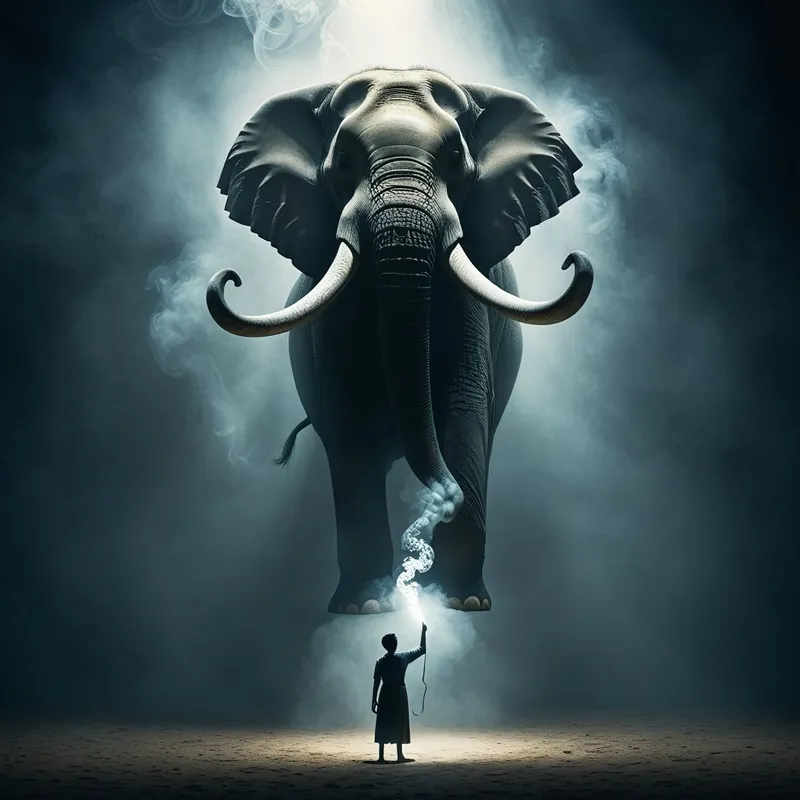
The myth of the Ankusha models the alchemical stage of coagulatio—the process of giving fixed, conscious form to the volatile, unconscious prima materia. The individuation journey is fraught with the discovery of one’s own “inner elephant”: the staggering, often frightening power of the shadow, the complexes, the libidinal and creative energies that have been roaming wild in the psychic landscape. The initial impulse may be to chain this elephant (repression) or to let it run amok (acting out), both leading to psychic disaster.
The alchemical work is the forging of your personal Ankusha. This is the development of a disciplined, observant, and firm consciousness—the ego strength that does not inflate itself to the size of the Self, but learns its specific function.
The transmutation occurs in the moment of contact: when conscious will, refined to a point of unwavering intent, makes respectful contact with the unruly power. This is not domination, but a sacred pact.
The hook’s pressure is the necessary friction of transformation—the difficult decision, the enforced boundary, the focused practice that redirects chaotic energy into a path. The goal is the myth’s resolution: a symbiotic unity. The individual no longer feels torn between wild impulses and rigid control. Instead, they ride the elephant of their own profound nature, the Ankusha held lightly but surely, guiding their immense inner resources with wisdom toward a destiny of their own conscious choosing. The power is not lessened; it is finally, harmoniously, engaged.
Associated Symbols
Explore related symbols from the CaleaDream lexicon: