Aningaaq and Malina Myth Meaning & Symbolism
A myth of sibling deities whose conflict creates the sun and moon, establishing the eternal chase of day and night from a moment of rupture.
The Tale of Aningaaq and Malina
Listen. In the time before time, when the world was soft and dark, there were no separate lights in the sky. There was only the great, warm glow of the communal house, and within it lived a brother and sister, Aningaaq, and his sister, Malina. They were not as we are now; they were closer to the first substance of the world, luminous and whole.
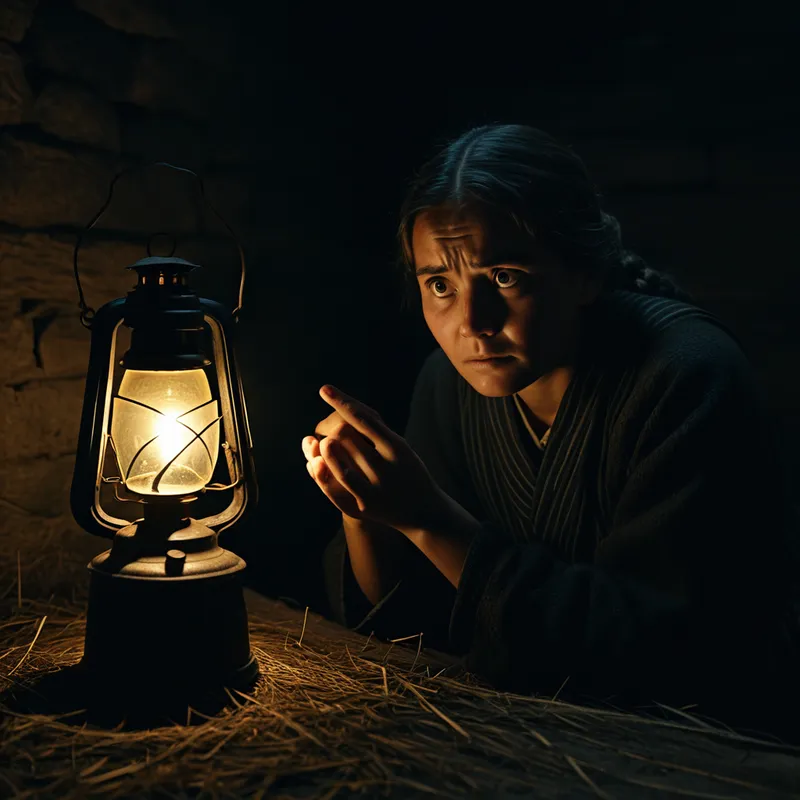
They lived in harmony, their light shared in the gentle gloom. But a shadow grew in Aningaaq's heart, a restless, smoldering thing. One night, as the oil lamps guttered low and Malina slept, a terrible curiosity seized him. He moved through the sleeping house, a silent shape drawn to his sister's radiant form. In a moment of confusion—was it desire? Was it a hunger to possess her light?—he crept to her side. The stories say he touched her, a violation in the deep dark.
Malina awoke with a shock, a gasp that was a small sunrise. She felt the soot from the lamp, black and grimy, on her skin where he had touched her. In the dim light, she saw the dark smear on her hand, and she saw the same black mark upon her brother's face. Horror and fury ignited within her. Her light, which was her very self, blazed forth, scorching and pure.
"You!" she cried, and her voice was the crack of new ice. She seized a piece of sinew, and with a strength born of betrayal, she struck him across the face. The soot on his cheek was sealed there, a permanent stain of shame.
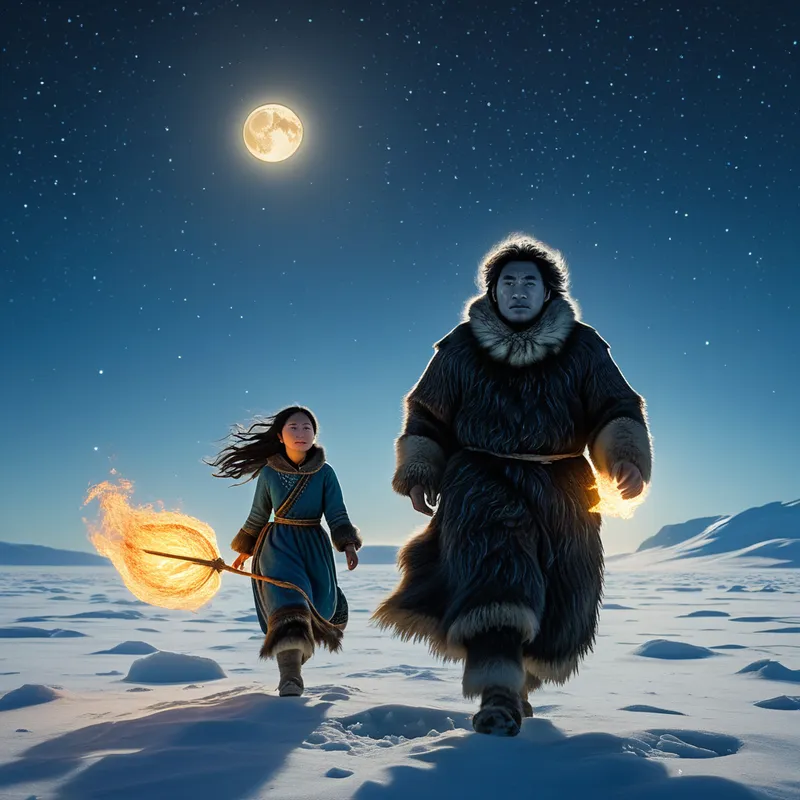
Aningaaq, his face burning with pain and disgrace, turned and fled. He burst from the warmth of the house into the endless, cold dark of the world outside. Malina, her heart a torch of righteous anger, seized a burning brand from the fire and gave chase. Her light poured out of her, flooding the void behind her brother.
And so the great chase began. Aningaaq, the stained one, ran in terror and remorse, his light now cool, pale, and reflected. Malina, the wrathful and wounded, pursued with a relentless, blazing heat. He ran and ran across the barren earth, and she followed, her light burning away the shadows, revealing the world for the first time.
They ran until their feet left the ground, until the earth curved away beneath them. Aningaaq, desperate, leaped into the sky, becoming a pale, cold disc—the Moon, forever marked. Malina, unwavering, ascended after him, becoming the brilliant, hot disc—the Sun. But she could never catch him. The order was set: day and night, summer and winter, the eternal, wearying pursuit across the dome of the world. Sometimes, in the deep dark of winter, Malina draws close, and we feel her anger as a faint warmth. Sometimes, Aningaaq nearly escapes in the long nights. But the chase is forever. The rupture is eternal. The light is divided.
Cultural Origins & Context
This foundational myth originates from the Inuit peoples across the Arctic regions of Greenland, Canada, and Alaska. It was not written but breathed, passed from elder to child in the intimate, smoky atmosphere of the winter iglu or the long twilight of the summer tent. The storyteller, often a grandmother or a respected hunter, would weave the tale during times of gathering, using it to explain the most fundamental rhythms of existence: the rising and setting of the sun, the phases of the moon, the turning of the seasons.
Its societal function was profound and practical. It was a cosmological map, explaining the celestial mechanics that dictated hunting cycles, migration patterns, and survival. But more deeply, it was a moral and psychological anchor. It framed the universe not as a random place, but as one born from relational drama—from a breach of trust and its consequences. It taught about boundaries, the consequences of transgression, and the inescapable nature of cosmic law born from personal action. The myth embedded the idea that the very structure of reality is psychological, woven from the threads of relationship, shame, and the endless work of establishing order from chaos.
Symbolic Architecture
At its heart, this is a myth of differentiation. The primordial unity—the warm, undifferentiated glow of the sibling home—is shattered by an act that forces a separation. This is the birth of consciousness itself, where the self becomes aware of the Other, and in that awareness, sees both desire and taboo.
The first light is not a gentle dawn, but a flash of betrayal that illuminates the eternal separation between self and other, creating the very space in which life and pursuit become possible.
Malina represents the active, conscious principle. She is clarity, moral certainty, and the fierce energy that drives growth and revelation (the day, summer). Her light exposes and demands accountability. Aningaaq embodies the passive, unconscious principle. He is mystery, intuition, shadow, and the realm of hidden impulses and shame (the night, winter). His marked face is the stain of the repressed, the part of the self that acts without full consciousness and must flee from the illuminating gaze of the ego.
Their eternal chase is the dynamic tension necessary for life. Without the sun's chase, the moon would stagnate in perpetual darkness. Without the moon to flee, the sun would have nothing to define itself against. They are opposites bound in a single system, a psychic totality called the syzygy.
The Dreamer's Resonance
When this myth patterns a modern dream, it signals a profound process of psychic differentiation underway. To dream of being relentlessly chased by a radiant or fiery figure often points to the ego being pursued by a repressed truth or a moral failing (one's inner Malina) coming to light. The dreamer may be avoiding a confrontation with a part of their own behavior that feels "stained" or shameful.
Conversely, to dream of chasing a pale, elusive figure through a vast landscape suggests a conscious effort to integrate a neglected, intuitive, or shadowy aspect of the self (the inner Aningaaq). The somatic feeling is often one of exhaustion, futility, or cold anxiety—a direct reflection of the eternal, cosmic chase. These dreams arise at life junctures where a old, unified state of being (a relationship, a self-concept, a career) has been ruptured by an act—either yours or another's—and the psyche is now laboring to establish a new, stable order from the resulting chaos. The chase is the integration process.
Alchemical Translation
The alchemical journey mirrored here is the separatio followed by the impossible yearning for coniunctio. The initial unity is the prima materia, the unconscious, undifferentiated state. Aningaaq's transgression is the necessary first catalyst, the "darkening" that forces a separation of the elements (sun/moon, conscious/unconscious, gold/silver).
The goal is not to end the chase, but to understand that you are both the pursuer and the pursued, the stain and the light, and that the tension itself is the engine of the soul.
For the modern individual, this myth models the individuation path. We all originate in a kind of psychic unity with our family and culture. Individuation requires a rupture—a often painful or shameful act of asserting a separate will, of touching a forbidden boundary. This creates our "stain," our unique complex or wound (Aningaaq's face). We then spend a lifetime being chased by the consequences (Malina's rage) and chasing after the part of us we cast into shadow (the fleeing moon).
The triumph is not in catching or being caught, but in sustaining the chase—in living consciously within the dynamic tension. To recognize that our periods of cold introspection (winter, moon-time) and our periods of vigorous action and clarity (summer, sun-time) are part of a single, ordered cycle. We become whole not by returning to the undifferentiated house, but by honoring the celestial dance our rupture created. We learn to see by the light of our own personal sun, and dream by the light of our own personal, marked moon.
Associated Symbols
Explore related symbols from the CaleaDream lexicon:
- Moon — The celestial embodiment of Aningaaq, representing the reflective, shadowy, and intuitive self marked by a primal shame, forever fleeing the light of full consciousness.
- Sun — The celestial embodiment of Malina, representing the illuminating, conscious, and morally assertive principle that pursues truth and exposes what is hidden, creating order from chaos.
- Shadow — The dark stain on Aningaaq's face, symbolizing the repressed impulse, the act committed in darkness that forever alters the self and defines one's destiny.
- Chase — The eternal dynamic between the siblings, representing the core psychic process of differentiation, where conscious awareness perpetually seeks to integrate the elusive contents of the unconscious.
- Darkness — The primordial state before the myth, the undifferentiated unity of the psyche and the realm where transgression occurs, necessary for the birth of light and form.
- Light — The force of revelation and separation born from Malina's wrath, which creates the world of discernible forms and chases away the amorphous dark.
- Betrayal — The catalytic act that shatters unity, forcing the separation of opposites and initiating the cosmic and psychological drama that defines existence.
- Order — The resulting celestial pattern of day, night, and seasons, showing how a broken relationship creates the fundamental structures and rhythms of reality.
- Brother — Represents one pole of the primordial self, the aspect tied to instinct, darkness, and the potential for transgression that leads to exile and differentiation.
- Sister — Represents the other pole of the primordial self, the aspect tied to relational integrity, light, and the fierce enforcement of boundaries that creates form.
- Sky — The vast, eternal arena of the chase, representing the expanded field of consciousness and the cosmic scale of inner psychological dramas.
- Shame — The indelible mark left by the transgression, the emotional soot that fuels the flight and becomes a permanent, visible feature of the exiled self.