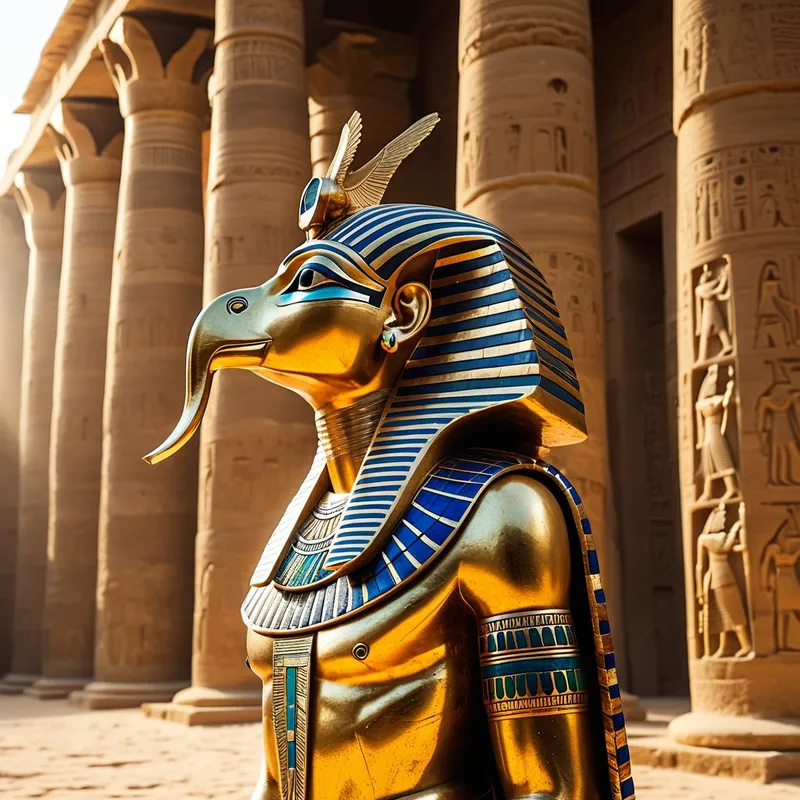
Animal-headed Deities Myth Meaning & Symbolism
Ancient Egyptian deities with animal heads reveal a sacred map of the psyche, where human consciousness and primal instinct unite to navigate the cosmos and the soul.
The Tale of Animal-headed Deities
Listen. Before the world knew the sharp division between beast and man, the gods walked in a different skin. They emerged from the primordial waters of Nun, not as abstract spirits, but as presences you could feel in the hot breath of the desert wind and the silent glide of the river’s predator.
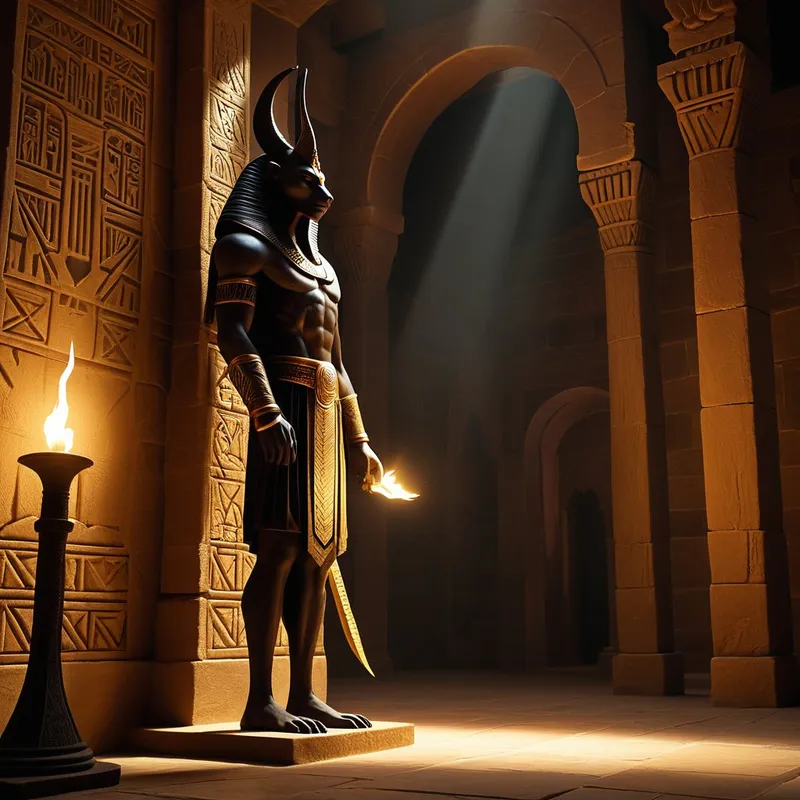
The sun, Ra, first broke the darkness with a cry that was both the piercing shriek of a falcon and the commanding voice of a king. He sailed his barque of fire across the dome of heaven, and below, the earth stirred. From the black, fertile silt left by the great river’s retreat, a god with the head of a jackal lifted his muzzle. This was Anubis, guardian of thresholds. His was the first scent of decay and the first promise of preservation, his black coat the color of the rich soil and the night through which souls must travel.
But order was fragile. The brother-gods Set, with his curved, unknowable snout of a fantastical beast, and Horus</ab title="The falcon-headed sky god, king of the gods">rus, with the unblinking eyes of a hunting falcon, clashed in a conflict that shook the pillars of the world. Set, in his envy, committed a terrible act in the twilight, bringing darkness to the land. Horus, the rightful heir, rose with the sun at his back. Their battle was not merely physical; it was the storm against the clear sky, the drought against the flood, confusion against clarity. Horus lost an eye in the struggle, a terrible sacrifice that rolled into the dust.
Yet from this loss came a greater seeing. The eye was restored, made whole and potent—the Wedjat eye. And in the silent halls of the underworld, presided over by Osiris, the jackal-headed Anubis performed his sacred duty. He took the hearts of the departed and placed them on a scale of pure gold, balancing them against the feather of Ma'at. The air would grow still. The heart, heavy with a lifetime’s deeds, might tremble. But if it balanced, if truth was found, a voice like rustling papyrus would speak: the ibis-headed Thoth, scribe of the gods, would record the verdict, granting passage to the eternal fields.
Thus the world was maintained—not by gods who were purely human, but by powers who knew the secret language of the crocodile in the reeds, the patience of the scarab pushing its ball of dung, and the soaring perspective of the hawk. They were the sacred bridge, and their strange, beautiful faces were the map of a unified reality.
Cultural Origins & Context
This was not a myth told merely for entertainment around a fire. It was the living architecture of a civilization defined by its environment. The ancient Egyptians lived in a stark, binary landscape: the predictable, life-giving ribbon of the Nile Valley versus the chaotic, lethal expanse of the desert. Their deities embodied this cosmology. The animal forms were not arbitrary but direct reflections of observed neteru—the manifest principles or powers of nature.
The lioness-headed Sekhmet represented the terrifying, curative power of the sun’s heat and epidemic. The cow-eared Hathor embodied the nourishing, protective, and joyous aspects of the celestial. These stories were passed down through an elite priestly class who performed intricate daily rituals in temple sanctuaries, but they also permeated popular cults and funerary practices. Every farmer who saw a falcon circling overhead saw a glimpse of Horus. Every family who buried a loved one with a scarab amulet invoked the transformative, self-created power of Khepri.
The myth’s societal function was paramount: it explained and maintained Ma'at, the fundamental order of the universe. The pharaoh, as the living embodiment of Horus, was the human anchor of this order. The animal-headed gods were the divine operators of the system, ensuring the sun rose, the Nile flooded, and justice—both cosmic and personal—was ultimately served.
Symbolic Architecture
At its core, the animal-headed deity is a supreme symbol of integration. It represents the conscious marriage of two fundamental realms of existence that modern thought often insists on separating.
The animal head is not a mask hiding a human, but a revelation: the human form is the vehicle for an intelligence that is ancient, instinctual, and deeply connected to the fabric of the biological world.
The human body signifies consciousness, civilization, and the capacity for moral action (the heart weighed against the feather). The animal head signifies the specific, potent archetypal force that this consciousness is meant to channel and direct. Thoth’s ibis head is not merely about a bird; it is the embodiment of probing curiosity (the long beak delving into the mud for nourishment), precise action, and the connection between the earthly waters and the sky. Horus’s falcon head is the penetrating vision that sees the whole field from a great height, the focused power of the dive, the sovereignty of the sky.
This is not a primitive confusion but a sophisticated psychological model. It says: to be whole, you must not repress the instinctual, chthonic power (the animal), but you must not be ruled by it blindly either. You must give it a voice and a direction through the vessel of conscious humanity. The deity is the successful integration; the monstrous chimera or the devouring beast represents its failure.
The Dreamer's Resonance
When such figures appear in modern dreams, they often signal a critical moment of intra-psychic negotiation. The dreamer is being confronted with a powerful, instinctual aspect of themselves that is seeking recognition and conscious relationship.
To dream of a jackal-headed figure guarding a doorway often points to a transition—a death of an old identity, a journey into an unknown psychological territory (the underworld of the unconscious). The jackal does not block the way; it presides over it, asking the dreamer to prepare, to preserve what is essential, and to leave behind what is not. A dream of a falcon-headed being might appear when the dreamer needs clarity, a “bird’s-eye view” on a complex life situation, or is grappling with issues of personal authority and rightful action (the Horus-Set conflict). The somatic feeling is often one of awe, slight fear, and profound gravity. The psyche is staging a council of its own archetypal powers, and the animal-headed forms are its native ambassadors.
Alchemical Translation
The myth models the alchemical process of individuation—the journey toward psychic wholeness. The initial state is one of potential unity, but also of latent conflict (the brothers Set and Horus). The “work” is the confrontation and integration of these opposing forces.
The restoration of the Wedjat eye is the ultimate symbol of this alchemy. It is not the original, innocent eye. It is the eye that has seen conflict, endured loss, and been made whole again with greater wisdom and perception.
For the modern individual, this translates to acknowledging the “animal” within—the raw anger of Sekhmet, the cunning of Set, the nurturing pull of Hathor—not as enemies to be destroyed, but as potent, divine energies that are part of the self. The “human” body of consciousness must learn to host these forces without being overthrown by them. The ritual of the weighing of the heart is the internal moment of truth, where one’s actions (the heart) are measured against one’s own deepest integrity (the feather of Ma’at). Thoth, the ibis-headed scribe, represents the reflective, intellectual faculty that observes and records this process, turning lived experience into wisdom.
Thus, the animal-headed gods offer a timeless map. They guide us to not transcend our nature, but to fully incarnate it—to become the sacred vessel where instinct gains a moral compass, and consciousness gains the raw, creative power of the beast. They invite us to become, in our own way, living bridges between the earth of our bodies and the sky of our spirits.
Associated Symbols
Explore related symbols from the CaleaDream lexicon: